- Forex: Tuesday's review
Market news
9 March 2011
Forex: Tuesday's review
The euro fell the most in two weeks against the dollar as concern the region’s leaders won’t agree on a solution to its debt crisis damped appetite for its assets.
The 17-nation currency retreated from almost the strongest level in nine months against the yen. Financing costs rose as Greece sold 1.625 billion euros ($2.3 billion) of treasury bills a day after having its credit rating cut by Moody’s Investors Service.
The euro, which has risen 3.9 percent against the dollar this year, has struggled to extend its advance beyond $1.40 as European Union leaders clashed about how to deal with the sovereign-debt crisis that forced Ireland and Greece to seek financial aid last year. The 27-nation EU intends to approve a “comprehensive” package of measures at a March 24-25 summit in a bid to calm bond markets.
Austria opposes easing conditions of bailouts sought by Ireland and Greece, Chancellor Werner Faymann told reporters today in Vienna.
The pound reached a one-week low against the dollar and snapped a four-day decline versus the euro. Retail sales dropped 0.4 percent from January, when they gained 2.3 percent, a report from the British Retail Consortium and KPMG showed. Bank of England policy makers will maintain the U.K. interest rate at 0.5 percent on March 10, according to all 61 economists.
The 17-nation currency retreated from almost the strongest level in nine months against the yen. Financing costs rose as Greece sold 1.625 billion euros ($2.3 billion) of treasury bills a day after having its credit rating cut by Moody’s Investors Service.
The euro, which has risen 3.9 percent against the dollar this year, has struggled to extend its advance beyond $1.40 as European Union leaders clashed about how to deal with the sovereign-debt crisis that forced Ireland and Greece to seek financial aid last year. The 27-nation EU intends to approve a “comprehensive” package of measures at a March 24-25 summit in a bid to calm bond markets.
Austria opposes easing conditions of bailouts sought by Ireland and Greece, Chancellor Werner Faymann told reporters today in Vienna.
The pound reached a one-week low against the dollar and snapped a four-day decline versus the euro. Retail sales dropped 0.4 percent from January, when they gained 2.3 percent, a report from the British Retail Consortium and KPMG showed. Bank of England policy makers will maintain the U.K. interest rate at 0.5 percent on March 10, according to all 61 economists.
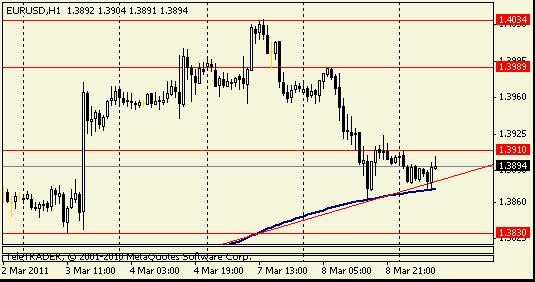
EUR/USD: on results of yesterday's session the pair decreased in around $1,3900.
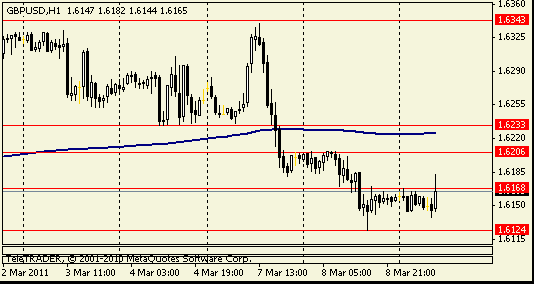
GBP/USD: on results of yesterday's session the pair decreased in around $1,6160.
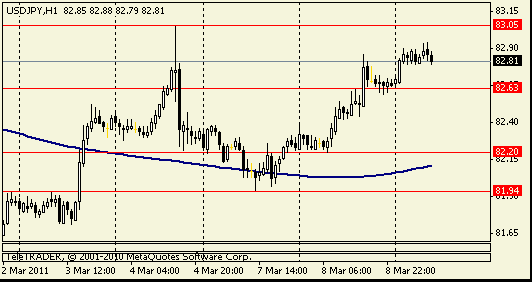
USD/JPY: on results of yesterday's session the pair grown in around Y82,70.
European data includes the 1100GMT release of Germany industrial output, which is expected to grow 1.9% m/m, 11.4% y/y in January.
UK data starts at 0930GMT with BoE Quoted Rates data and also Trade data for January, which is expected to show a total trade balance of -stg3.9 billion, a non-EU trade balance of -stg5.1 billion and global trade balance of -stg8.5 billion.
Market Focus
 Material posted here is solely for information purposes and reliance on this may lead to losses. Past performances are not a reliable indicator of future results. Please read our full disclaimer
Open Demo Account & Personal Page