- Oil climbed
Market news
Oil climbed
Oil climbed
after reports pointed to accelerating global growth and as the spread between
West Texas Intermediate crude in the
Futures
rose as much as 1.3 percent as
Applications
for unemployment insurance payments decreased by 5,000 to
The index
of
Nationwide
crude stockpiles rose 2.81 million barrels to 363.1 million in the week ended
Jan. 18, according to the EIA. A 2.15 million-barrel gain was projected, according
to the median of 10 responses in a survey of analysts.
Gasoline
inventories declined 1.74 million barrels to 233.3 million, versus an expected
gain of 1.25 million. Stockpiles of distillate fuel, a category that includes
heating oil and diesel, increased 508,000 barrels to 132.9 million, versus a
forecast of no change.
Refineries
operated at 83.6 percent of capacity last week, the lowest level since March,
the report from the Energy Department’s statistical arm showed.
Crude oil
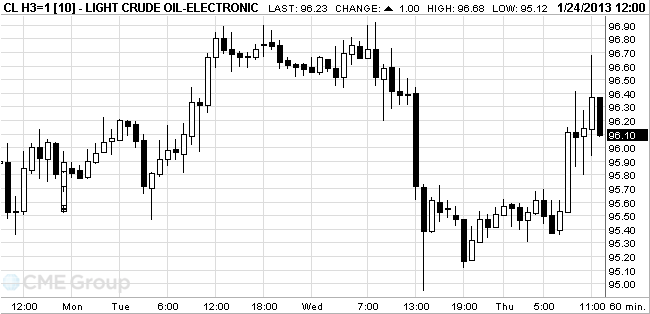
for March delivery gained to $96.68 a barrel on the New York Mercantile
Exchange.
Brent oil
for March settlement increased 72 cents, or 0.6 percent, to $113.52 a barrel on
the London-based ICE Futures Europe exchange. Volume was 30 percent above the
100-day average.
 Material posted here is solely for information purposes and reliance on this may lead to losses. Past performances are not a reliable indicator of future results. Please read our full disclaimer