- Oil steady
Market news
Oil steady
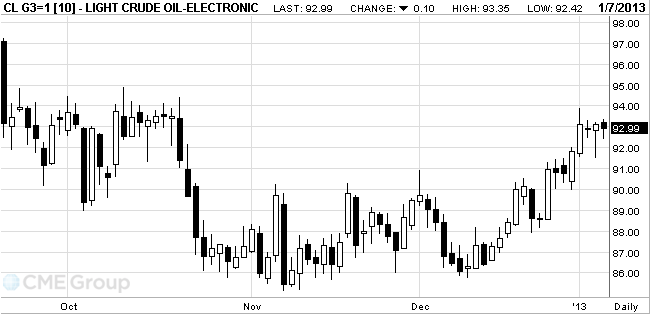
Oil fluctuated amid concern that Congress will fail to raise the U.S. debt ceiling, hurting economic confidence, and on speculation that supplies in the world’s biggest crude-consuming country will rebound.
Futures traded in a 93-cents-a-barrel range as Republicans vowed to require spending cuts in exchange for increasing the U.S. borrowing limit. Lawmakers struck a compromise last week that averted a package of spending cuts and tax gains known as the fiscal cliff. Crude supplies in the week ended Dec. 28 were up 9.2 percent from a year earlier, Energy Department data show.
Enterprise Products Partners LP (EPD) and Enbridge Inc. (ENB) plan to resume service on the 500-mile (805-kilometer) Seaway link at full rates this week after more than doubling the line’s capacity to 400,000 barrels a day from 150,000.
U.S. crude supplies tumbled 11.1 million barrels to 359.9 million barrels in the week ended Dec. 28, leaving stockpiles at the lowest level since September, last week’s report showed. Stockpiles have decreased during December for the past six years because of inventory shifts for tax and accounting purposes. Companies in Gulf Coast states minimize supplies at the end of the year to reduce local taxes.
Crude oil for February delivery fell to $92.42 a barrel on the New York Mercantile Exchange. Brent oil for February settlement slipped 12 cents to $111.19 a barrel on the London-based ICE Futures Europe exchange.
 Material posted here is solely for information purposes and reliance on this may lead to losses. Past performances are not a reliable indicator of future results. Please read our full disclaimer