- EUR/GBP Price Analysis: Pierces 78.6% Fibo to refresh seven-month high on downbeat UK GDP
Market news
EUR/GBP Price Analysis: Pierces 78.6% Fibo to refresh seven-month high on downbeat UK GDP
- EUR/GBP refreshes seven-month high after UK Q1 GDP eased.
- Preliminary GDP growth softened to 0.8% QoQ versus 1.0% forecast.
- Clear break of 13-month-old trend line direct buyers towards September 2021 peak.
Alike other GBP pairs, EUR/GBP also portrayed the British pound’s weakness following a slew of the key macroeconomic data from the UK. That said, the cross-currency pair jumped to a fresh high since October 2021 after downbeat data, recently around 0.8610.
UK’s first readings of the Q1 2022 GDP eased to 0.8% QoQ, below 1.0% forecasts while the monthly negative print of -0.1% for March, versus +0.1% expected and prior, gains major attention and drown the GBP/USD prices. Other than the UK GDP, Industrial Production and Manufacturing Production for March also disappoint the cable traders and add strength to the bearish bias.
Read: UK Manufacturing Production drops 0.2% MoM in March vs. 0% expected
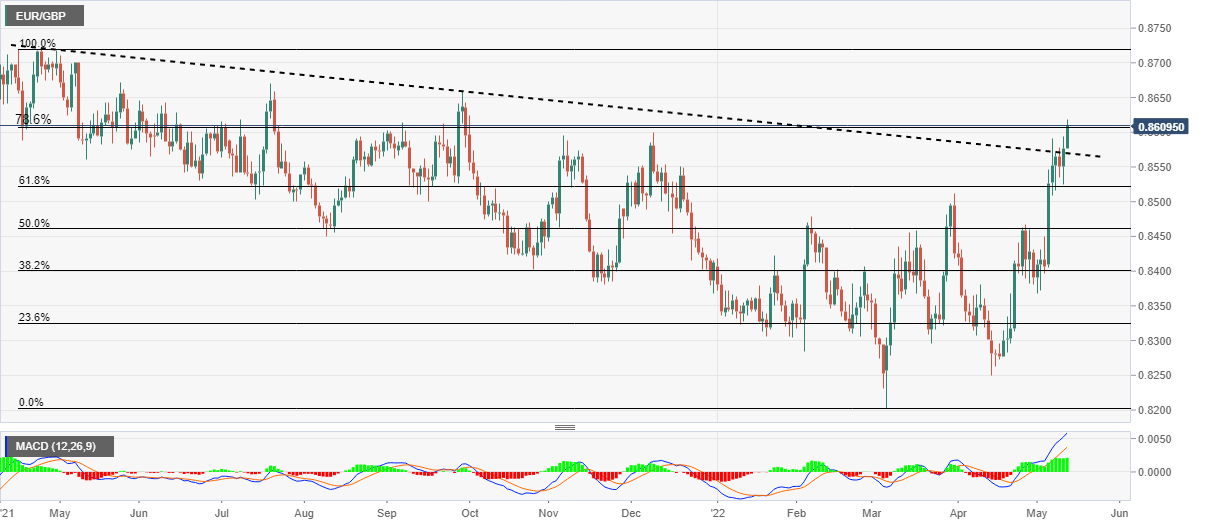
On a technical front, the pair’s sustained break of a downward sloping trend line from April 2021, around 0.8570 by the press time, helps the EUR/GBP to cross the 78.6% Fibonacci retracement (Fibo.) of April 2021 to March 2022 downturn.
The trend line breakout, as well as 78.6% Fibo crossing, also gains from the bullish MACD signals, which in turn suggests the pair’s further upside towards the October 2021 peak of 0.8660.
Should the quote rises past 0.8660, the 0.8700 threshold and early 2021 levels surrounding 0.8715-20 will challenge the EUR/GBP pair’s further advances.
On the flip side, a daily closing below the previous resistance line, around 0.8570, could trigger a profit-booking move that initially targets March’s peak of 0.8512.
However, EUR/GBP bears remain cautious until the pair stays above the 50% Fibonacci retracement level of 0.8461.
EUR/GBP: Daily chart
Trend: Further upside expected
 Material posted here is solely for information purposes and reliance on this may lead to losses. Past performances are not a reliable indicator of future results. Please read our full disclaimer