- AUD/USD Price Analysis: Clings above 0.7200, amid a risk-off mood, strong USD
Market news
AUD/USD Price Analysis: Clings above 0.7200, amid a risk-off mood, strong USD
- The AUD/USD is ready to finish the week positive, up by 0.90%.
- The odds of a US Federal Reserve 0.50% rate hike in September lie at 80%.
- AUD/USD Price Forecast: Range-bound due to DMAs trendless and an RSI showing mixing signals.
The Australian dollar slumps during the last day of the week but remains stubbornly above the 0.7200 threshold as AUD/USD sellers mount a break to the figure. At 0.7210, the AUD/USD reflects the aforementioned, as risk-aversion rules the market, and the greenback got a boost on upbeat US data.
Risk-aversion and a strong US Dollar weigh on the AUD/USD
European stocks ended the week with losses. Equities are tumbling between 0.67% and 2.13% in the US after market players digested a stronger-than-expected jobs report, though financial analysts’ opinions reinforced the Federal Reserve tightening pace. Money market futures odds of the US central bank hiking 50 bps in September lie at 85%, while the June and July meetings are fully priced in.
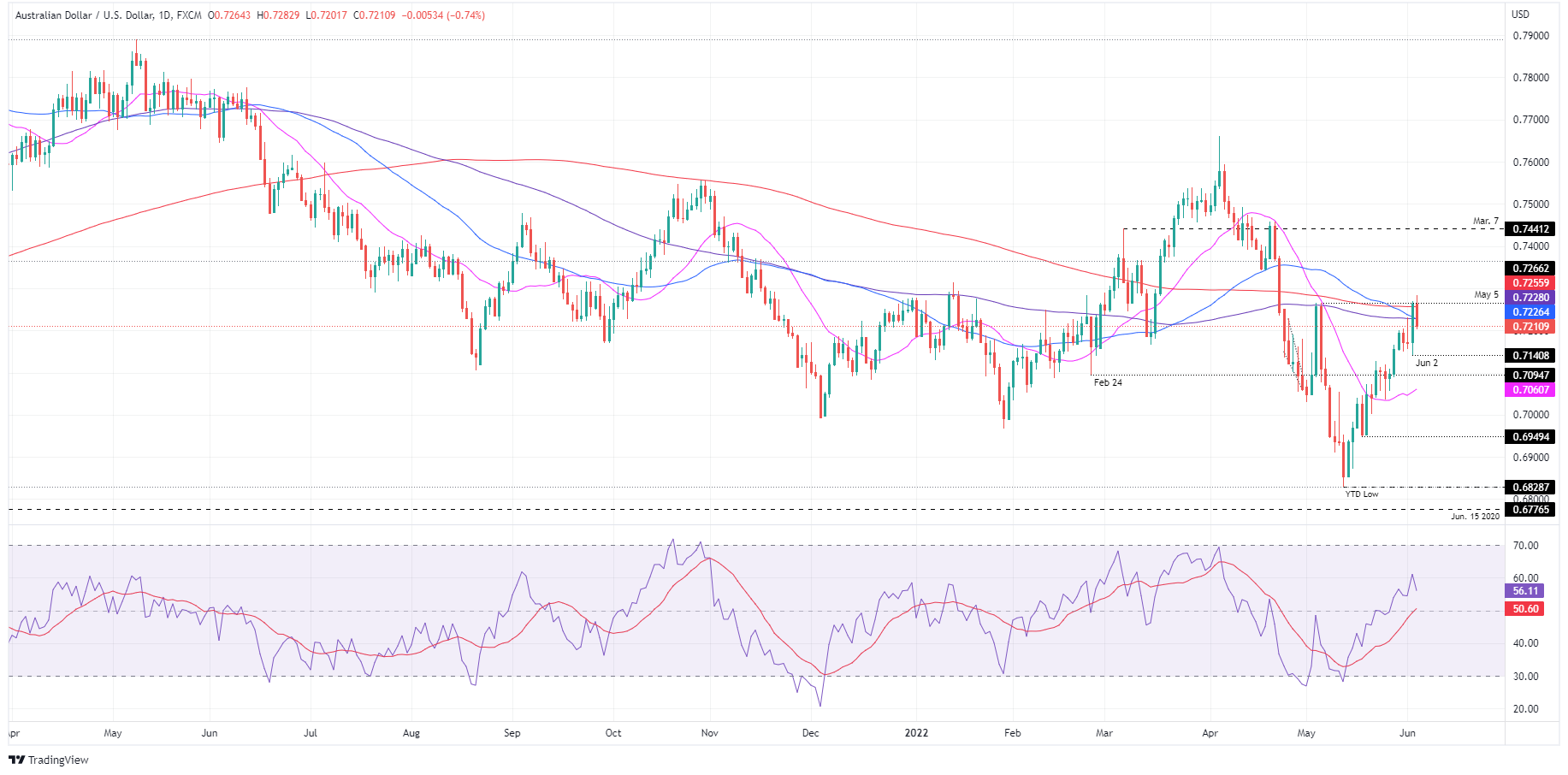
The AUD/USD Friday’s price action shows the major failure to remain above the 200-day moving average (DMA), at 0.7256. Additionally, the AUD/USD slid below the crossing of the 50-DMA under the 100 one, further exacerbating a downward move. Also, the Relative Strength Index (RSI), albeit in bullish territory, the oscillator slope shifted downwards, aligned with the major’s price action.
AUD/USD Price Forecast: Technical outlook
The AUD/USD is neutral biased, as the daily moving averages (DMAs) remain directionless. Nevertheless, traders need to be aware that although the AUD/USD broke above the May 5 0.7266 high, buyers could not hold to it, and sellers dragged the pair from above the 200-DMA, under the previously-mentioned, alongside the 50 and 100-DMAs.
However, the bias stays neutral due to the horizontal slope of the DMAs and the RSI showing mixing signals. Upwards, the AUD/USD’s first resistance would be the confluence of the 50 and 100-DMA around the 0.7226-28 region. Once broken, the following supply zone would be the 200-DMA at 0.7256, followed by the 0.7283 weekly high. On the other hand, the AUD/USD first support would be 0.7200. A breach of the latter would expose the June 2 swing low at 0.7140, followed by February 24 swing low at 0.7094.
 Material posted here is solely for information purposes and reliance on this may lead to losses. Past performances are not a reliable indicator of future results. Please read our full disclaimer