- AUD/USD retraces from weekly highs, back below 0.6900
Market news
AUD/USD retraces from weekly highs, back below 0.6900
- AUD/USD reached a two-week high around 0.690 but tumbled as the mood remains mixed.
- During the week, US housing data shows the impact of higher US interest rates.
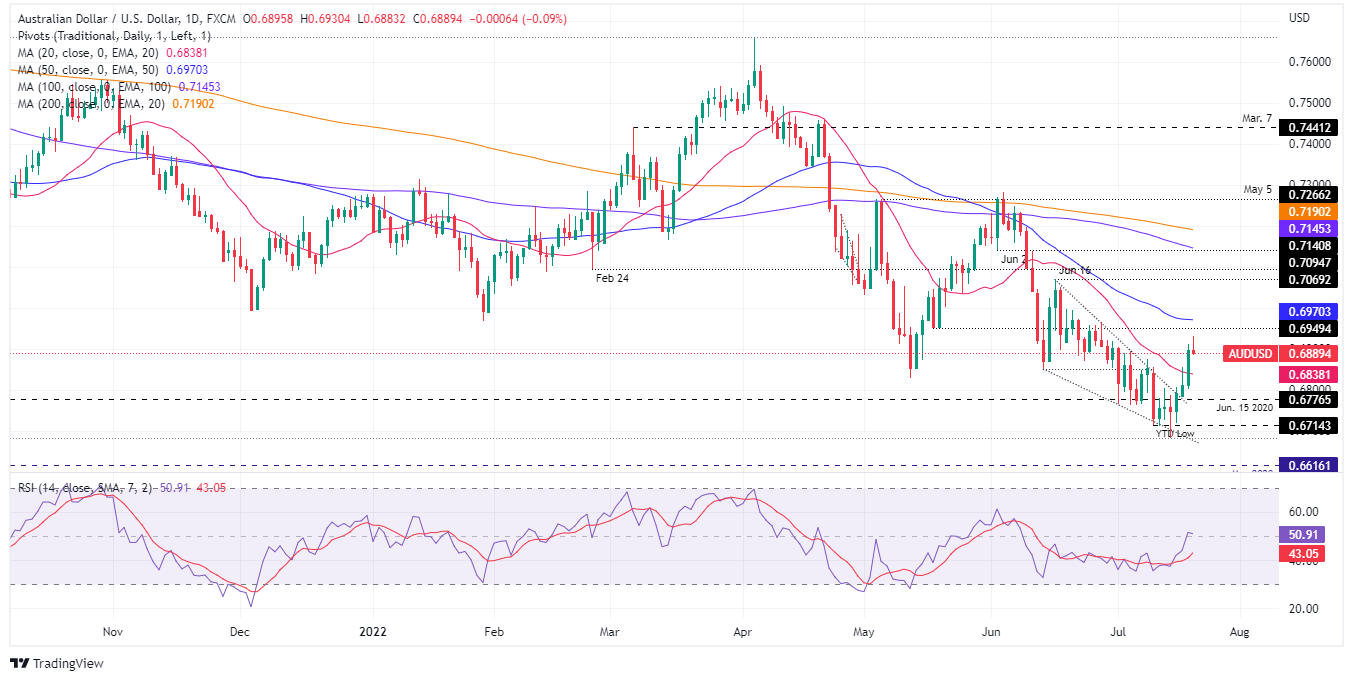
- AUD/USD Price Analysis: The upward break rising wedge opens the door towards 0.7000; otherwise, a fall to 0.6800 is on the cards.
The AUD/USD snaps three days of gains during the North American session, retreating from three-week highs around 0.6930 after opening around the 0.6880s area before hitting the latter.
However, during the last hour, the AUD/USD slipped below the 0.6900 figure after US housing data showed a deceleration in the housing market, meaning that recession fears are lingering in traders’ minds. At the time of writing, the AUD/USD is trading at 0.6889, almost flat, amidst a mixed market mood, which augmented the appetite for safe-haven peers.
US housing data show signs of an economic slowdown
During the week, US housing data has started showing higher interest rates. On Tuesday, Housing and Building Permits showed a contraction in the housing market, each by 2% and 0.6%, respectively. Further fueling recession fears are Existing Home Sales, which also dropped by 5.4%, reaching a two-year level, falling off the cliff, vs. expectations of a 5.4% growth.
In the meantime, during the Asian session, the Reserve Bank of Australia (RBA) Governor Philip Lowe crossed newswires. Lowe said that further interest rate hikes are needed while stating that the bank needs to “chart a credible path back to 2-3%” inflation, in which unemployment persists at lows while the economy grows. Lowe’s raised rates by 125 bps since May, and some analysts expect the RBA will move to the newest threshold of 75 bps in the August meeting.
All that said, a stagflationary scenario in the US would bolster the greenback’s appetite. But, also, an aggressive RBA might refrain AUD/USD traders from opening aggressive short positions in the near term.
AUD/USD Price Analysis: Technical outlook
AUD/USD buyers have achieved what they expected: an upside break of a falling wedge, which propelled the major above the 0.6900 threshold for a 150 pip gain from the break level around 0.6785 to the weekly high at 0.6930. Nevertheless, the pair remains downward biased from a medium to long-term perspective, despite that the 20-day EMA gave way to buyers.
Upwards, the AUD/USD will face resistance at the 0.6900 figure, followed by the 50-day EMA at 0.6970 and the triple-zero at 0.700. figure. On the downside, the AUD/USD’s next support level would be the 20-day EMA at 0.6838, followed by the 0.6800 mark.
 Material posted here is solely for information purposes and reliance on this may lead to losses. Past performances are not a reliable indicator of future results. Please read our full disclaimer