- WTI slumps from weekly highs, unable to crack above $100
Market news
WTI slumps from weekly highs, unable to crack above $100
- The US crude oil benchmark lost some 0.83% on Tuesday, weighed by oil’s news aiming to increase supply.
- Sentiment shifted sour, augmenting appetite for safe-haven assets to the detriment of commodity prices.
- According to the Department of Treasure, previous releases from SPR and foreign partners brought gasoline prices down by “40 cents per gallon.”
The US crude oil benchmark, WTI, slides for the first time in the week, down some 0.83%, and is trading at $95.58 BPD at the time of writing. A risk-off mood, dented appetite for the black gold. US companies reporting earnings, and one of the biggest US retailers, blaming high inflation as one of the factors that spurred a slash in profits, kept investors on their toes.
WTI falls on recession fears as the WH taps the SPR reserves
Alongside the abovementioned, on Monday, prices spiked on news that Russia’s Gazprom slashed natural gas flows to Europe from 40 to 20%, as Moscow reported that the missing turbine was on its way to maintenance but had not been installed. WTI reacted upwards to the announcement and closed around $96.26 BPD.
Sources cited by Reuters said, “The announcement revived fears that Russia, despite its cynical denial, will not shy away from using its energy as a weapon in order to gain concessions in its war against Ukraine and ... could probably expect short-term success.”
On Tuesday, earlier in the North American session, EU countries agreed to reduce gas use for the following winter, which was cheered by oil bears, further pushing prices lower. Furthermore, the White House (WH) announced it would sell 20 million barrels from the Strategic Petroleum Reserve. The WH said it would repurchase oil “in future years, likely after 2023.”
Linked to the previously mentioned, the Department of Treasure said that the previous releases from the SPR, alongside releases of crude oil from foreign partners, helped reduce gasoline prices by “about 40 cents per gallon.”
WTI Daily chart
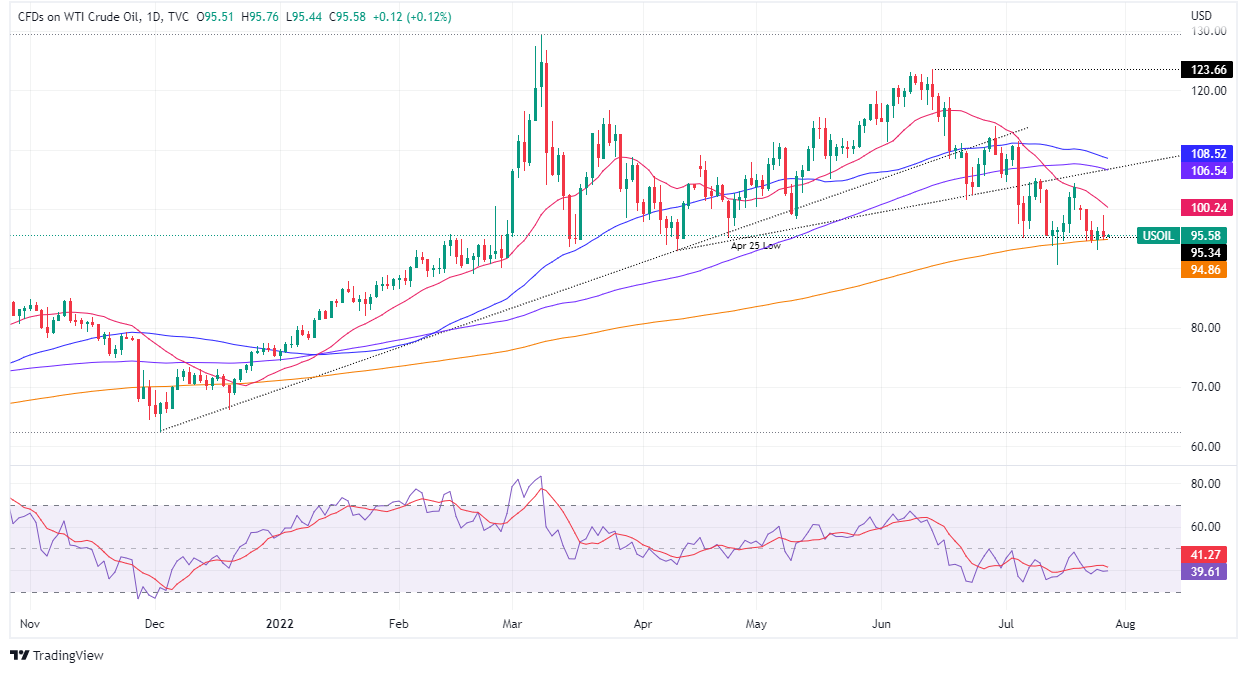
WTI Key Technical Levels
 Material posted here is solely for information purposes and reliance on this may lead to losses. Past performances are not a reliable indicator of future results. Please read our full disclaimer