- Oil futures maintained gains
Noticias del mercado
Oil futures maintained gains
Oil futures maintained gains after a U.S. government report showed a bigger-than-expected decline in inventories.
Supplies fell 7.43 million barrels to 357.1 million barrels last week, the Energy Department said today. Inventories were forecast to decline 4.95 million barrels, according to the median of 12 analyst estimates.
Futures also advanced as the European Central Bank announced specifics of its bond-buying plan and data boosted optimism in the labor market. ECB President Mario Draghi said policy makers agreed to an unlimited bond-purchase program.
The ECB will target government bonds with maturities of one to three years, including longer-dated debt that has a residual maturity of that length, Draghi said at a press conference in Frankfurt after the ECB held its benchmark rate at a record low of 0.75 percent. Purchases will be fully sterilized, meaning that the overall impact on the money supply will be neutral, and the ECB will not have seniority, he said.
Companies in the U.S. added 201,000 workers in August, according to figures from Roseland, New Jersey-based ADP Employer Services. Jobless claims fell by 12,000 to 365,000 in the week ended Sept. 1, the fewest in a month, the Labor Department reported today in Washington.
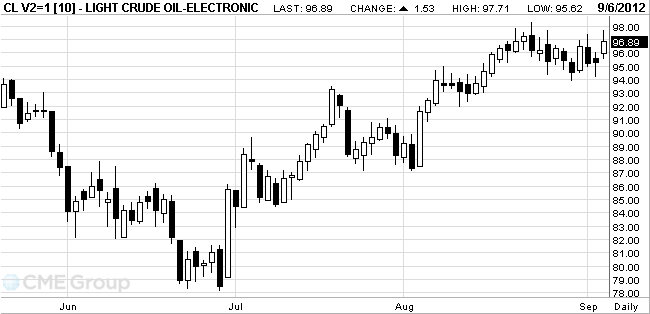
Crude oil for October delivery advanced to $97.71 a barrel on the New York Mercantile Exchange.
Brent oil for October settlement on the ICE Futures Europe exchange in London advanced as much as $1.27, or 1.1 percent, to $114.36 a barrel. The European benchmark crude was at a premium of $17.52 to New York-traded West Texas Intermediate grade, compared with $17.72 yesterday.
 Material posted here is solely for information purposes and reliance on this may lead to losses. Past performances are not a reliable indicator of future results. Please read our full disclaimer