- Oil has grown because of the escalating conflict between Israel and Hamas
Noticias del mercado
Oil has grown because of the escalating conflict between Israel and Hamas
Oil rose on concern that the clash between Israel and Hamas will escalate into a wider conflict that would endanger Middle East crude shipments.
Futures advanced as much as 1.8 percent as Israel extended its bombing of Gaza and Palestinian missiles struck areas around Jerusalem and Tel Aviv. Egyptian Prime Minister Hisham Qandil visited Gaza today and called for an international effort to end the violence. Israel’s army said it has deployed tanks near the Gaza border and called up reservists.
Air-raid sirens sounded in both Jerusalem and Tel Aviv. At least one rocket landed south of Jerusalem in the Gush Etzion region of the West Bank, where Jewish settlements are located, hitting an “open area” with no casualties or damage reported, Micky Rosenfeld, an Israeli police spokesman, said by phone. A blast was heard in Tel Aviv at about 1:30 p.m. and air-raid warnings sounded around the same time.
Israel said yesterday it’s ready to step up its operation if rocket fire continues, signaling the possibility of the first ground assault on Gaza since December 2008, when more than 1,100 Palestinians and 12 Israelis dead.
Palestinians are “fully entitled” to defend themselves against “any forms of Israeli aggression,” Iran’s Deputy Foreign Minister Abbas Araqchi said in an interview with Russian state broadcaster RT.
Hamas, the Islamic group that controls the Gaza Strip, is fighting for a “just cause,” Iran’s Araqchi was cited as saying in an interview by RT, according to a transcript of his comments translated into Russian and e-mailed today.
Countries in the Middle East and North Africa accounted for 36 percent of global oil production and held 52 percent of proved reserves in 2011, according to BP Plc (BP/)’s Statistical Review of World Energy.
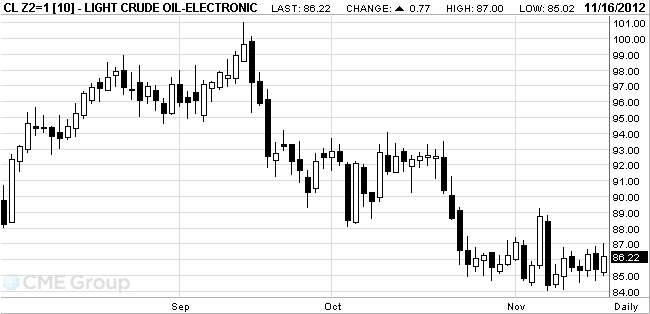
Crude oil for December delivery, which expires today, rose to $87.00 a barrel on the New York Mercantile Exchange.
Brent oil for January settlement increased 51 cents, or 0.5 percent, to $108.52 a barrel on the London-based ICE Futures Europe exchange, boosted by disruptions in the North Sea. Statoil ASA (STL), Norway’s largest energy company, said its Troll C field will remain shut after it found corrosion on two tanks in separate gas-treatment systems, cutting the country’s crude output by close to 10 percent.
 Material posted here is solely for information purposes and reliance on this may lead to losses. Past performances are not a reliable indicator of future results. Please read our full disclaimer