- Price of oil futures fell sharply
Noticias del mercado
Price of oil futures fell sharply
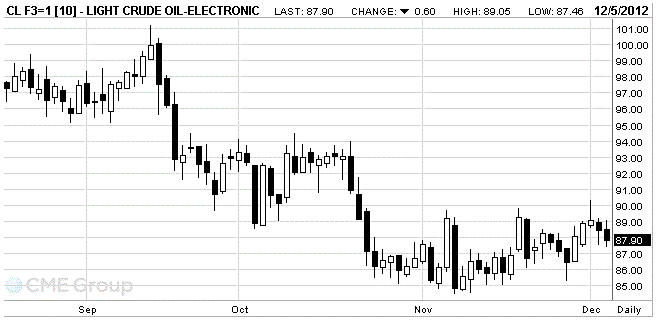
Today, for most of trading oil prices were rising, correcting after yesterday's fall. But the situation has changed after the report from the government showed that crude oil inventories fell last week. Given these data, the cost of oil has fallen sharply, updating the yesterday's low.
As we learned from the report of the Ministry of Energy, crude oil inventories in the week ended Nov. 30, fell by 2.4 million barrels, or 0.6%, to the level of 371.8 million barrels, which is 10.8%, compared with last year. Note that analysts expected stocks to decrease by only 1.25 million barrels.
The same time, gasoline inventories rose by 7.9 million barrels, or 3.8%, to 212.1 million barrels, which is 1.3% lower than last year. It was expected that gasoline supplies to increase by 2 million barrels.
Also, the data showed that gasoline demand in the four weeks ended Nov. 30, up 0.1% from a year earlier, and has averaged 8.6 million barrels per day.
Note that the average U.S. refineries operated at 90.6% of the total capacity, which is 2 percentage points higher than the previous week. Analysts had expected the capacity will increase to the level of 89.2%.
In addition, stocks of distillate fuel, which include diesel and heating oil, rose by 3 million barrels and reached the level of 115.1 million barrels, while analysts had expected distillate stocks to increase by only 800,000 barrels.
January futures price of U.S. light crude oil WTI (Light Sweet Crude Oil) fell to 87.90 dollars a barrel on the New York Mercantile Exchange.
January futures price of North Sea petroleum mix of mark Brent fell $ 0.80 to $ 109 per barrel on the London Stock Exchange ICE Futures Europe.
 Material posted here is solely for information purposes and reliance on this may lead to losses. Past performances are not a reliable indicator of future results. Please read our full disclaimer