Noticias del mercado
-
23:37
Gold Price Forecast: XAU/USD struggles around $1,800 ahead of ISM Services PMI data
- Gold price is hovering around $1,800.00 as investors await US ISM Services PMI data.
- The upbeat US NFP data has failed to fade the odds of the Fed’s rate hike slowdown.
- Solid United States Services New Orders could drive inflation expectations higher.
Gold price (XAU/USD) is facing immense pressure in conquering the round-level resistance of $1,800.00 in the early Tokyo session. The precious metal is highly expected to display more gains ahead and may extend towards a fresh three-month high at $1,824.63 as the upbeat US Nonfarm Payrolls (NFP) failed to fade the risk appetite theme.
The US Dollar Index (DXY) is looking to re-test the previous week’s low around 104.40 as the market participants are of the view that solid employment generation in November is unable to fade expectations of a slowdown in interest rate hike pace by the Federal Reserve (Fed). Also, the 10-year US Treasury yields have dropped further below 3.50% and are not getting any intermediate cushion.
The economic catalyst that investors are awaiting for further guidance is the United States ISM Services data, which will release on Monday. The economic data is seen higher at 55.6 vs. the prior release of 54.4. Apart from that, the catalyst which will impact Gold prices is the ISM Services New Orders Index data. The economic data is expected to land higher at 58.5, which indicates robust demand by households that may provide a cushion to inflation ahead.
Gold technical analysis
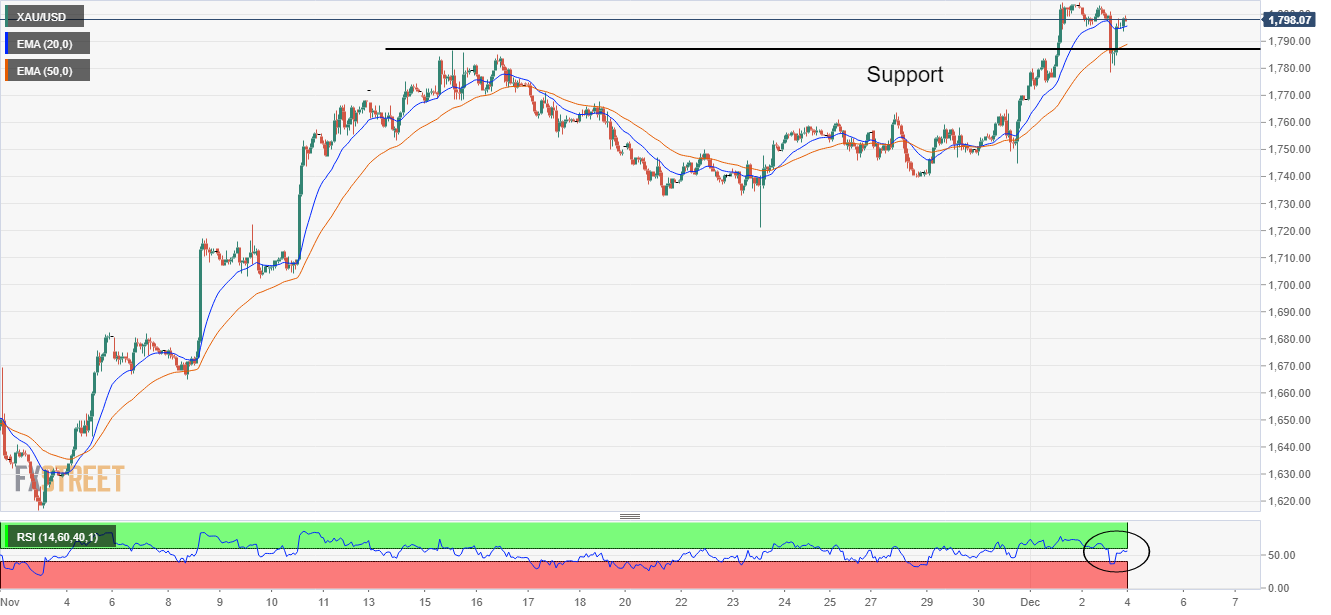
On an hourly scale, the Gold price has picked up decent demand after a correction to near November 15 high at $1,777.32. The yellow metal is aiming to reclaim a three-months high at around $1,805.00. The Gold price has scaled above the 20-period Exponential Moving Average (EMA) at $1,795.90 after sensing support from the 50-EMA around $1,790.00, which indicates that the short-term trend has tilted north.
Gold hourly chart
-
23:21
Australia S&P Global Composite PMI: 48 (November) vs 47.7
-
23:21
Australia S&P Global Services PMI came in at 47.6, above forecasts (47.2) in November
-
23:20
Australia AiG Performance of Construction Index increased to 48.2 in November from previous 43.3
-
23:00
EUR/USD aims for 1.0550 despite upbeat US NFP data, Eurozone Retail Sales eyed
- EUR/USD is looking to conquer 1.0550 as the focus has shifted to Eurozone Retail Sales data.
- The USD Index failed to extend recovery despite solid additions in the labor market.
- A solid Eurozone retail demand is going to strengthen inflation expectations ahead.
The EUR/USD pair is hovering around a fresh five-month high at 1.0545 in the early Asian session. The major currency pair is expected to extend its rally to near 1.0550 ahead amid an upbeat market mood. Expectations of a decline in interest rate hike extent ahead by the Federal Reserve (Fed) have underpinned the risk appetite theme for a longer period.
The US Dollar Index (DXY) is expected to test the previous week’s low around 104.40 as the recovery move banked on stronger-than-projected United States Nonfarm Payrolls (NFP) data faded after failing to extend the rebound move above 105.60. S&P500 ended on a subdued note on Friday as upbeat labor additions acted as a double-edged sword for the market.
The 10-year US Treasury yields continued their downside journey and dropped below 3.50% as the Fed is highly expected to decelerate its rate hike pace.
The US NFP data rose to 263K, significantly higher than the projections of 200K. Demand for labor remained extremely solid in November despite accelerating interest rates by the Fed. This implies robust retail demand by the households, which could be a barrier to the declining inflation desire. Apart from that, Average Hourly Earnings rose to 5.1% respecting solid labor demand, which is going to support inflation as households will have higher money at their disposal.
On the Eurozone front, investors are awaiting the release of the Retail Sales data, which will release on Monday. The economic data is expected to improve dramatically by 2.7% against a contraction of 0.6% on an annual basis. A solid retail demand is going to strengthen inflation expectations ahead as it is not providing any incentive to factory owners to offer lower prices for products and services.
-
22:50
Russia rejects Western price cap for oil exports
Speaking to a Russian TV station on Sunday, accusing the Western countries of violating the rules of the World Trade Organization, Russian Deputy Prime Minister and Minister of Energy Alexander V. Novak said his country would not export its oil under the price cap recently set by Western countries despite potentially needing to cut its oil production.
Novak said that Russia will continue to sell oil to countries that follow the free market rules. Novak explained that Russia is working on measures to impose ban on oil exports to the countries that might follow the Western price cap.
This follows Friday's news that EU member countries, as well as the United State, the United Kingdom, Canada and Australia, have agreed to set the price of Russian oil exports at USD 60 per barrel as from this Monday.
-
ECB's Villeroy: In favour of 50 bp rate hike on Dec. 15
WTI technical analysis
Meanwhile, West Texas Intermediate (WTI) is correcting into the Fibonacci scale drawn on the prior bullish leg as follows:
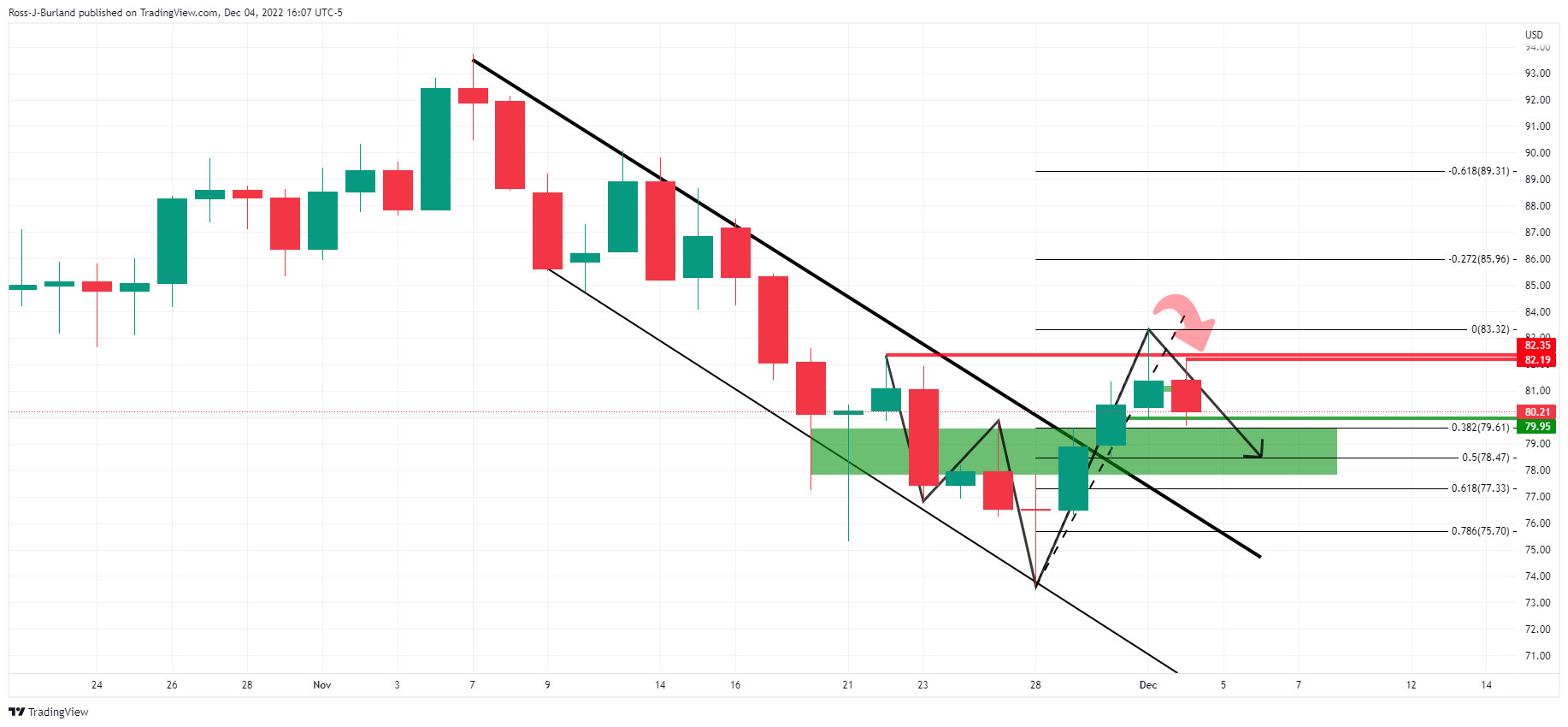
As per the daily chart analysis above, the W-formation is a reversion pattern and the price would be expected to be drawn towards the neckline in which this case has a confluence with the 50% mean reversion area near $78.50bbls.
-
-
22:33
ECB's Villeroy: In favour of 50 bp rate hike on Dec. 15
Reuters reports that Europen Central Bank board member François Villeroy de Galhau said on Sunday that he is in favour of a 50 basis point hike to 2% of the European Central Bank's main rate at its board meeting on Dec. 15.
The central banker also said in an interview with LCI television that he expects inflation will peak in the first half of next year.
Key notes
ECB's Villeroy says inflation should peak in first half next year.
ECB's Villeroy says he personally favours 50 bp hike at rate meeting on Dec 15.
ECB's Villeroy says rate hikes will continue after Dec 15, cannot say when they will stop.
ECB's Villeroy says thinks France and Europe will escape hard landing of economy.
ECB's Villeroy says recession next year is unlikely.
ECB's Villeroy says expects to beat inflation by 2024-2025.EUR/USD update
Meanwhile, the Euro fell to below 1.05 vs. the US Dollar on Friday, following a hotter-than-expected jobs report for the US. However, EUR/USD recovered back towards the highs of the day ending around 1.0540 on dovish rhetoric from Federal Reserve speakers. As for the ECB, analysts stay divided on whether the central bank will hike borrowing costs by a 75bps for the third time when it meets in December or will opt for a smaller 50bps increase.
-
22:09
OPEC+ agrees to maintain their current oil-output targets
Oil traders will note the weekend news that OPEC and its allied producers (OPEC+) have agreed to maintain their current oil-output targets despite a recent decline in energy prices.
Sunday's meeting was an important one for the oil industry given the recent moves in the oil price into fresh bearish cycle lows for the end of the year. West Texas Intermediate has been pressured of late given a deteriorating demand outlook from China and Europe recently agreeing to a price cap for Russian oil that is set to take effect this Monday.
At the meeting on Sunday, OPEC+ has agreed to sustain the 2 million-barrels-per-day cut that was announced in October that had drawn criticism from the Biden administration that regards the cut as a blatant display of siding with Moscow.
Meanwhile, in response to the Ukraine invasion, G7 nations, the European Union and Australia agreed at the end of last week to cap the price of Russian seaborne oil at $60 per barrel starting on Dec. 5. The Kremlin said this weekend that it would not comply with the price cap.
WTI technical analysis
Meanwhile, WTI is correcting into the Fibonacci scale drawn on the prior bullish leg as follows:
The W-formation is a reversion pattern that tends to see the price drawn towards the neckline in which this case has a confluence with the 50% mean reversion area near $78.50bbls.
-
22:01
South Korea FX Reserves came in at 416.1B, above forecasts (405.92B) in November
-
21:31
AUD/USD Price Analysis: Eyes are on critical daily dynamic support
- AUD/USD bears eye a 50% mean reversion in the lower quarter of the 0.6700s.
- A break of the supporting trendline and subsequent test of 0.6640/50 could be a significant bearish development.
As per the prior analysis, AUD/USD Price Analysis: Bulls eye 0.6850 while bears look to 0.6650, AUD/USD remains within familiar ranges, struggling to get beyond 0.6800 as the following illustrates:
AUD/USD prior analysis
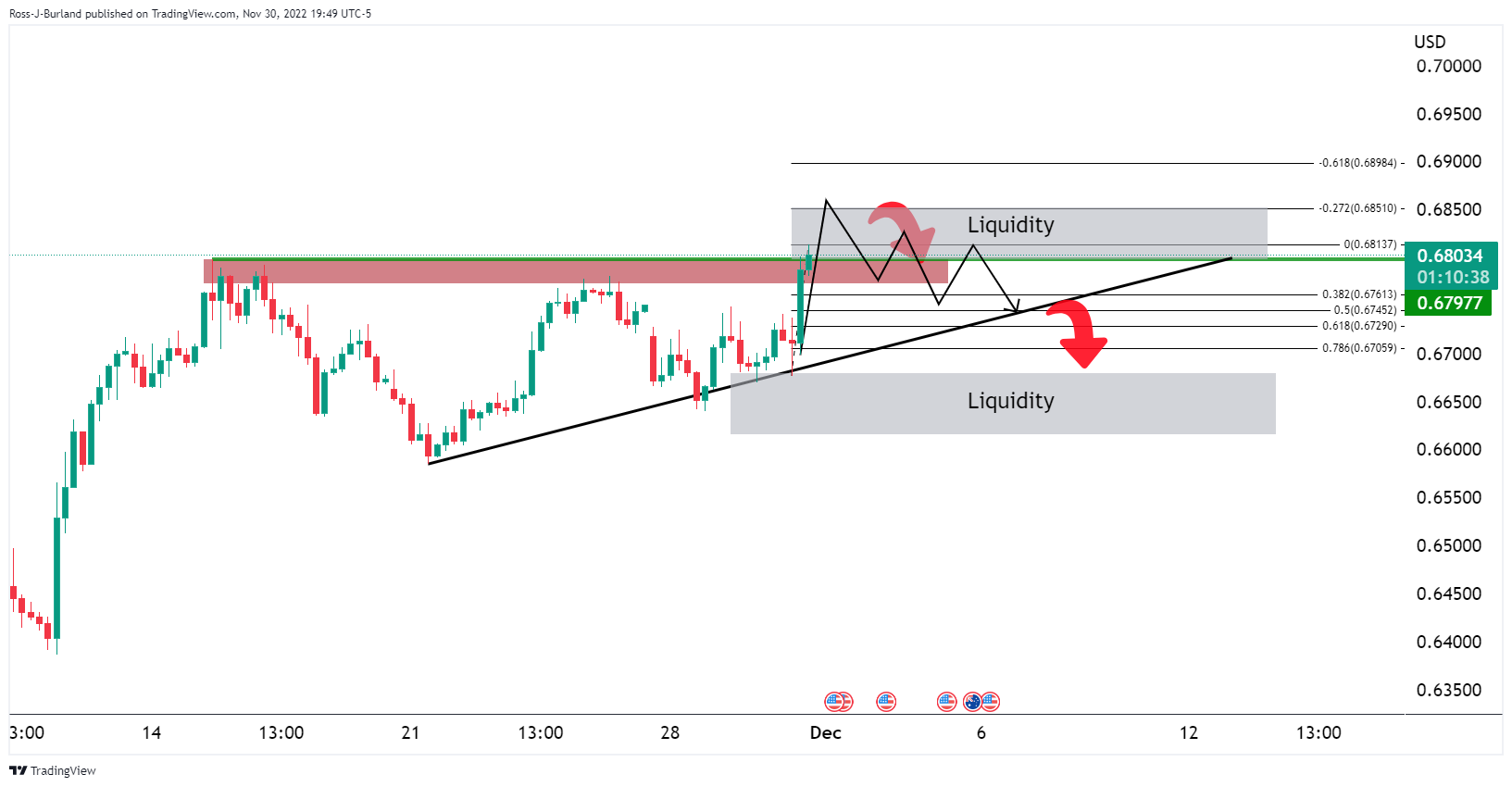
The price has reached through the resistance area but has subsequently moved in on the length taking on the midpoint of the prior bullish impulse as follows:
AUD/USD H4 chart update
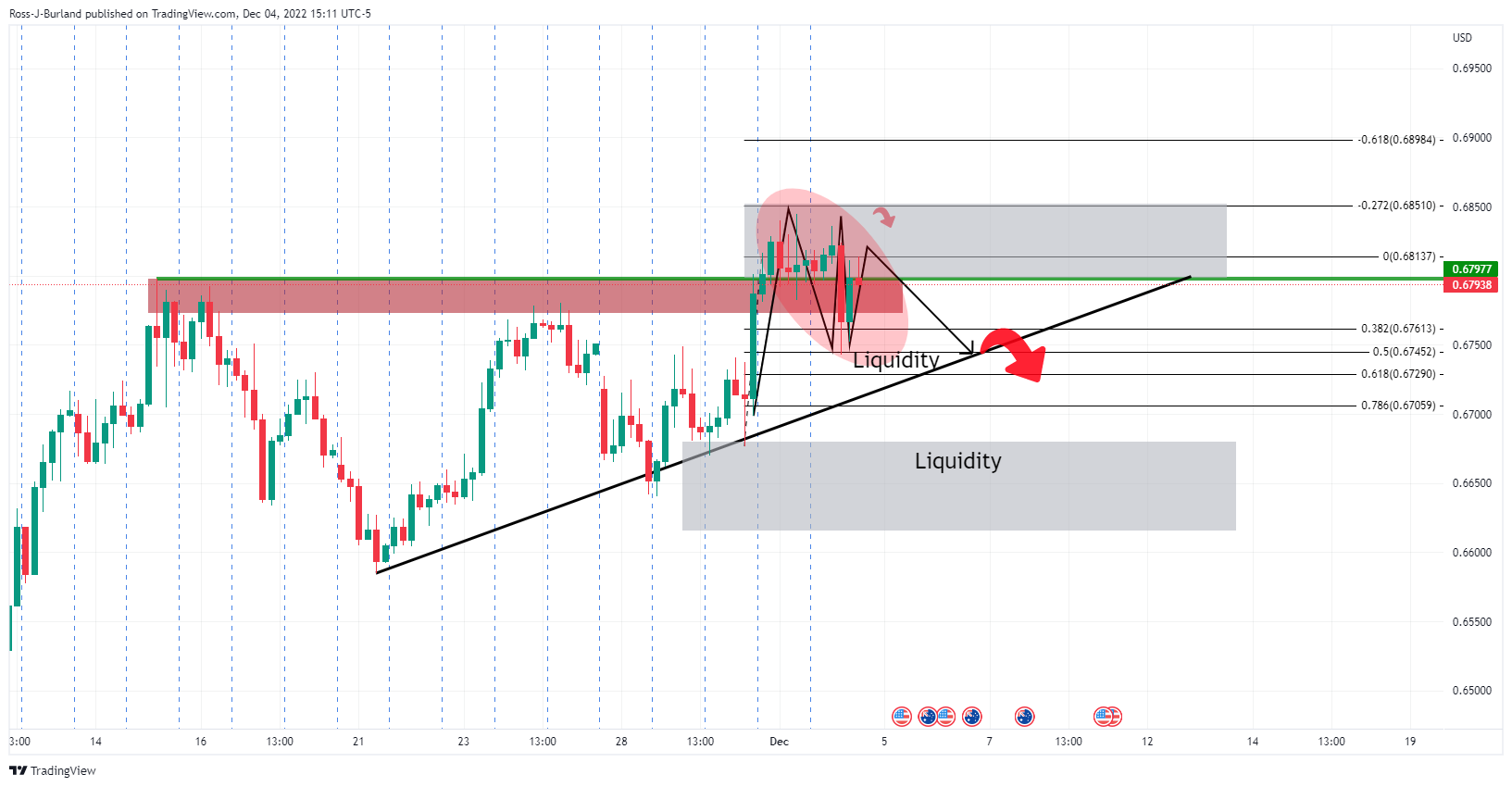
The engulfment came in a strong move to the downside that leaves the bias bearish for the opening sessions at the start of the week with the dynamic trendline support eyed.
AUD/USD daily chart
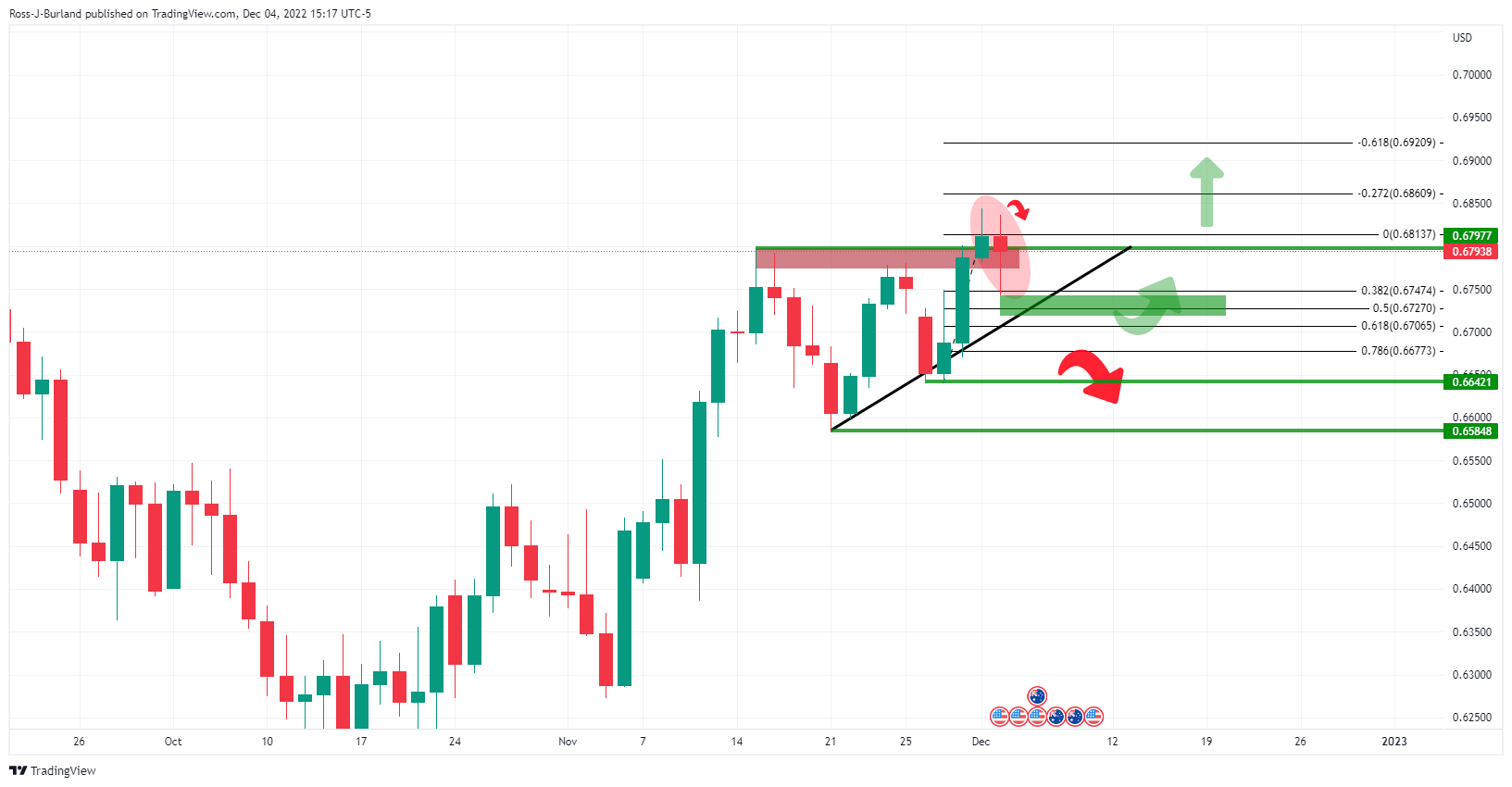
On the daily time frame, support is expected in the 50% mean reversion area and lower quarter of the 0.6700s. Should the supporting trendline be broken, a move below 0.6640/50 could be a significant bearish development ahead of the critical remaining calendar events for the year.
-
 Material posted here is solely for information purposes and reliance on this may lead to losses. Past performances are not a reliable indicator of future results. Please read our full disclaimer