Noticias del mercado
-
23:48
Regulators close Signature bank, announce plan to make depositors whole
“New York state's Department of Financial Services said on Sunday it has taken possession of New York-based Signature Bank and appointed the U.S. Federal Deposit Insurance Corp as receiver, the second bank failure in a matter of days,” reported Reuters.
“Signature Bank had deposits totaling approximately $88.59 billion as of December 31,” adds the news.
The news also mentioned that the US Treasury Department along with other bank regulators said in a joint statement on Sunday that all depositors of Signature Bank will be made whole, and that "no losses will be borne by the taxpayer."
Also read: US Treasury Department, Fed unveil action plan on Silicon Valley Bank fallout
Risk appetite improves
The news allows traders to begin the week on a positive footing after a downbeat close on Friday. The same propels S&P 500 Futures after a negative close the previous day.
-
23:20
US Treasury Department, Fed release joint statements on Silicon Valley Bank action
“Taking decisive actions to protect the US economy by strengthening public confidence in our banking system,” said the US Treasury Department and Federal Reserve (Fed) in joint statements on the action plan to defend the Silicon Valley Bank (SVB).
Key quotes
Boards of the FDIC and the Federal Reserve, and consulting with the President, Secretary Yellen approved actions enabling the fdic to complete its resolution of Silicon Valley Bank.
No losses associated with the resolution of Silicon Valley Bank will be borne by the taxpayer.
We are also announcing a similar systemic risk exception for signature bank, New York, which was closed today by its state chartering authority.
All depositors of this institution will be made whole.
Signature shareholders and certain unsecured debt holders will not be protected.
Signature senior management has been removed.
The Federal Reserve board on Sunday announced it will make available additional funding to eligible depository institutions to help assure banks have the ability to meet the needs of all their depositors.
Banking system remains resilient and on a solid foundation.
Any signature bank losses to the deposit insurance fund to support uninsured depositors will be recovered by a special assessment on banks.
Fed will make available additional funding to eligible depository institutions to help assure banks can meet depositors' needs.
To provide liquidity to US depository institutions, each Federal Reserve Bank would make advances to eligible borrowers, taking as collateral certain types of securities
Treasury department, using the exchange stabilization fund, would provide $25 billion as credit protection to the federal reserve banks in connection with bank term funding program.
Today's actions demonstrate US commitment to take 'necessary steps' to ensure that depositors' savings remain safe.
Eligible collateral includes any collateral eligible for purchase by the federal reservebanks in open market operations.
Rate for term advances will be the one-year overnight index swap rate plus 10 basis points; The rate will be fixed for the term of the advance on the day the advance is made.
Collateral valuation will be par value; margin will be 100% of par value.
Advances can be requested under the program until at least March 11, 2024.
Advances made under the program are made with recourse beyond the pledged collateral to the eligible borrower.
Market sentiment improves
With the US authorities are in action mode to defend the world’s largest economy from another financial crisis, the market’s risk appetite improved after a disappointment on Friday.
Also read: Source: US marshalling 'material action' to stem SVB fallout – Reuters
-
23:10
Source: US marshalling 'material action' to stem SVB fallout – Reuters
US authorities were preparing "material action" on Sunday to shore up deposits in Silicon Valley Bank (SVB) and try to stem any broader financial fallout from the sudden collapse of the tech startup-focused lender, mentioned Reuters while relying on anonymous sources familiar with the matter.
Elsewhere, Bloomberg also cites people familiar with the matter to mention that the US Federal Reserve is considering easing the terms for banks to access its discount window to prevent another collapse similar to Silicon Valley Bank.
Further, Mint reports that the US Federal Reserve will hold a closed-door emergency meeting on Monday of the Board of Governors amid the fallout of the Silicon Valley Bank. The news also adds, “According to a statement released by Fed it will review and determine the advance and discount rates to be charged by the Federal Reserve Banks during the meeting.”
Key quotes
Biden administration officials worked through the weekend to assess the impact of SVB Financial Group's Friday failure, with a particular eye on the venture capital sector and regional banks, the sources said.
Details of an announcement expected on Sunday were not immediately available, but one of the sources said the Federal Reserve could take action similar to what it did to keep banks operating during the COVID-19 pandemic.
U.S. authorities are considering safeguarding all uninsured deposits at SVB, weighing an intervention to prevent what they fear would be panic in the country's financial system, the Washington Post reported, citing three people with knowledge of the matter.
Officials at the Treasury Department, Federal Reserve and Federal Deposit Insurance Corporation discussed the idea this weekend, the report said.
CNBC reported that the Fed and the FDIC are discussing two different facilities to manage the fallout from the closure of SVB if no buyer materializes.
US Treasury Secretary Janet Yellen said she was working with banking regulators to respond after SVB became the largest bank to fail since the 2008 financial crisis.
As fears deepened of a broader fallout across the U.S. regional banking sector and beyond, Yellen said she was working to protect depositors, but ruled out a bailout.
Market implications
The SVB fallout shocked global markets and propelled risk-off mood on Friday, drowning the US Treasury bond yields and weighing on the US Dollar. Hence, any positive development on the front can help the US Dollar to regain its upside bias.
Also read: Forex Today: DXY ends week flat after Powell and NFP, ahead of US CPI; Wall Street plunges
-
22:51
New Zealand Business NZ PSI up to 55.8 in February from previous 54.5
-
22:45
New Zealand Food Price Index (MoM) above forecasts (0.6%) in February: Actual (1.5%)
-
22:37
EUR/USD gaps up as US Dollar gets shunned in the open
- EUR/USD bulls in the market at the open.
- EUR/USD jumps in a gap to start the week after NFP.
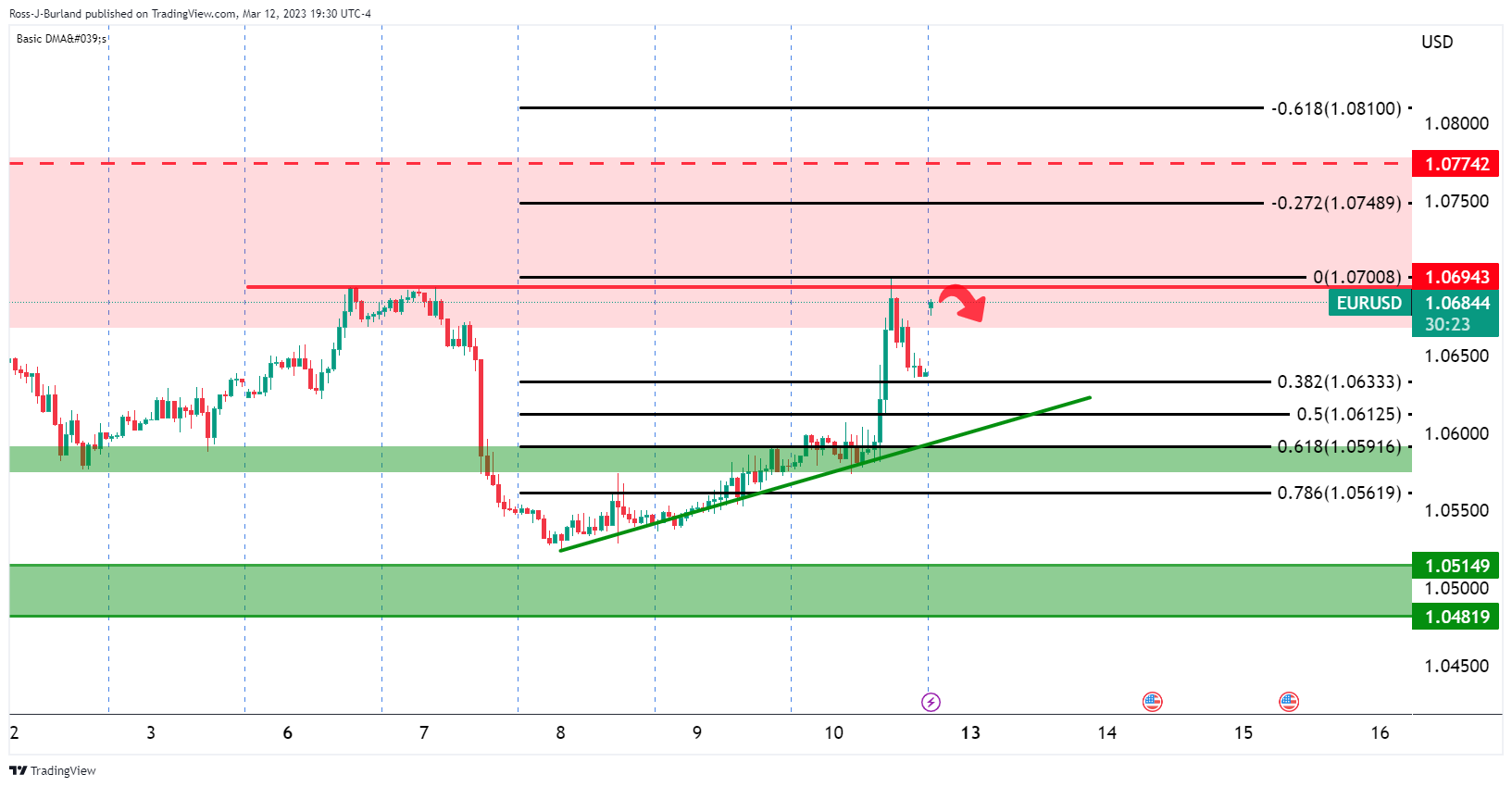
EUR/USD 1.0590 target in a 61.8% Fibonacci retracement for the day ahead. On the other hand, a continuation towards 1.0770s could just as easily play out.
EUR/USD has opened with a large gap in the open and is trading around 1.0680 after closing on Friday at 1.0639 after a mixed Nonfarm Payrolls report triggered a sell-off in the US Dollar.
However, as analysts at ANZ Bank said in a note before the open, ´´after so much anticipation it was ironic that it got lost in the noise, but non-farm payrolls rose 311k in February, indicating very strong momentum in jobs growth continues.´´
Additionally, the analysts explained that ´´the January data was barely revised, and the 3-month average of jobs growth is now 355k vs 321k in the prior three months. The unemployment rate edged higher to 3.6% as the participation rate rose 0.1% to 62.5%. Average hourly earnings slowed to 0.2% MoM (4.6% YoY). That will be of some comfort to the Fed, but the weaker monthly rise owed much to strong gains in low-paying jobs: leisure and hospitality and retail, suggesting firms expect discretionary consumer spending to remain strong,´´ they said.
Nevertheless, a significant repricing across the curve and in the terminal rate weighed on the US Dollar due to weaker-than-expected wages. The Fed funds rate implied upper bound fell from 5.89% to 5.5% and the probability of a 50bp hike in March declined substantially.
EUR/USD technical analysis
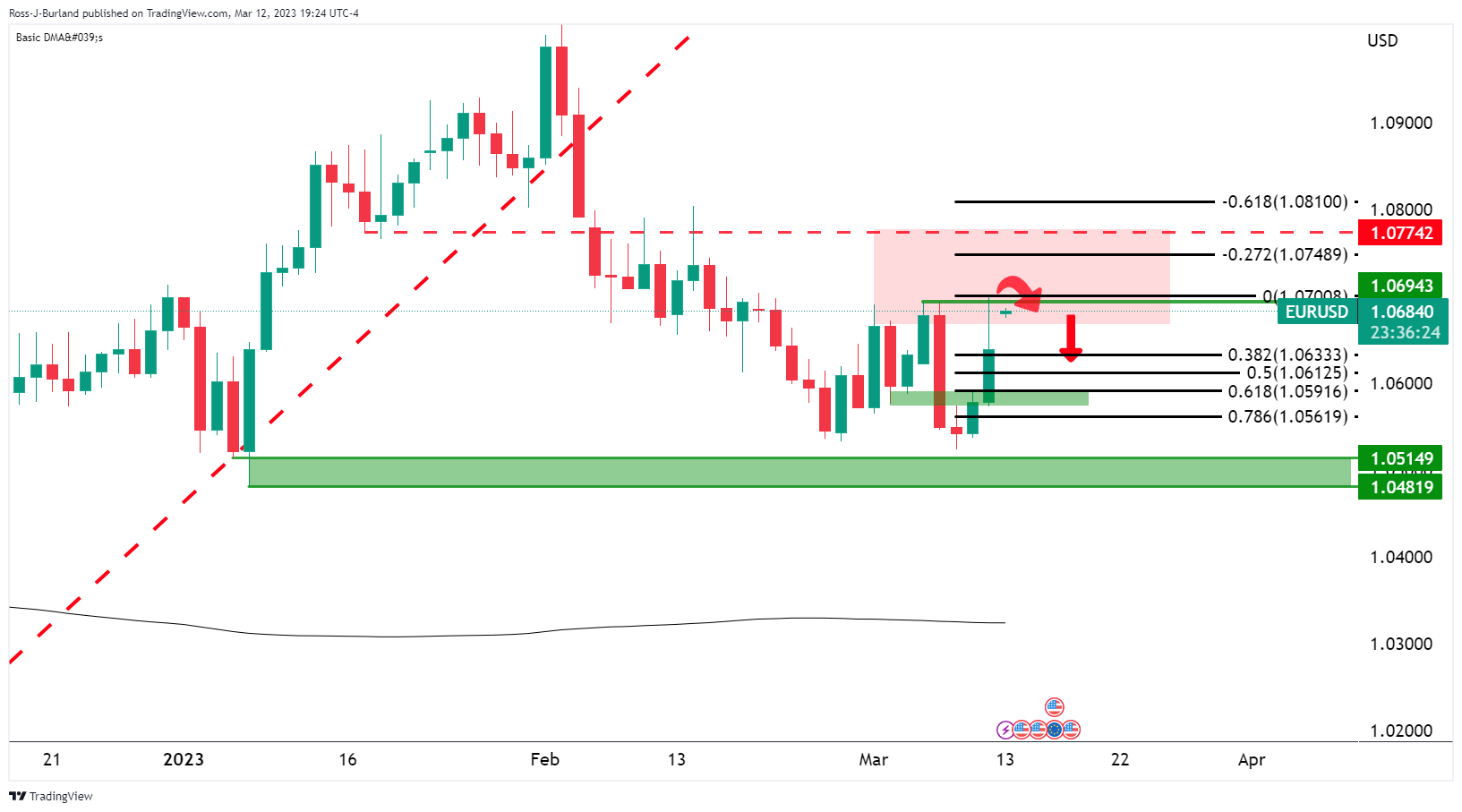
The price is reaching a liquidity area that could see the bears move in with eyes on a 1.0590 target in a 61.8% Fibonacci retracement for the day ahead. On the other hand, a continuation towards 1.0770s could just as easily play out.
-
21:27
AUD/USD Price Analysis: H1 M-formation holds the bears hostage for the open
- AUD/USD´s H1 M-formation, a reversion pattern, holds 0.6600 as a target for the open.
- AUD/USD bears need to get below a consolidative pattern and support near 0.6570.
As per the prior analysis and before the Nonfarm Payrolls event on Friday that sent the US Dollar substantially lower, AUD-USD remains in the realms of a geometrical bearish formation:
AUD/USD prior analysis
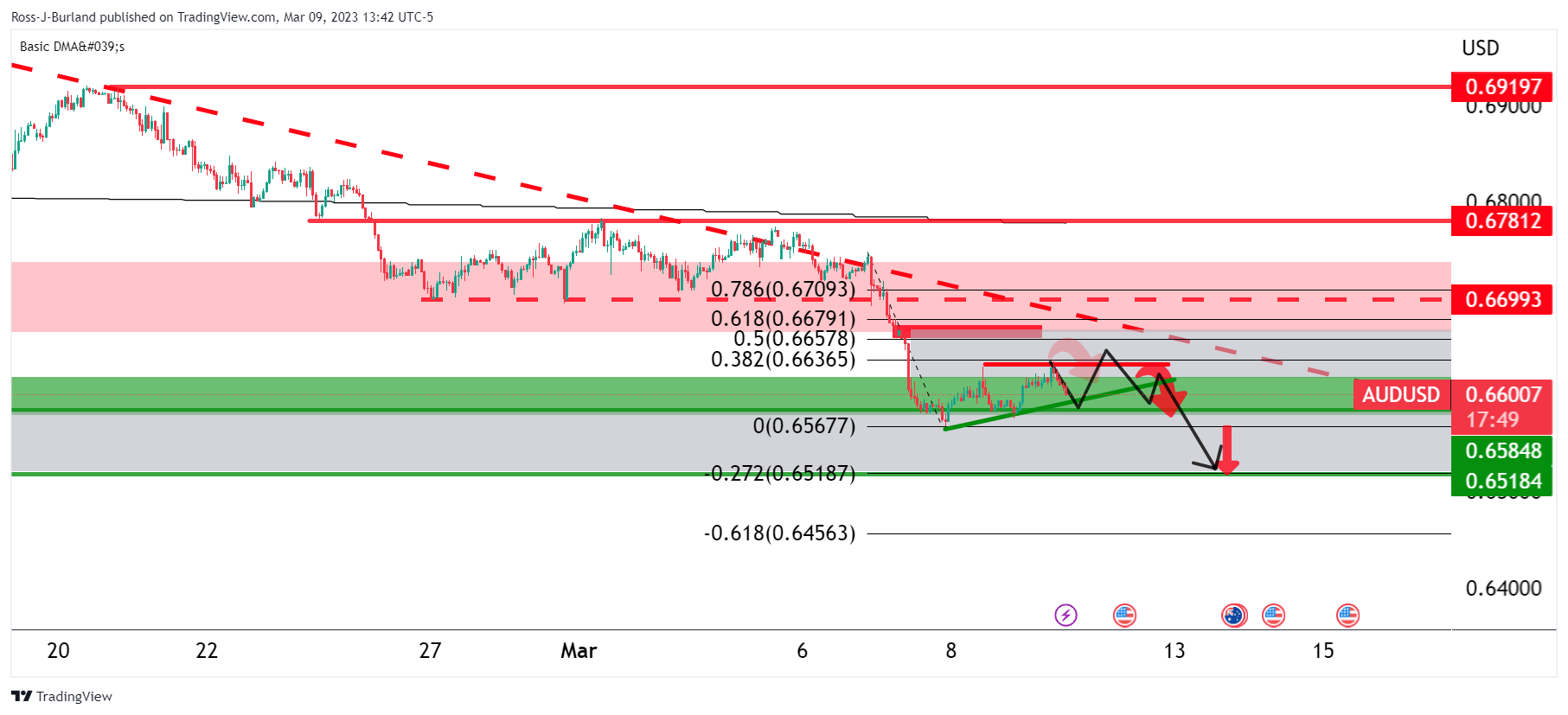
It was stated that the price was carving out a geometrical box, an ascending triangle, in a downtrend which is considered a bearish chart pattern.
´´Two-way price action can be expected from here with a bearish bias while on the front-side of the bear trend and below the 200 DMA,´´ the analysis stated with 0.6520 being key in this regard as it guarded a move towards 0.6380.
AUD/USD update
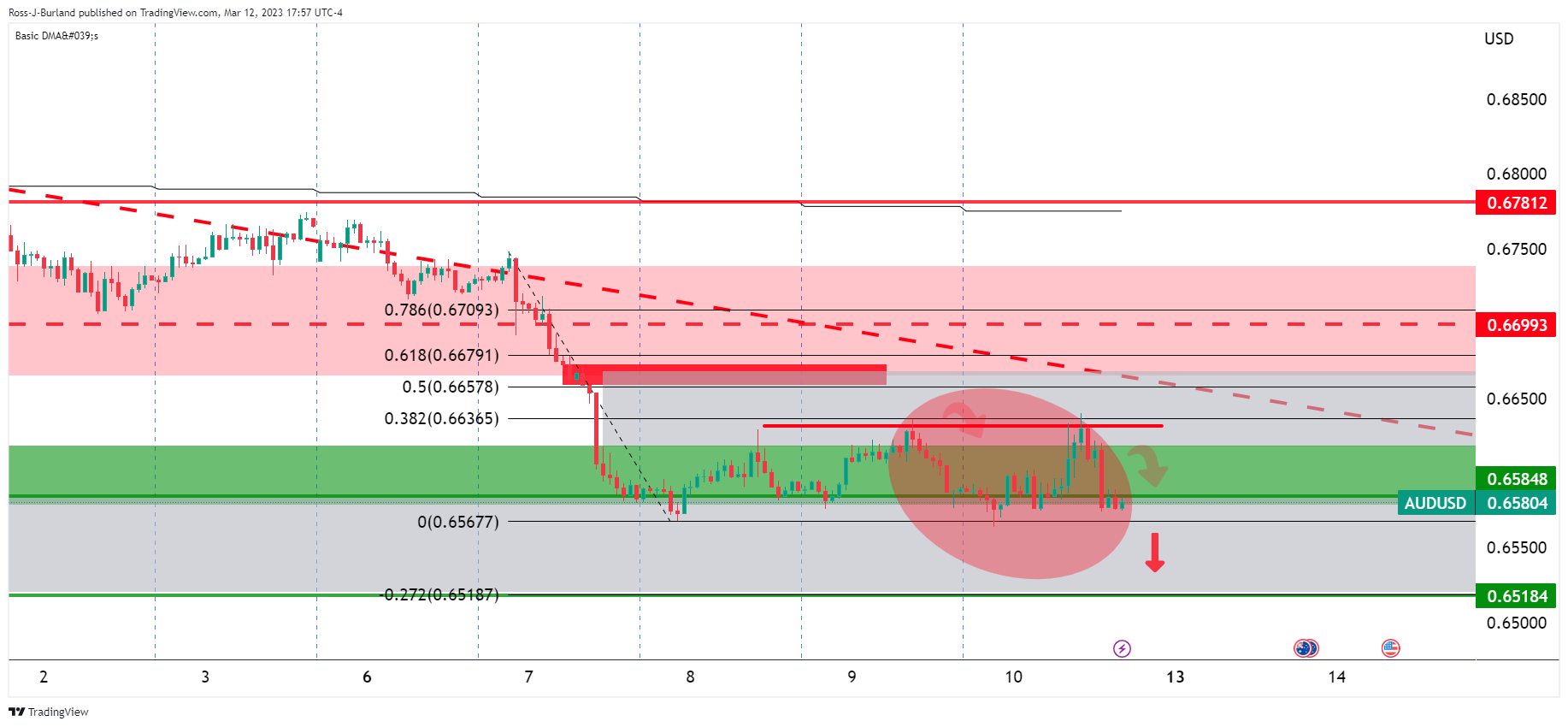
The triangle formation has morphed into a sideways consolidation. Of note, an M-formation has formed on this hourly chart:
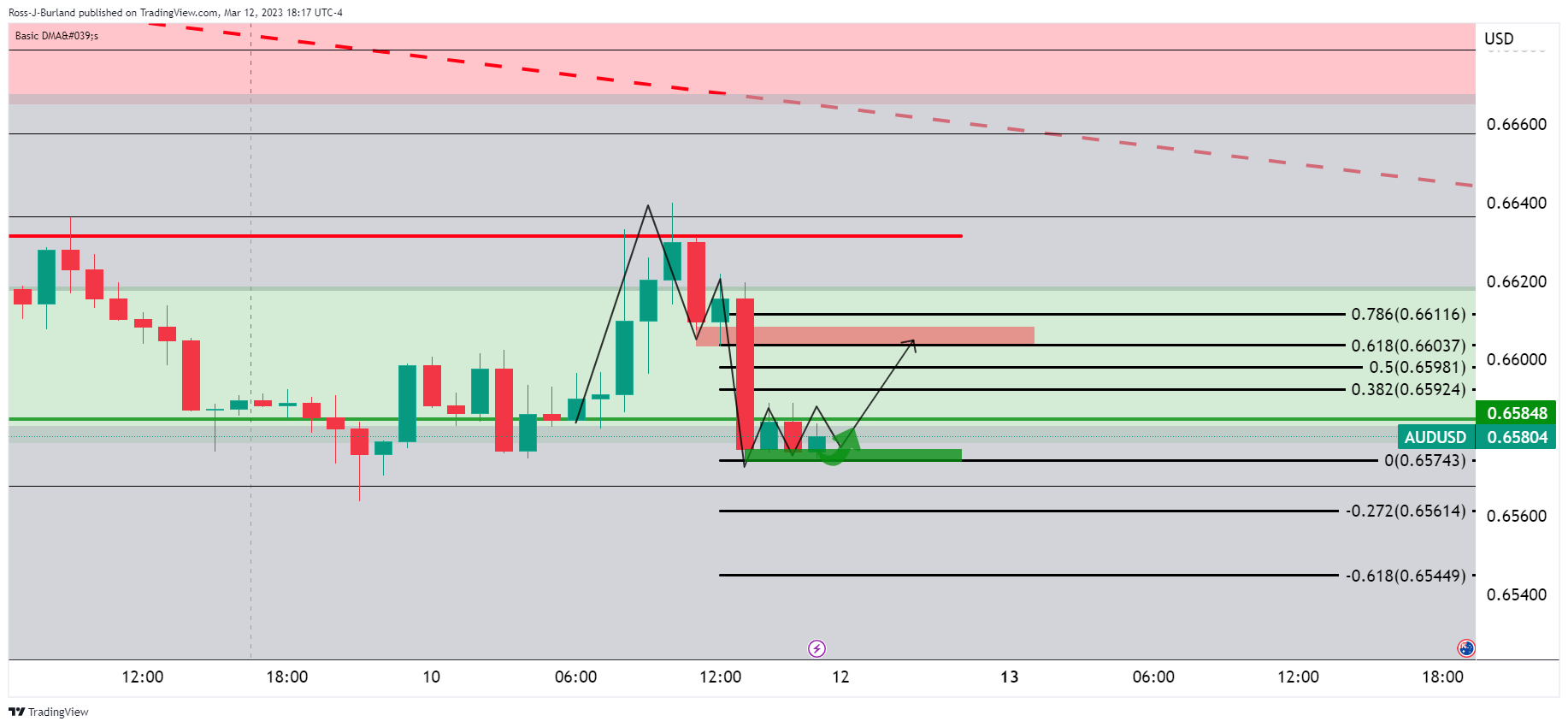
The M-formation is a reversion pattern and the price can be pulled into the neckline for a restest which is yet to play out, so far. However, it is worth noting for the open this week with 0.6600 being a key level in this regard.
-
 Material posted here is solely for information purposes and reliance on this may lead to losses. Past performances are not a reliable indicator of future results. Please read our full disclaimer