Noticias del mercado
-
23:46
Gold Price Forecast: XAU/USD rebounds ahead of United States data, Federal Reserve talk
- Gold price bounces off short-term key support but struggles to gain upside momentum.
- Downbeat United States Purchasing Managers’ Indexes favored Gold buyers.
- Hawkish Federal Reserve talk challenges XAU/USD recovery moves.
- US Durable Goods Orders, Fed’s preferred inflation gauge eyed for clear directions.
Gold price (XAU/USD) defends the bounce off a short-term key support confluence around $1,793 as traders await the United States (US) statistics for clear directions. The metal price witnessed the biggest weekly loss in four in the last as the global central banks, including the Federal Reserve (Fed) appeared hawkish. However, the US Purchasing Managers’ Index (PMI) for December appeared to be weak and helped the Gold price to end the week on a positive note.
Gold bears return on hawkish central banks
Be it the Federal Reserve (Fed) or the European Central Bank (ECB), not to forget the Bank of England (BOE) and the Swiss National Bank (SNB), the majority of the key central banks announced 50 basis points (bps) of rate hikes the last week. Although the rate lift was smaller than the previous moves, the policymakers’ readiness to defend the higher rates for the longer time seemed to have teased the Gold sellers.
The same could be sensed in the latest comments from Federal Reserve Bank of Cleveland President Loretta Mester and New York Federal Reserve President John Williams. That said, New York Fed President William said that it was possible for the FOMC to hike more than the terminal rate projected in the dot plot. On the same line, Cleveland Fed President Loretta Mester said her estimate for interest rates is higher than that of her colleagues and the central bank needs sustained tight policy to defeat inflation.
United States Purchasing Managers’ Indexes teased XAU/USD buyers
Gold price recovered from short-term important support on Friday on the downbeat prints of the United States (US) Purchasing Managers’ Indexes (PMIs) for December. That said, the US S&P Global Manufacturing PMI dropped to 46.2 from 47.7 in November, as well as the market expectation of 47.7. Further, S&P Global Services PMI declined to 44.4 in December's flash estimate from 46.2 in November and market expectation of 46.8.
Receding optimism over China teases Gold sellers
The gold price earlier cheered easing in China's Zero-Covid policy but the softening of the activity data from China and doubts over the recently declining COVID-19 numbers keep XAU/USD buyers on the edge. “China President Xi Jinping and his senior officials pledged to shore up China's battered economy next year as the deaths of two veteran state journalists highlighted the worsening spread of COVID-19 in the capital Beijing,” per Reuters.
The news adds that the reports of the deaths came as China set out urgent plans on Friday to protect rural communities from the virus as millions of city-dwellers plan their Lunar holidays, starting on Jan. 22, for the first time in years. But the excitement that met the policy U-turn allowing them to travel has cooled amid concerns that China is unprepared for the coming wave of infections, and the blow it could deliver to the world's second-largest economy.
US Durable Goods Orders, Federal Reserve’s preferred inflation gauge in focus
To confirm the weekly loss in the Gold price, traders will pay attention to Friday’s United States (US) Durable Goods Orders for November, expected 0.0% versus an upwardly revised 1.1% prior. Also important will be the Core Personal Consumption Expenditures (PCE) - Price Index for the said month, expected 4.6% YoY versus 5.0% prior. The PCE Price Index is known to be the Federal Reserve’s (Fed) preferred gauge of inflation and hence gains the major attention of Gold traders. Should the scheduled inflation data appear firmer, together with the upbeat Durable Goods Orders, the hawkish Fed talks could be materialized and signal further weakness of the metal. However, the year-end inaction may restrict the metal’s heavy momentum.
Gold price technical analysis
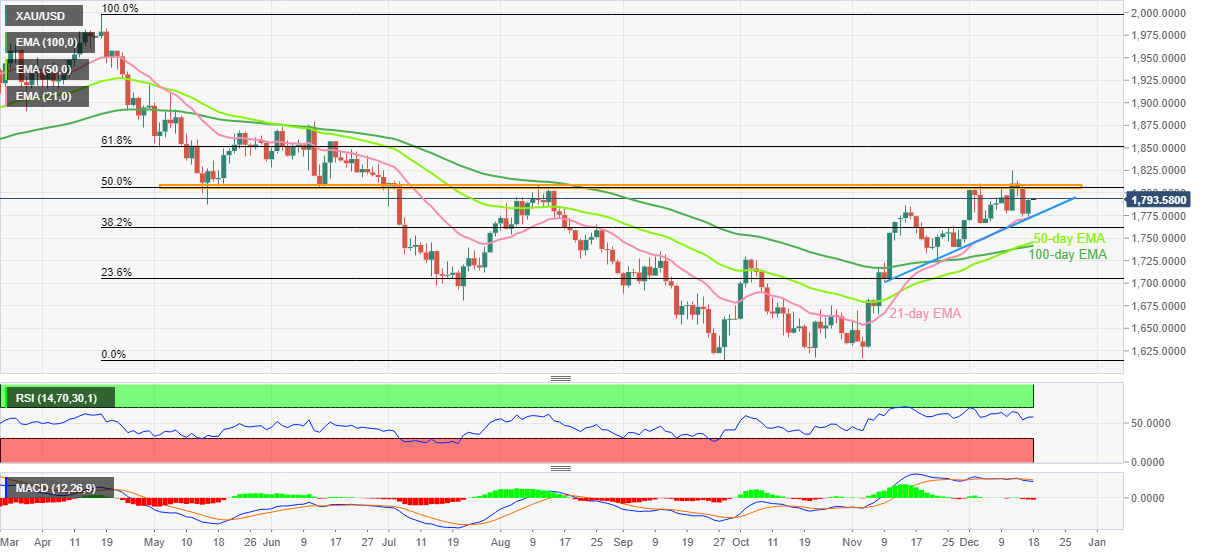
Gold defends the previous day’s bounce off a five-week-old ascending trend line and the 21-day Exponential Moving Average (EMA), around $1,775 by the press time, as it licks the wounds after the biggest weekly loss in a month.
In doing so, the yellow metal again approaches the $1,808-10 resistance confluence including the seven-month-old horizontal region and the 50% Fibonacci retracement level of the Gold’s April-September downside.
However, bearish signals from the Moving Average Convergence and Divergence (MACD) indicator join the sluggish Relative Strength Index (RSI), located at 14, to challenge the metal’s further recovery.
Even if the XAU/USD crosses the $1,810 hurdle, the 61.8% Fibonacci retracement level, also known as the “Golden Ratio”, around $1,852, will precede the June 2022 peak surrounding $1,880 to challenge the Gold buyers.
Alternatively, a clear downside break of the $1,775 support confluence could quickly drag the Gold price towards a convergence of the 50-day EMA and 100-day EMA near $1,745. However, tops marked in September and October, respectively around $1,735 and $1,730, could challenge Gold buyers afterward.
Overall, Gold’s latest rebound from important support appears elusive unless crossing the $1,810 hurdle.
Gold price: Daily chart
Trend: Further weakness expected
-
23:32
New Zealand Business NZ PSI down to 53.7 in November from previous 57.4
-
23:19
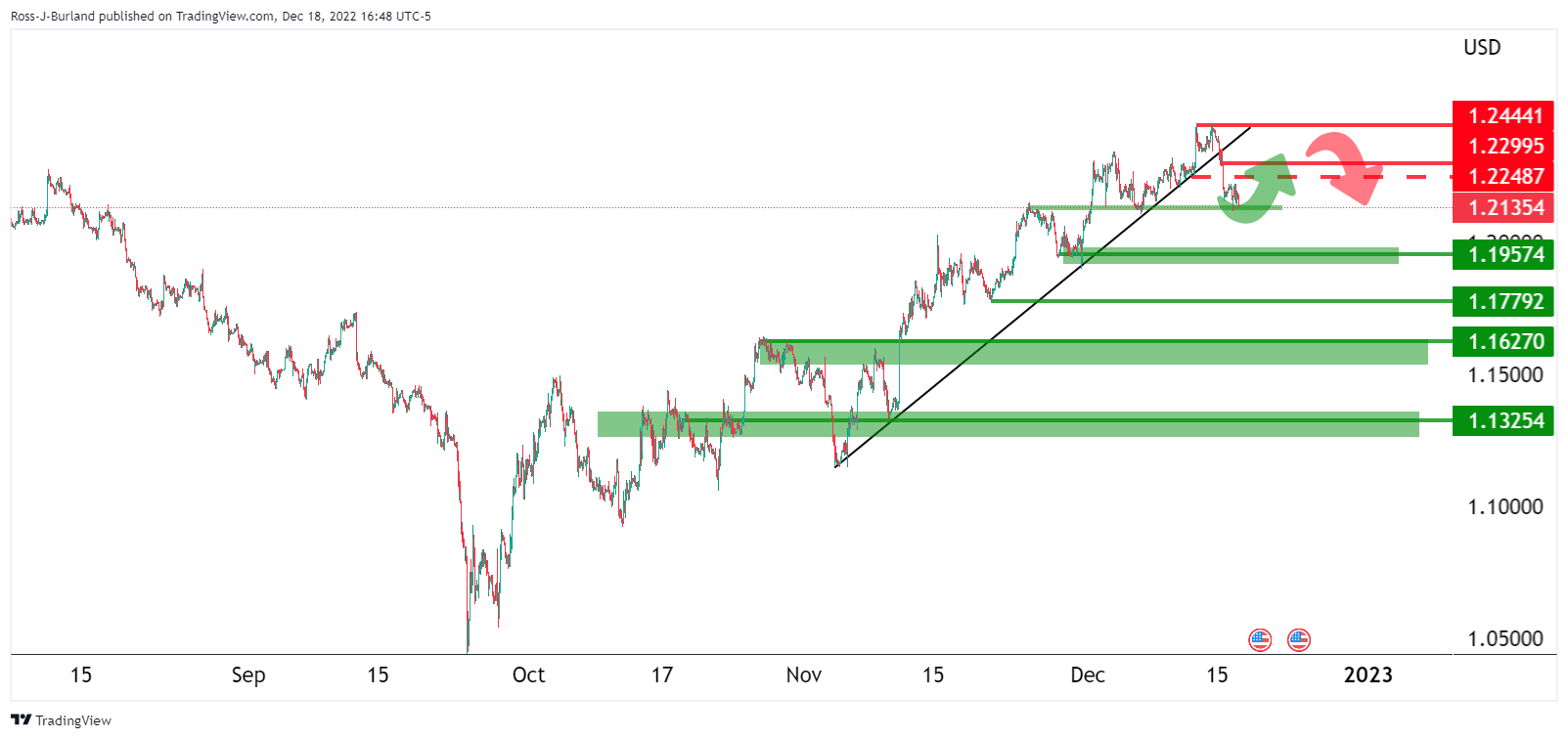
GBP/USD bulls are guarding 1.1950 and eye 1.22s
- GBP/USD bulls have stepped in at the open.
- Bulls look to the 1.2220s and 1.2300 which could be up for mitigation.
GBP/USD is moving higher in the open, up some 0.2% having popped from a low of 1.2135 and reaching 1.2159 so far on the day. Markets are backing the greenback, however, as risk appetite sours into the final weeks of the year while investors fret over the prospect that borrowing costs still have a long way to climb following a slew of hawkish rate hikes.
The Bank of England (BoE) hiked the Bank Rate by 50bp to 3.50% with 6 members voting for a 50bp hike, one member voting for 75bp and two members voting for keeping the Bank Rate unchanged. There was no news in regards to QT-communication as outright selling of government bonds commenced on 1 November.
However, analysts at Danske Bank expect the BoE to deliver a final 25bp hike in February. ''Our expectations fall below current market pricing (currently 100bps until August 2023) as we expect the rest of the BoE committee to eventually turn less hawkish amid a weakening growth backdrop and easing labour market conditions.''
GBP/USD technical analysis
Meanwhile, at a critical support structure and should the bulls move in, the price imbalance between the 1.2220s and 1.2300 could be up for mitigation.
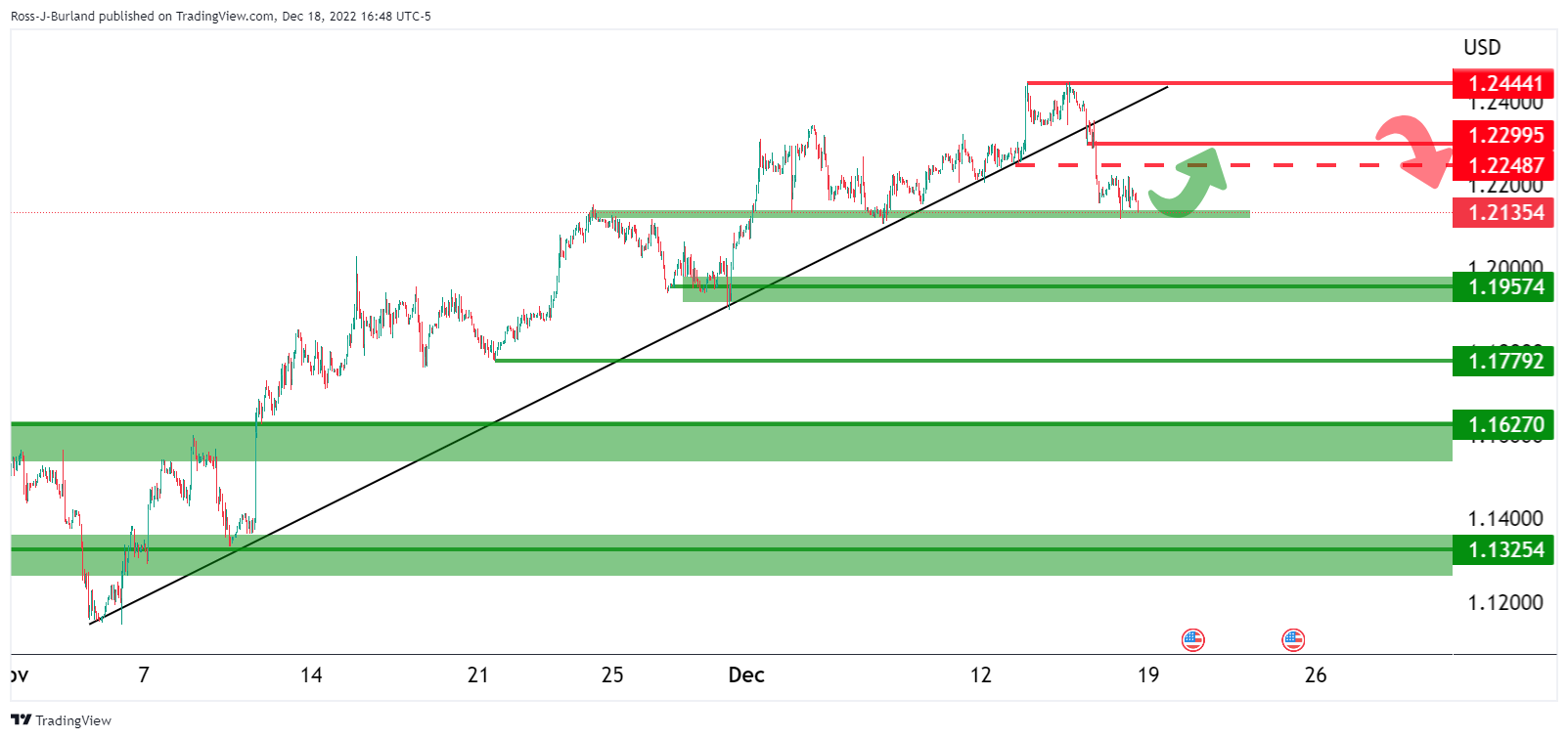
Zoomed in:
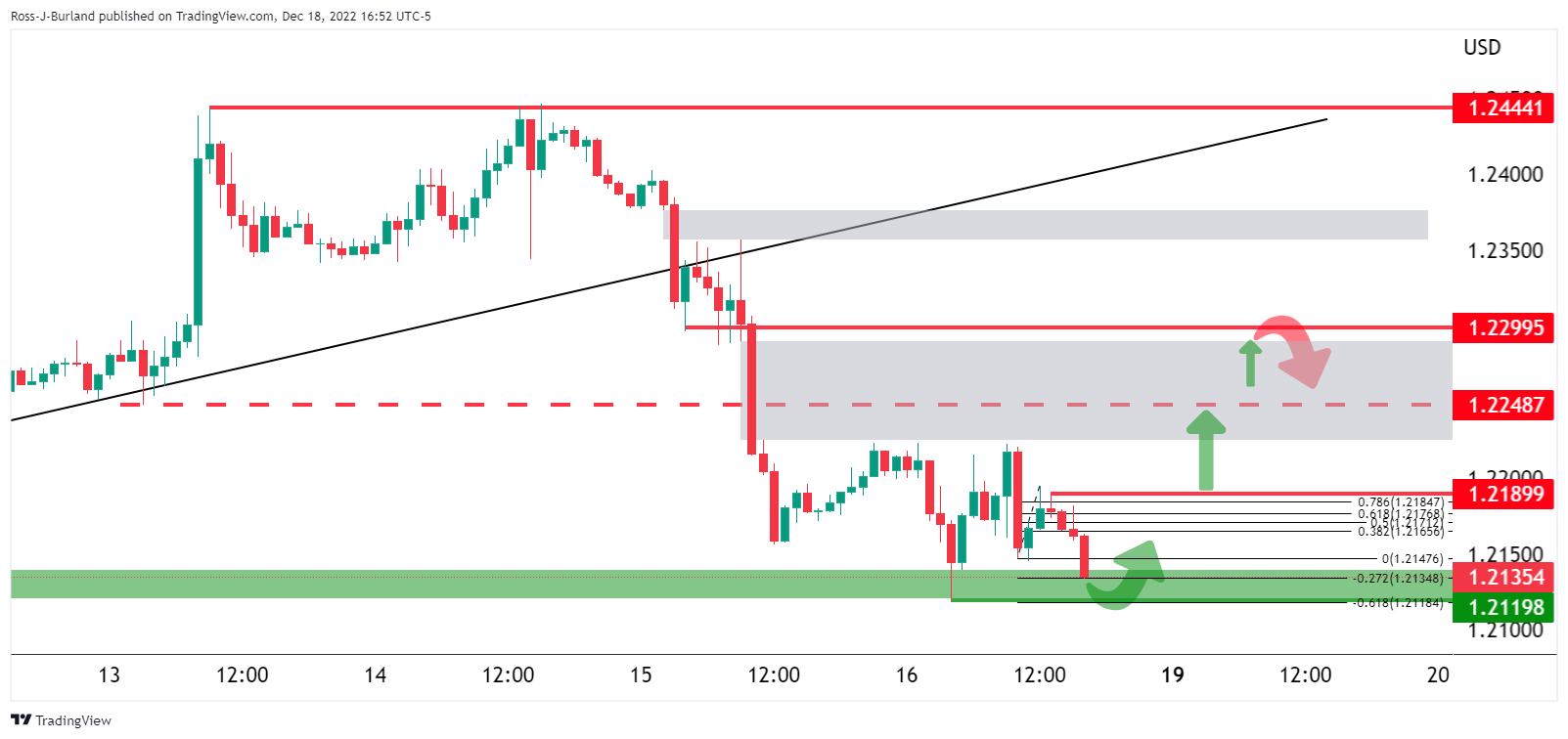
If the bears commit, then the thesis will be that the highs are locked in and the focus will be on a downside continuation towards 1.2000.
-
22:12
BoJ to water down price target
Reuters reported that Japan's government is set to revise a decade-old joint statement with the Bank of Japan (BOJ) that commits the central bank to achieve its 2% inflation "at the earliest date possible," Kyodo news agency reported on Saturday, citing government sources.
With the revision, Prime Minister Fumio Kishida will aim at making the BOJ's 2% inflation target a more flexible goal with room for allowance, Kyodo reported.
The new statement could remove the phrase "at the earliest date possible," or change the language to clarify that the 2% inflation target is a medium- to long-term goal rather than one that needs to be achieved quickly, Kyodo said.
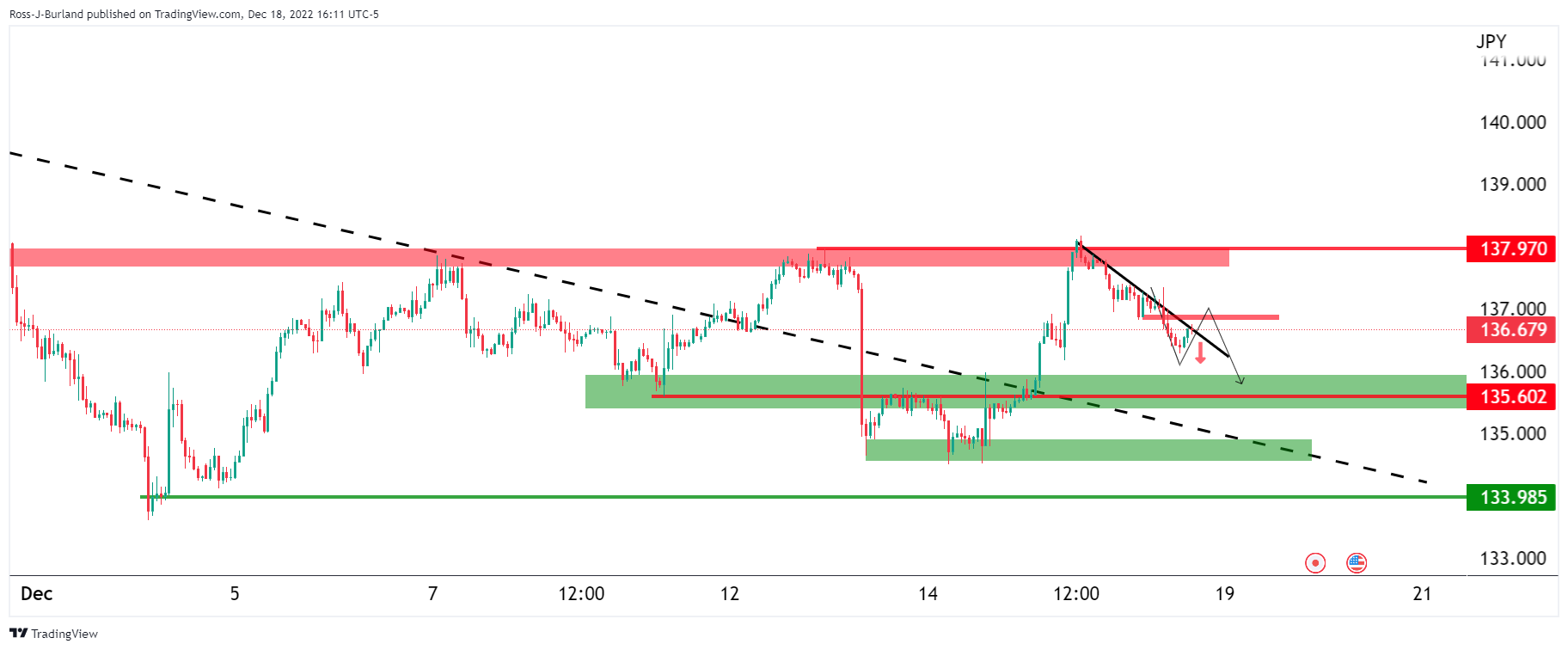
USD/JPY update
The speculation is that the BOJ will tweak its ultra-loose monetary policy under a new central bank governor next year. This is set to give the yen a lift that is technically headed higher vs the greenback already:
-
21:25
EUR/USD Price Analysis: Bulls under pressure as bears test commitments at 1.0600
- EUR/USD bears are homing in on the 1.0580s and the bulls will need to show up on the front side of the more dominant trendline support.
- On the upside, we have 1.0700 as a key dailylevel and 1.0790 thereafter as the next level.
As per the prior analysis, EUR/USD Price Analysis: Bears move in and eye a break of 1.0600, the W-formation was stated to have been a reversion pattern whereby bulls would be expected to move in at a discount from the neckline should there be a test of 1.0600 or thereabouts.
EUR/USD prior analysis
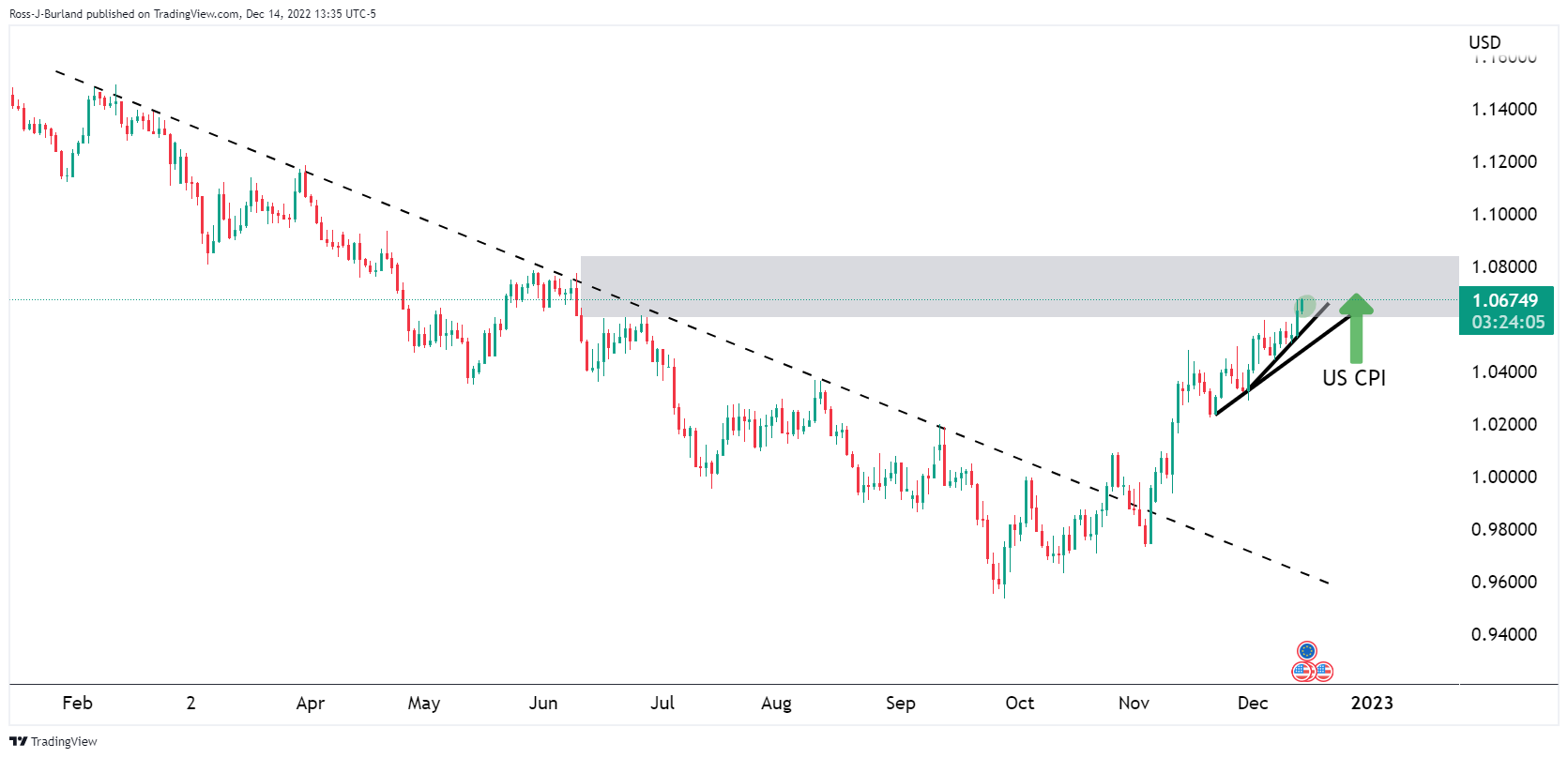
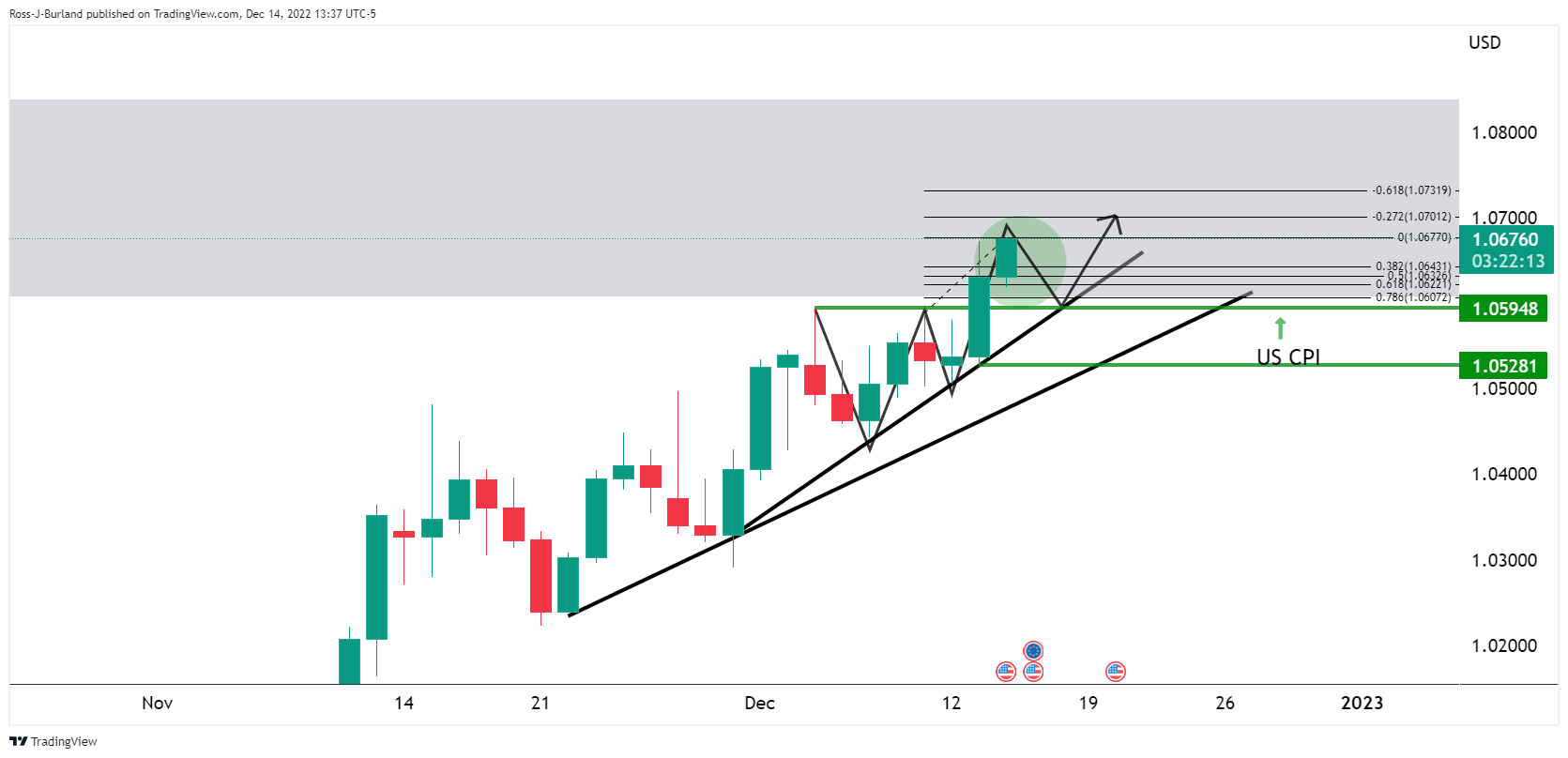
This marked 1.0600 as a key support area and 1.0520s below it as being the CPI take-off point.
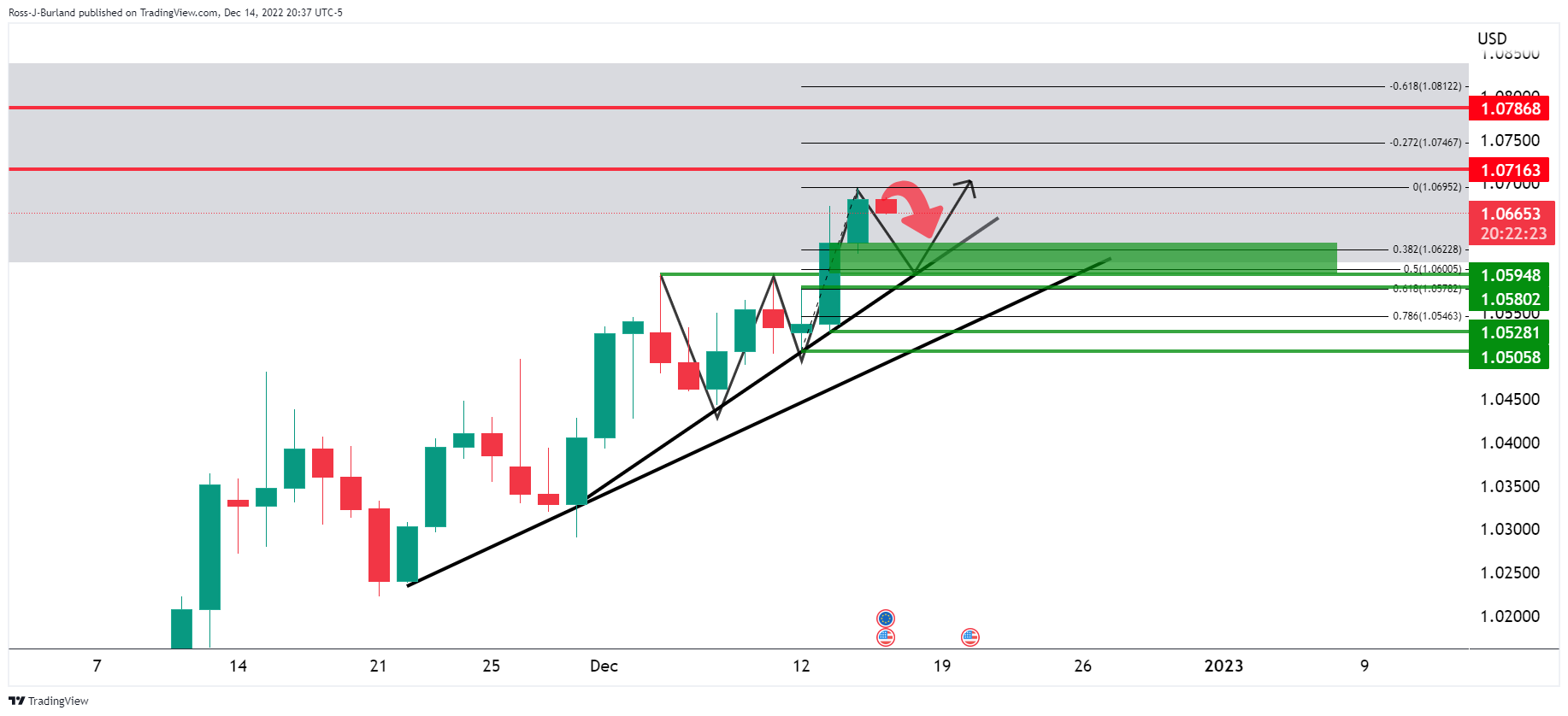
Thereafter, it was noted that the price was stalling on the bid and the W-formation was anticipated to pull in to the price to test the 1.0620s as a first objective and then to test 1.0600 thereafter. 1.0580 and 1.0520/05 were called as the last defence for a significant bearish correction for the weeks ahead and New Year.
EUR/USD update
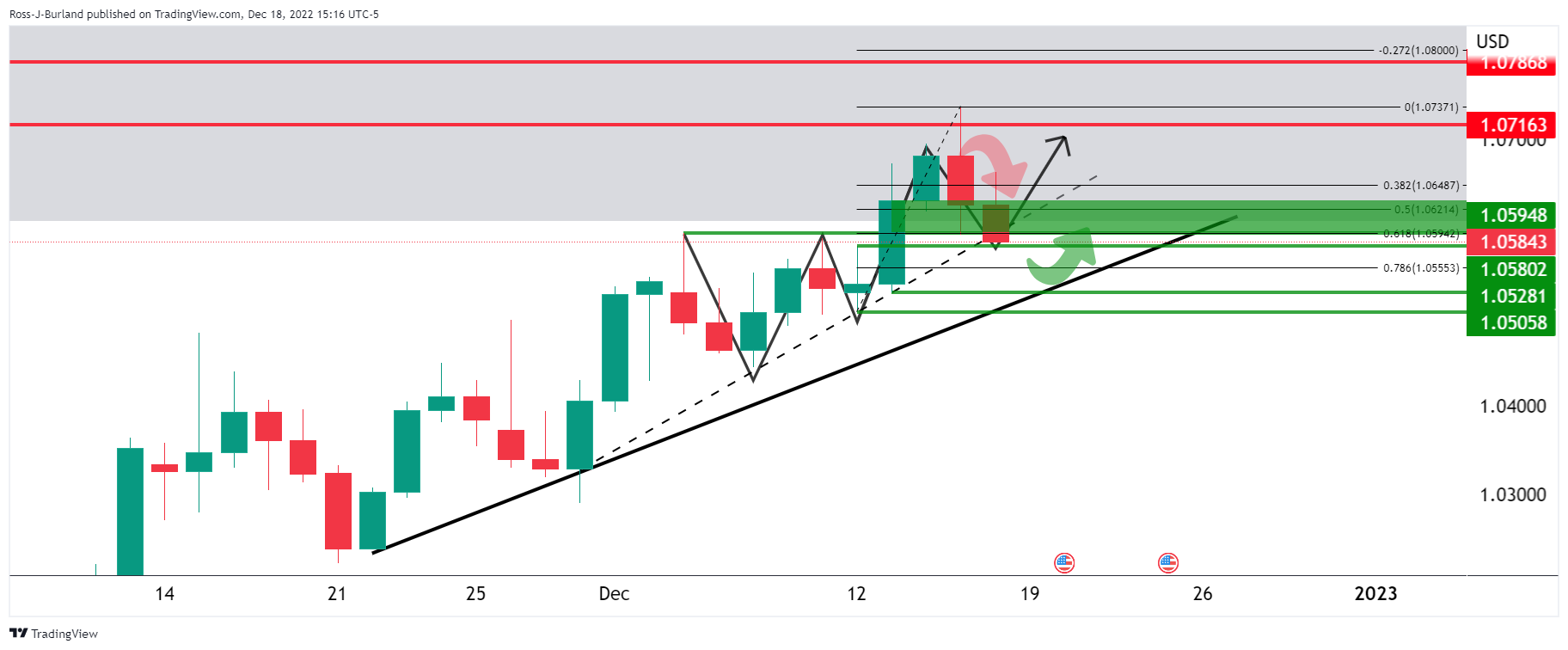
The price has broken the first trendline and is homing in on the 1.0580s. The bulls will need to show up on the front side of the more dominant trendline support or face a downside continuation as explained above. On the upside, however, we have 1.0700 as a key level. We have 1.0790 thereafter as the next level.
-
20:45
AUD/USD Price Analysis: Bears eye the coiled conditions, testing 0.6670 structure
- AUD/USD 0.6670 structure will be important for the open.
- AUD/USD 0.6580 guards a test of 0.65 the figure.
Risk tolerance dropped at the end of last week with hawkish central banks. Subsequently, AUD/USD, after taking out the channel support, is now eyeing a move towards the Volume Point of Control (VPC) of the late August to mid-October bear cycle as follows:
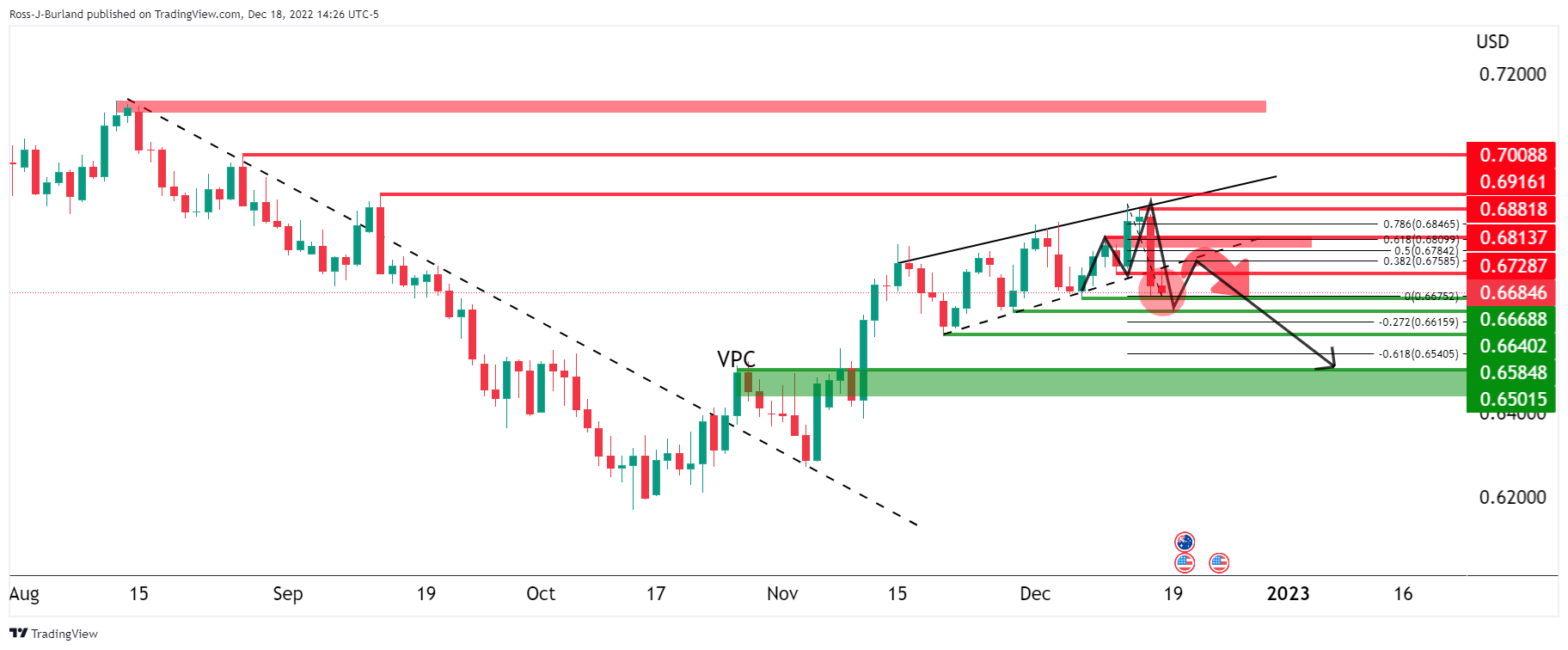
In the meanwhile, the neckline of AUD/USD M-formation could serve as the resistance of a possible stronger correction in the coming days and that could lead to a downside continuation below the now counter-trendline to target the 0.65s.
AUD/USD H4 chart
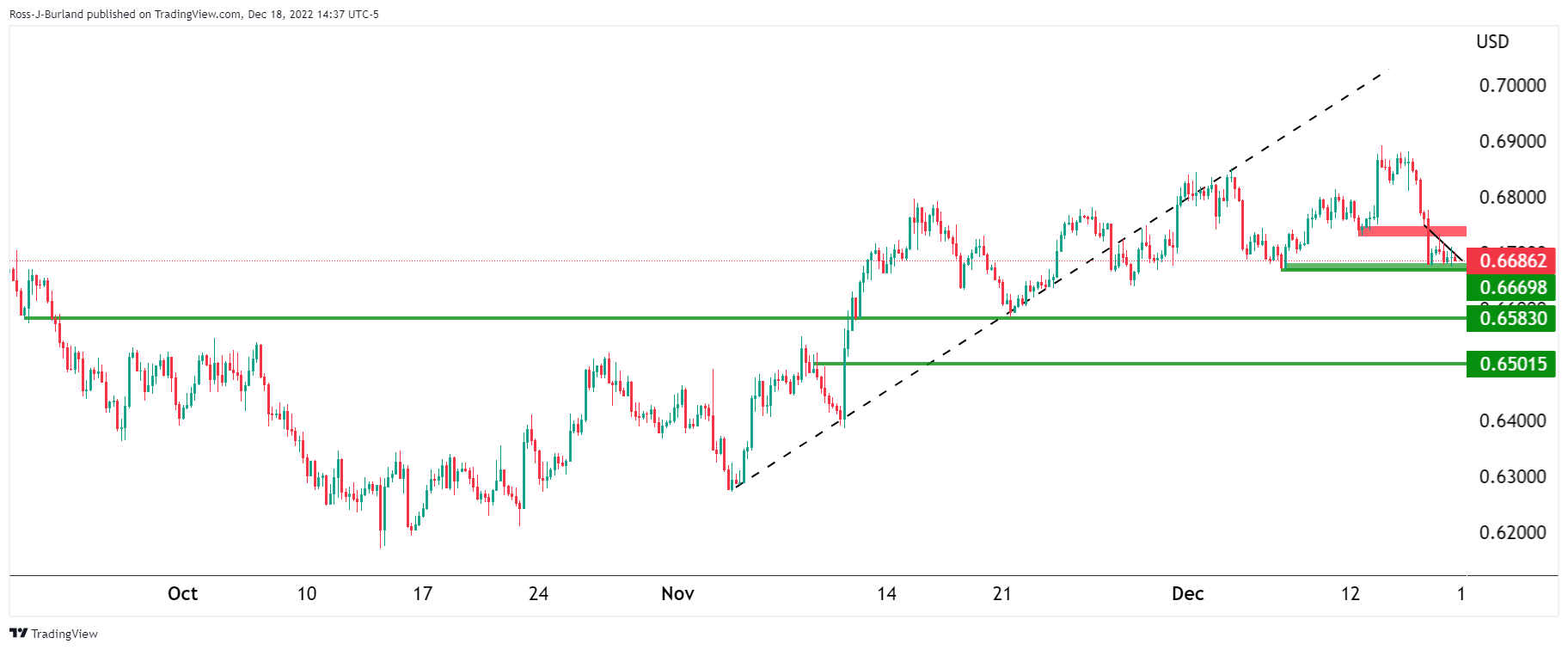
On the 4-hour time frame, the descending triangle is a bearish formation that anticipates a downside breakout:
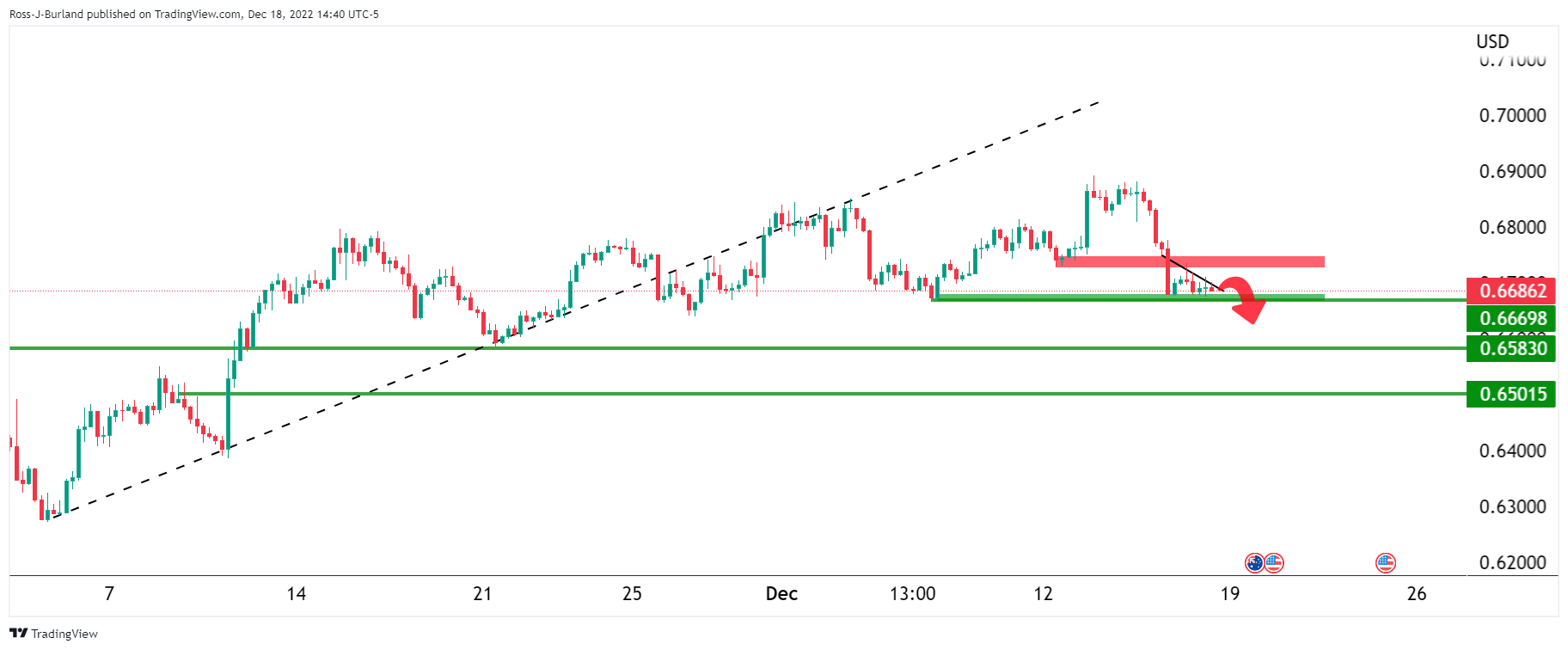
0.6670 structure will be important for the open as it guards a move lower that will lock in the highs and potentially carve the downside bias out for the initial days of trade for this week. 0.6580 guards a test of 0.65 the figure.
-
20:11
Fed's Mester sees rates rising more than most policy makers have forecast
Speaking on Bloomberg’s television channel, Federal Reserve Bank of Cleveland President Loretta Mester said her estimate for interest rates is higher than that of her colleagues and the central bank needs sustained tight policy to defeat inflation.
Against the Fed’s projection that the current federal funds rate of between 4.25% and 4.5% will rise to 5.1% next year, Mester said, “I’m a little higher than the median.”
"We need to continue to bring up interest rates into a restrictive stance," Mester said.
"We did a lot of work this year" moving rates up aggressively, she said, adding once the Fed finishes raising rates, it will need to hold them there for "quite a while in order to get inflation on a sustainable downward path."
Her comments come after Wednesday's FOMC meeting where by the members raised the Fed's target rate by half a percentage point as it continues to work toward lowering the highest levels of inflation seen in decades.
Mester said recent inflation data pointing to moderating price increases is "good news," but added the data does not yet show that a peak in price pressures has occurred.
US Dollar update
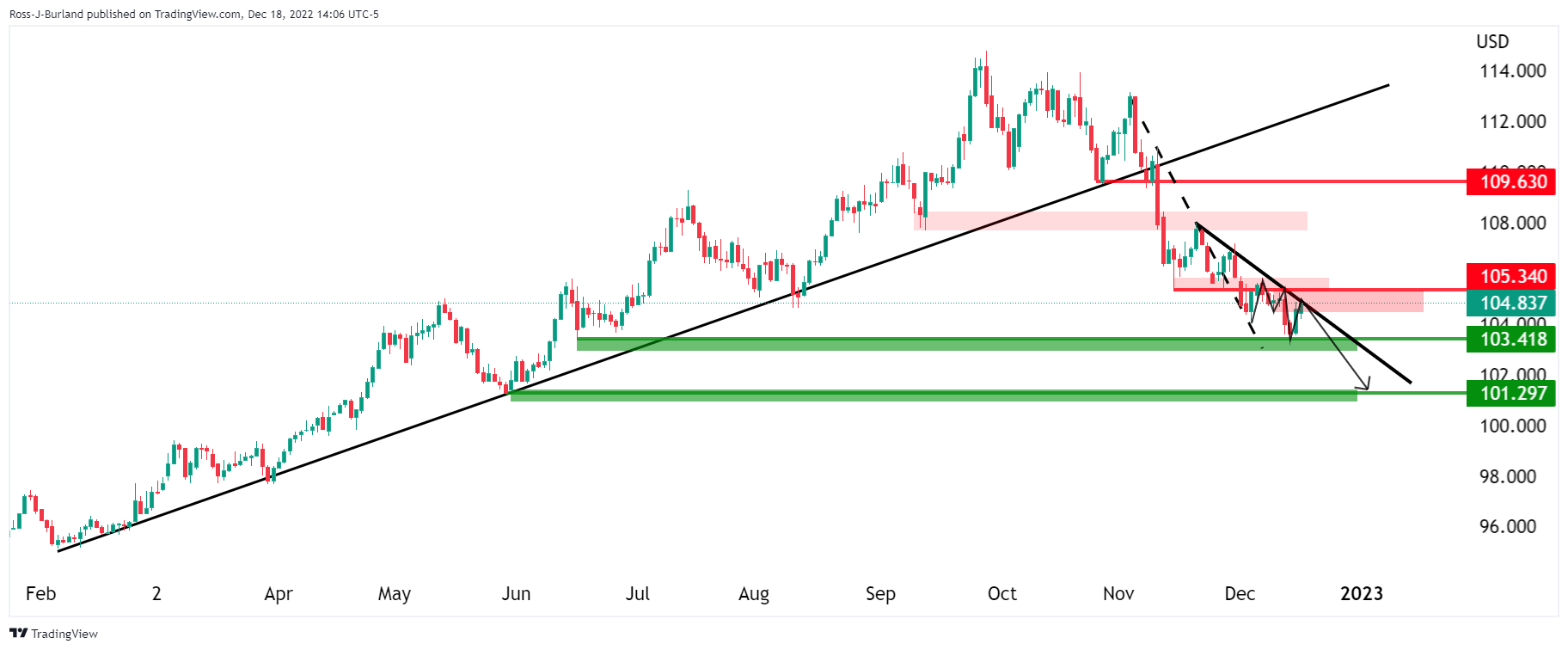
The US Dollar, as measured by the DXY index, remains in a bear cycle while below the micro trendline. However, it was extending sharp gains in the previous session as risk appetite soured and investors weigh with the prospect that the Fed still have a long ways to go.
-
 Material posted here is solely for information purposes and reliance on this may lead to losses. Past performances are not a reliable indicator of future results. Please read our full disclaimer