Noticias del mercado
-
23:59
USD/CAD stays firmer around 1.3400 as oil price declines, focus on US/Canada employment data
- USD/CAD picks up bids to extend Friday’s recovery.
- Comments from Iraqi Official, concerns over Russian oil price cap weigh on the WTI.
- Covid woes challenge market sentiment and favor bulls even as hopes of Fed’s easy rate tease sellers.
- Risk catalysts, monthly job numbers from US, Canada will be crucial for the pair traders.
USD/CAD bulls attack the 1.3400 threshold while extending Friday’s corrective bounce during Monday’s Asian session. In doing so, the Loonie pair cheers the market’s risk-off mood, as well as softer prices of WTI crude oil, Canada’s main export item.
WTI crude oil remains pressured around $76.30, down for the third consecutive day, as bears cheer the market’s risk-off mood, as well as price-negative headlines from Iraqi official and relating to the Russian oil price cap.
“The OPEC+ meeting in December will take into account the condition and balance of the market,” Iraq's state news agency quoted Saadoun Mohsen, a senior official at the country's state oil marketer (SOMO), as saying on Saturday. Elsewhere, the talks among the members of the Group of Seven Nations (G7) and the European Union (EU) continue to drag on the Russian oil price cap. As per the latest updates, the $65 per barrel is the sticking point as discussions are likely to resume on Monday.
That said, the prospect of the Fed’s slower pace of interest rate hikes weighed on the US Dollar the previous week.
It’s worth noting that the People’s Bank of China’s (PBOC) cutting of the Reserve Requirement Ratio (RRR) by 25 basis points (bps) effective from December 5 joins the Covid woes to also propel the USD/CAD prices.
China reported an all-time high of COVID-19 daily cases with nearly 40,000 new infections on Saturday. The dragon nation has been using the stringent policy to limit the virus spread but the outcome hasn’t been a positive one so far. On the contrary, a deadly fire in a building was allegedly linked to the virus-linked lockdown measures and resulted in mass protests in Beijing and Shanghai.
Amid these plays, the US Dollar Index (DXY) stays defensive around 106.30 while the US stock futures and US Treasury yields pare recent losses.
Moving on, the second-tier US data relating to employment may entertain the USD/CAD traders but major attention should be given to the aforementioned risk catalysts and the November month’s job report for the US and Canada.
Technical analysis
A two-week-old symmetrical triangle restricts short-term USD/CAD moves between 1.3430 and 1.3340.
-
23:46
UK PM Sunak: Britain needs to stand up to competitors 'not with grand rhetoric but with robust pragmatism'
British Prime Minister Rishi Sunak plans to promise on Monday to maintain or increase military aid to Ukraine next year, and to confront international competitors "not with grand rhetoric but with robust pragmatism", reported Reuters. The news is based on extracts released by UK PM Sunak’s office, per Reuters, ahead of his first major foreign policy speech, which he plans to deliver on Monday in London's financial district.
Key quotes
Under my leadership we won't choose the status quo. We will do things differently.
Priorities would be "freedom, openness and the rule of law".
Sunak indicated no change with the policy pursued by Johnson and Truss.
We will stand with Ukraine for as long as it takes. We will maintain or increase our military aid next year. And we will provide new support for air defence.
It means delivering a stronger economy at home - because it is the foundation of our strength abroad. And it means standing up to our competitors, not with grand rhetoric but with robust pragmatism.
Sunak has previously described China as a ‘systemic challenge’ and "the single biggest state threat to our economic security.
Also read: GBP/USD seeks support around 1.2060 amid quiet market mood, US ADP payrolls eyed
-
23:38
Iraqi Official: OPEC+ meeting to take into account market conditions
“The OPEC+ meeting in December will take into account the condition and balance of the market,” Iraq's state news agency quoted Saadoun Mohsen, a senior official at the country's state oil marketer (SOMO), as saying on Saturday.
Elsewhere, the talks among the members of the Group of Seven Nations (G7) and the European Union (EU) continue to drag on the Russian oil price cap. As per the latest updates, the $65 per barrel is the sticking point as discussions are likely to resume on Monday.
Additional comments
OPEC+'s October decision to reduce production by two million barrels per day (bpd) had played an important role in stabilising global markets.
The cut hadn’t reduced Iraq's exports.
Iraq's current production represents 11 percent of the group's total output of 43 million barrels per day (bpd).
Iraq expects a crude price range of at least $85-95 next year.
Oil markets are witnessing ‘severe fluctuations’ due to the repercussions of the pandemic, a slowing global economy and the war in Ukraine, making it harder to ensure price stability.
Market implications
The news should exert downside pressure on the WTI crude oil prices which dropped to $76.30 by the end of Friday’s trading session.
-
23:31
GBP/USD seeks support around 1.2060 amid quiet market mood, US ADP payrolls eyed
- GBP/USD is looking for a cushion around 1.2060 after a marginal selling pressure.
- Accelerating interest rates and weak economic projections have led to a decline in consensus for US ADP employment.
- Sterling reserve is under threat amid multiple headwinds ahead, as cited by Natixis.
The GBP/USD pair has sensed a marginal selling pressure at open and has dropped near the immediate support of 1.2060 in the early Asian session. The positive sentiment is still solid, therefore, recovery is highly expected in the Pound Sterling.
The US Dollar Index (DXY) has sensed some strength after dropping to near the round-level support of 106.00. Meanwhile, the 10-year US Treasury yields are failing to cross the 3.70% hurdle as the Federal Reserve (Fed) is highly expected to ditch the 75 basis points (bps) rate hike spell in its December monetary policy meeting. S&P500 remained subdued on Friday amid the absence of a potential trigger that could drive global markets.
This week, the market participants are preparing for the release of the US Nonfarm Payrolls (NFP) data. But before that, Wednesday’s Automatic Data processing (ADP) Employment data will provide meaningful cues to investors. As per the projections, the economic data is expected to decline to 200k vs. the prior release of 239k. As interest rates are accelerating dramatically and economic projections are facing heat, firms have ditched their recruitment process for the time being.
The bleak growth outlook for the shopping season while Christmas is expected to impact demand for employees in the United States economy. US businesses are hiring fewer seasonal workers this holiday shopping season, as stubborn inflation dims the outlook for retail sales as reported by Financial Times. Employers posted 8.2 percent fewer holiday openings this year than last year, according to jobs site Indeed FT further added.
On the United Kingdom front, a note from analysts at Natixis indicates that “Sterling’s reserve currency role is under threat, particularly since the Brexit referendum, led by relatively weak growth, the reduced appeal of the UK for corporate investment, awareness of the small size of the UK economy relative to its reserve currency status, a decline in labor force due to the departure of Europeans and the onset of a vicious circle where because pound sterling is less attractive, it depreciates, which in turn makes it less attractive still.”
-
23:27
NZD/USD Price Analysis: Sellers attack fortnight-old support above 0.6200
- NZD/USD extends Friday’s pullback from three-month high, begins the week with a downside gap.
- Bearish MACD signals favor downside towards two-week-long horizontal support but further downside appears limited.
- 100-SMA, ascending trend line from early November offer strong challenge to sellers.
- Bulls need validation from 0.6270 to retake control.
NZD/USD holds lower ground near 0.6220, after beginning the week’s trading with a downside gap, as bears jostle with a short-term key support line during early Monday in Asia. In doing so, the Kiwi pair extend Friday’s pullback from the highest levels since early August.
That said, bearish MACD signals and failure to refresh the monthly-day high keep the NZD/USD sellers hopeful of breaking the 0.6220 immediate support.
However, multiple levels marked since November 15 could challenge the Kiwi pair’s further downside near 0.6200.
In a case where the quote breaks the 0.6200 key support, the odds of witnessing a slump toward the 100-SMA level surrounding 0.6080 can’t be ruled out. Even so, an upward-sloping support line from November 04, close to 0.6075 by the press time, could probe the NZD/USD bears afterward.
Meanwhile, recovery remains elusive unless the quote crosses a downward-sloping resistance line from November 24, near 0.6270 at the latest.
Following that, the monthly high of 0.6290 and the 0.6300 threshold may act as the upside filters before directing the bulls towards the early August highs near 0.6355 and the August month’s peak surrounding 0.6470.
NZD/USD: Daily chart
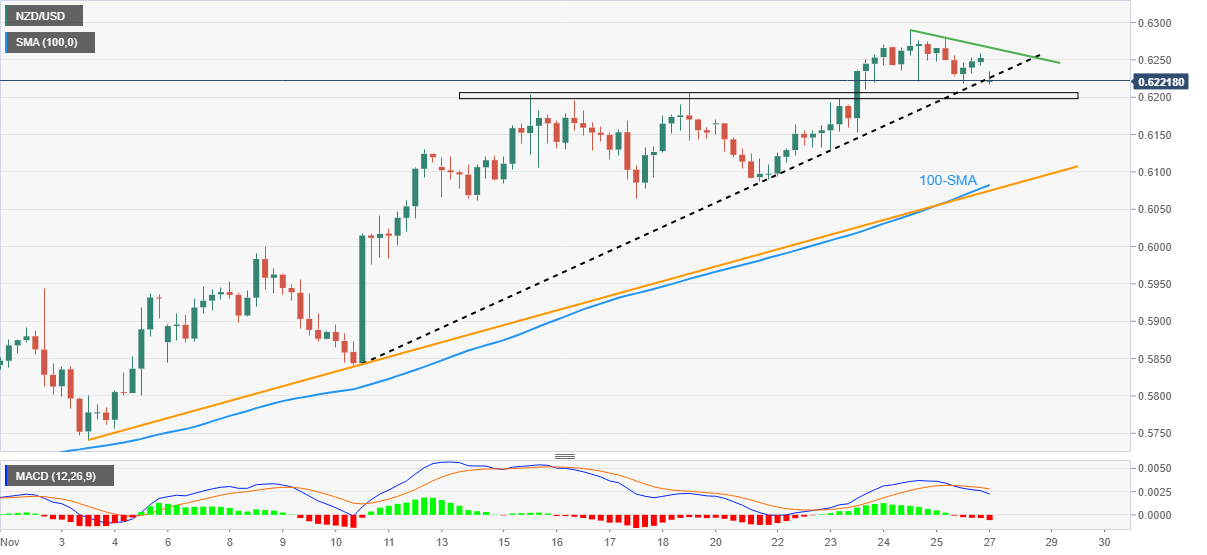
Trend: Further downside expected
-
23:10
AUD/USD slides towards 0.6700 on China Covid concerns, Aussie Retail Sales eyed
- AUD/USD faces barriers to extending the weekly gains.
- China reports record Coronavirus cases, witnesses civil disobedience in Shanghai, Beijing.
- Prospects of Fed’s easy rate hikes favor Aussie pair buyers even as RBA’s lacks hawkish moves.
- Australia’s Retail Sales, Inflation data and comments from RBA Governor Lowe, Fed Chair Powell can entertain traders pre-NFP.
AUD/USD witnesses hardships in stretching the weekly gains beyond 0.6750 as it begins the key week on a back foot around 0.6720.
Coronavirus fears in China joined the protest against the government’s Zero-Covid policy to add to the market’s woes. Additionally, the Reserve Bank of Australia’s (RBA) mixed comments and the Aussie pair trader’s anxiety ahead of the key data/events also challenge the AUD/USD bulls. Even so, concerns surrounding easy rate hikes from the US Federal Reserve (Fed) allowed the pair buyers to remain hopeful ahead of crucial data and events.
China reported an all-time high of COVID-19 daily cases with nearly 40,000 new infections on Saturday. The dragon nation has been using the stringent policy to limit the virus spread but the outcome hasn’t been a positive one so far. On the contrary, a deadly fire in a building was allegedly linked to the virus-linked lockdown measures and resulted in mass protests in Beijing and Shanghai.
Also negative for the AUD/USD pair could be the downbeat China data publishing this weekend. China’s Industrial Profit dropped to -3.0% during the January to October period versus -2.3% marked for the January-September era. Additionally, the record high growth in the US Black Friday online shopping also acts as a negative barrier for the AUD/USD prices.
It’s worth noting that the prospect of the Fed’s slower pace of interest rate hikes weighed on the US Dollar the previous week even if the Reserve Bank of Australia (RBA) officials appeared not too hawkish. Also positive could be the People’s Bank of China’s (PBOC) cutting of the Reserve Requirement Ratio (RRR) by 25 basis points (bps) effective from December 5.
Looking forward, Australia’s Retail Sales for October, expected 0.4% versus 0.6% prior, will act as an immediate catalyst for the AUD/USD pair. However, major attention will be given to the risk catalysts like the Covid headlines and rate concerns ahead of the nation’s recently initiated monthly inflation data, comments from RBA Governor Philip Lowe and Fed Chair Jerome Powell, as well as Friday’s US employment report for November.
Technical analysis
Despite the latest struggle, a convergence of the 100-Day Moving Average (DMA) and an upward-sloping support line from November 04, around 0.6690, restricts the short-term AUD/USD downside.
-
23:04
US Dollar is firm in a risk-off start to the week
- US Dollar bulls move in at the start of the week.
- Risk-off themes with China Covid dominates.
The US Dollar moved higher across the board on Friday in what was otherwise a quiet session following the US Thanksgiving holiday.
However, the greenback remained near multi-month lows on the prospect of the Federal Reserve moderating the pace of its policy tightening. With that being said, a risk-off start to the week could come of the protests in China and support the safe havens such as the US Dollar, yen and Treasuries.
Large violent, anti-government anti-lockdown protests have broken out in major Chinese cities. The BBC wrote that videos posted on social media appear to show hundreds of Wuhan residents taking to the streets, with some protesters pictured knocking down barricades and smashing metal gates.
US Dollar technical analysis
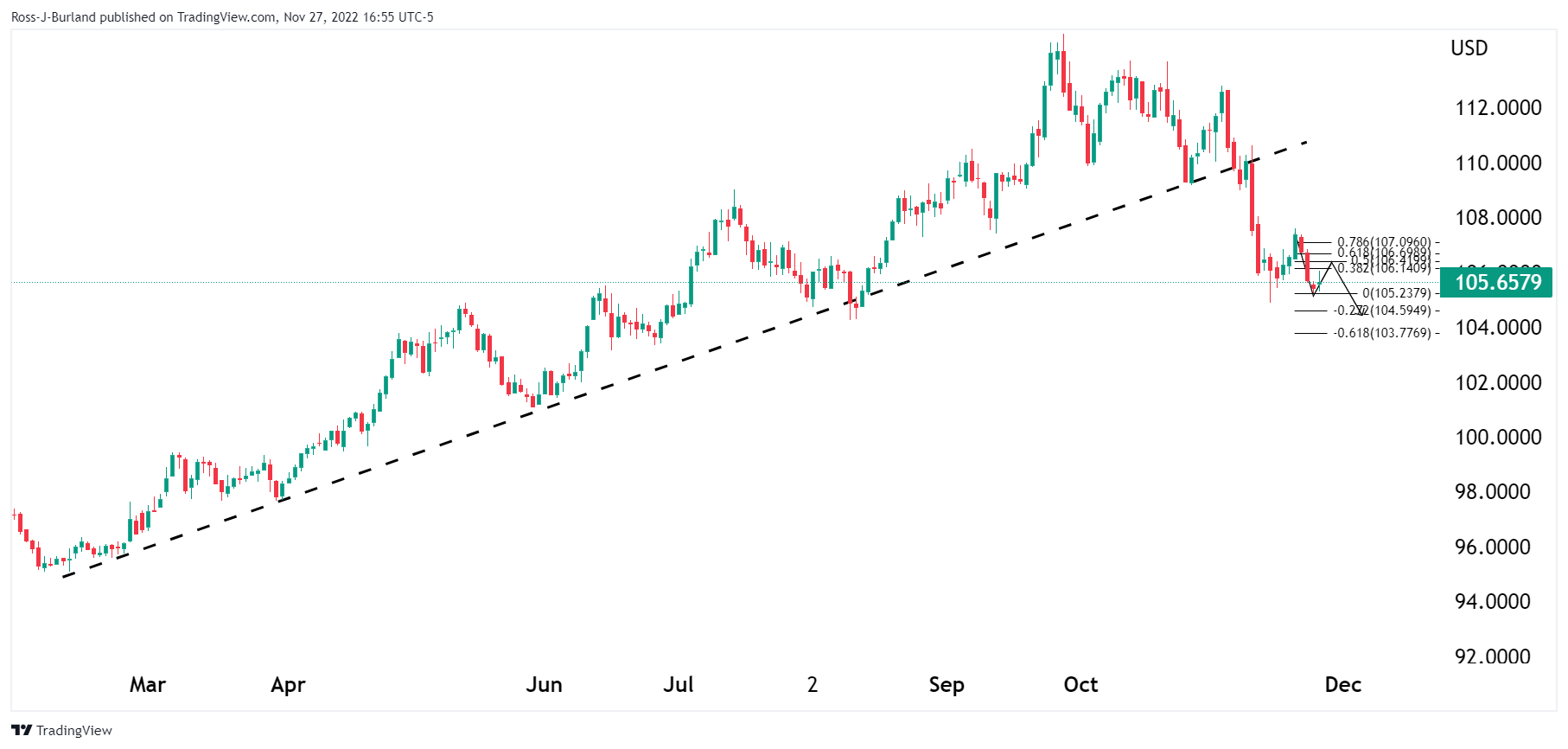
On the back side of the bullish trend, this price is making tracks to the downside. However, for the open, a bid in the US Dolar would be expected to see a deeper correction up the Fibonacci scale as follows:
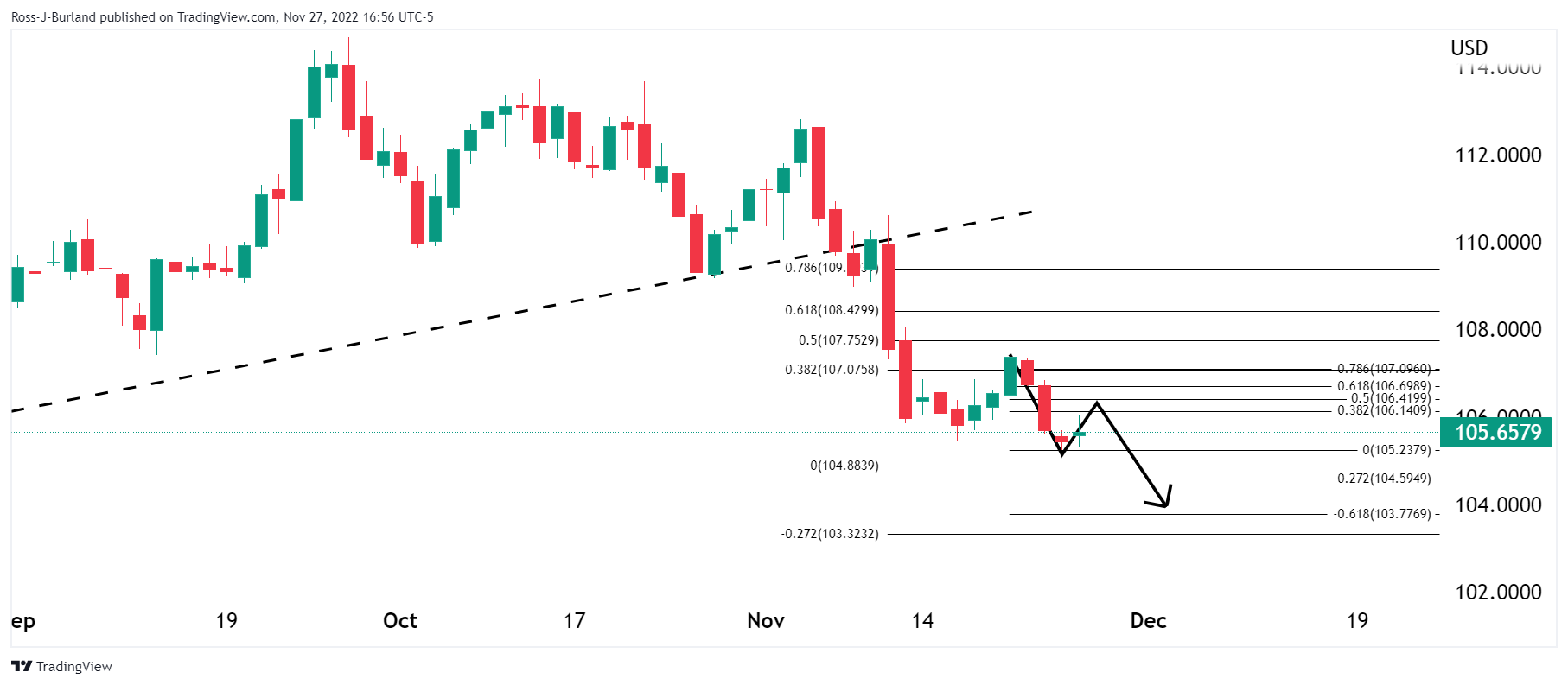
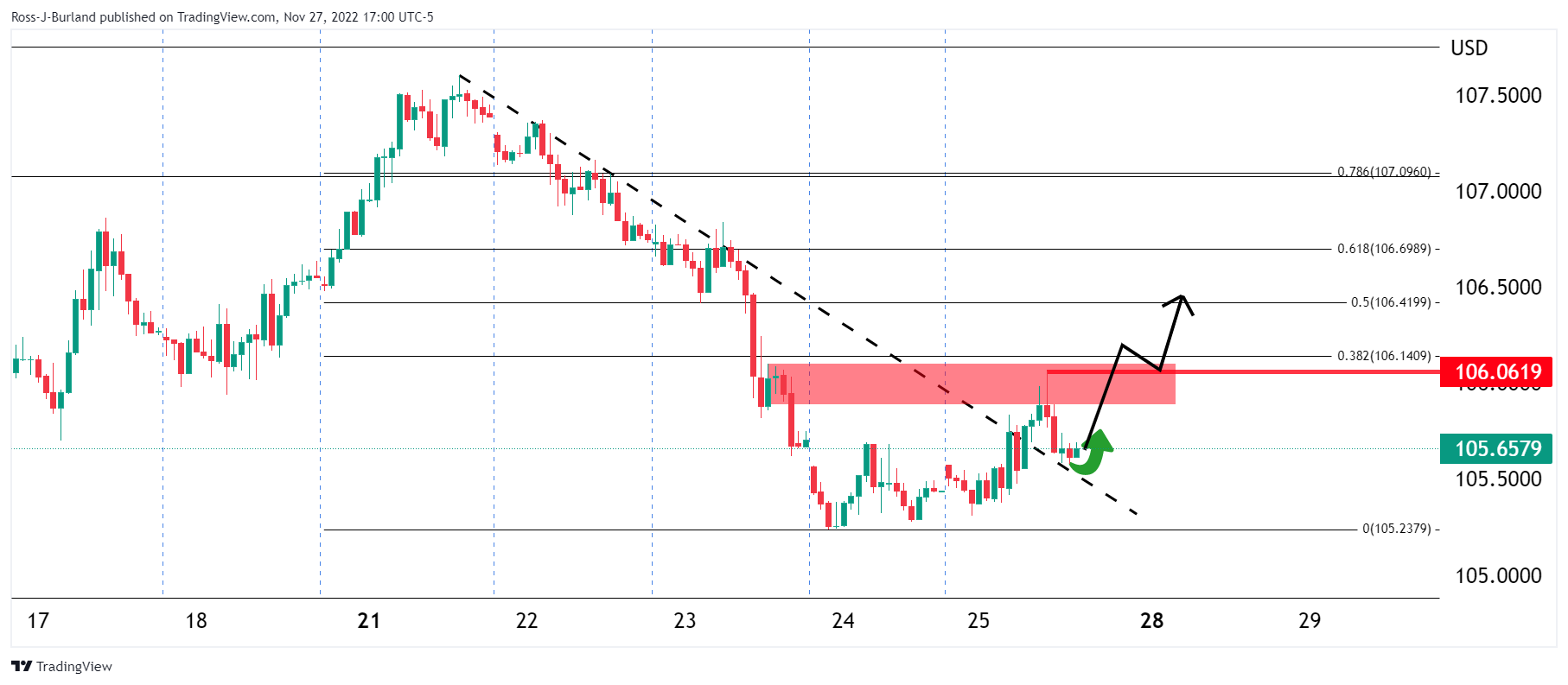
In doing so, the price could be expected to move in towards 106.50 on a break of resistance as per the following hourly chart:
-
22:59
Gold Price Forecast: XAU/USD holds gains above $1,750 as US GDP hogs limelight
- Gold price is aiming to shift its business above the immediate hurdle of $1,750.00.
- The US Dollar has sensed support around 106.00 amid a quiet market mood.
- The preliminary GDP for the third quarter is seen unchanged at 2.6%., however, a decline would delight the Fed.
Gold price (XAU/USD) is focusing on establishing above the critical resistance of $1,750.00 in the early Asian session after a solid recovery from $1,746.00 witnessed late Friday. Broadly, the precious metal is looking to recapture the three-and-a-half-month high at $1,786.54 amid a broader strength in market mood.
Global markets remained subdued on Friday amid the unavailability of a potential trigger that indicates a situation of volatility contraction. This week, the markets are expected to display some meaningful moves, therefore a power-pack performance is expected from various assets. Meanwhile, the US Dollar Index (DXY) has attempted a recovery after dropping to near 106.00. The 10-year US Treasury yields have failed to cross the critical hurdle of 3.70%.
Going forward, the US Gross Domestic Product (GDP) data will be of utmost importance. The preliminary GDP for the third quarter is seen unchanged at 2.6%. As the Federal Reserve (Fed) is utterly dedicated to bringing price stability, a slower growth rate is highly recommended. A spell of improvement in the growth rates will continue to keep reign into inflation as it indicates robust demand from individuals, which doesn’t lead to a decline in price growth by the manufacturers and service providers.
Gold technical analysis
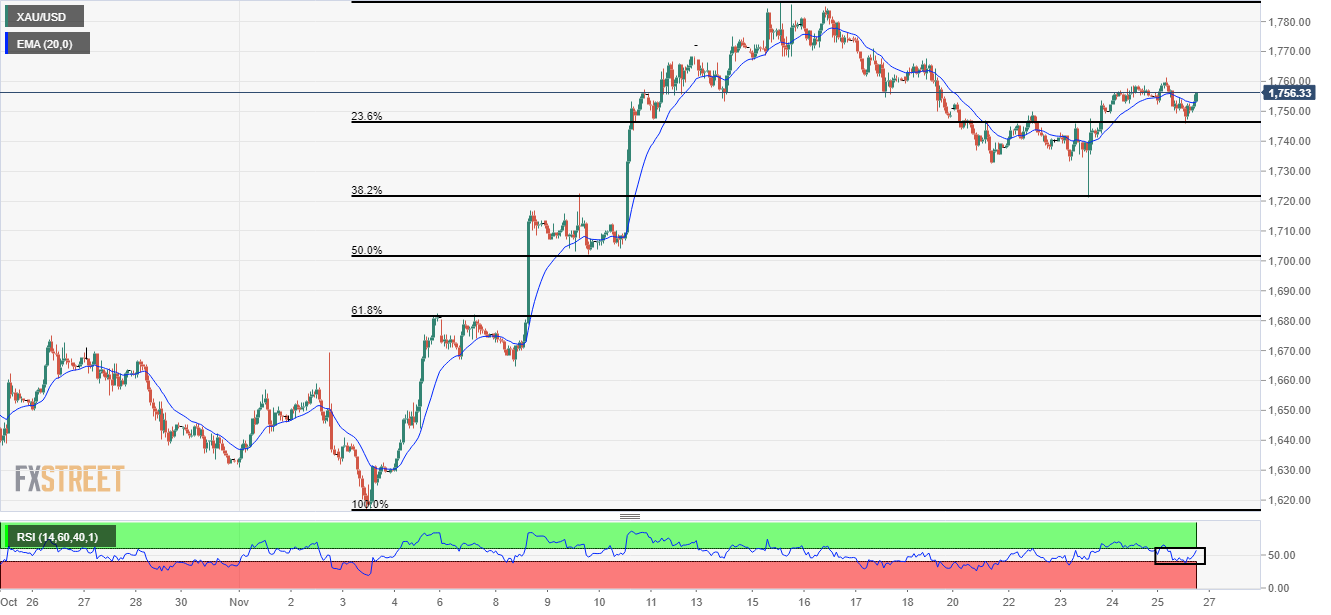
On an hourly scale, Gold price has displayed a steep recovery after testing the 38.2% Fibonacci retracement (plotted from November 3 low at $1,616.69 to November 15 high at $1,758.88) at $1,722.00 and has also crossed the 23.65 Fibo retracement at $1,746.50.
The precious metal has also crossed the 20-period Exponential Moving Average (EMA) at $1,753.17, which indicates that the short-term trend is solid again.
Meanwhile, the Relative Strength Index (RSI) (14) has rebounded after sensing support around 40.00, which signals that dips are explosively capitalized by the market participants.
Gold hourly chart
-
22:33
China Covid: Protests in major cities across the country make for a risk-off theme
In China, large violent, anti-government anti-lockdown protests have broken out in major Chinese cities. In the cities of Shanghai, Wuhan, Guangzhou and Beijing protesters were heard chanting ''down with XI''.
The BBC wrote that videos posted on social media appear to show hundreds of Wuhan residents taking to the streets, with some protesters pictured knocking down barricades and smashing metal gates. There are reports that the police were using billy clubs and gas against protesters.
In spite of the stringent measures, China's case numbers last week hit all-time records since the pandemic began. Such a risk-off theme could mean a stronger US dollar in the open which could be a weight for the yuan and the Australian Dollar and could be prompting investors to shift toward haven assets such as the yen and Treasuries. Rising risks may also weaken demand for stocks.
-
21:51
EUR/USD Price Analysis: Dynamic resistance is key for the opening sessions
- EUR/USD has been capped but bullish there are prospects while above 1.0300/1.0220.
- EUR/USD bulls need to get on the back side of the micro bearish trendline resistance.
EUR/USD remained close to the four-month high of 1.0481 touched in mid-November. For the week, the Euro was higher by 0.7% against the US Dollar that remains near multi-month lows on the prospects of the Federal Reserve moderating the pace of its policy tightening.
From a technical perspective, there could be some upside to come over the coming days on a break of 1.0450 while above 1.0220 as the following multi time frame analysis leans towards:
EUR/USD Weekly chart
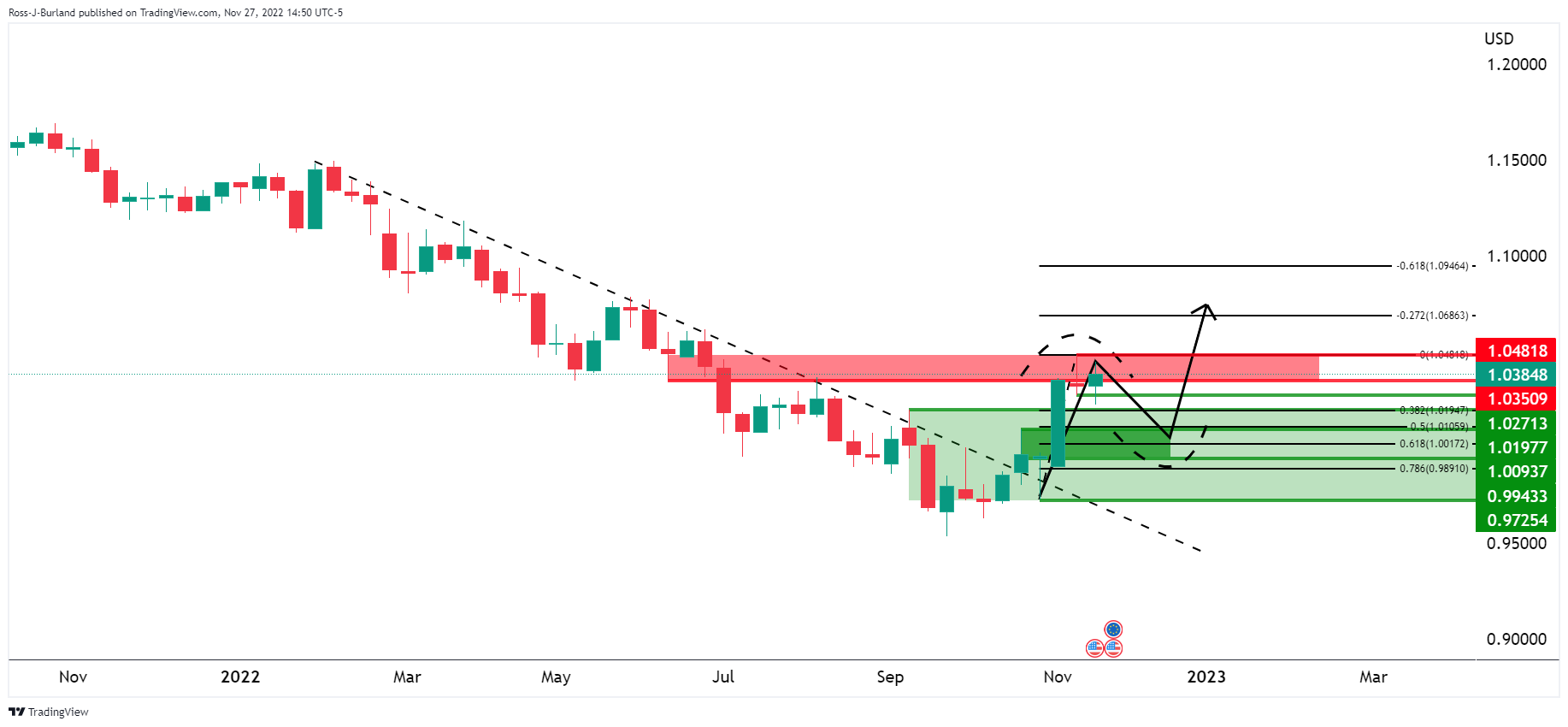
The weekly chart shows that a breakout could be immature and while below 1.0480, the bias is for a downside correction into the support structure. A 50% mean reversion comes in near 1.0050.
EUR/USD daily charts
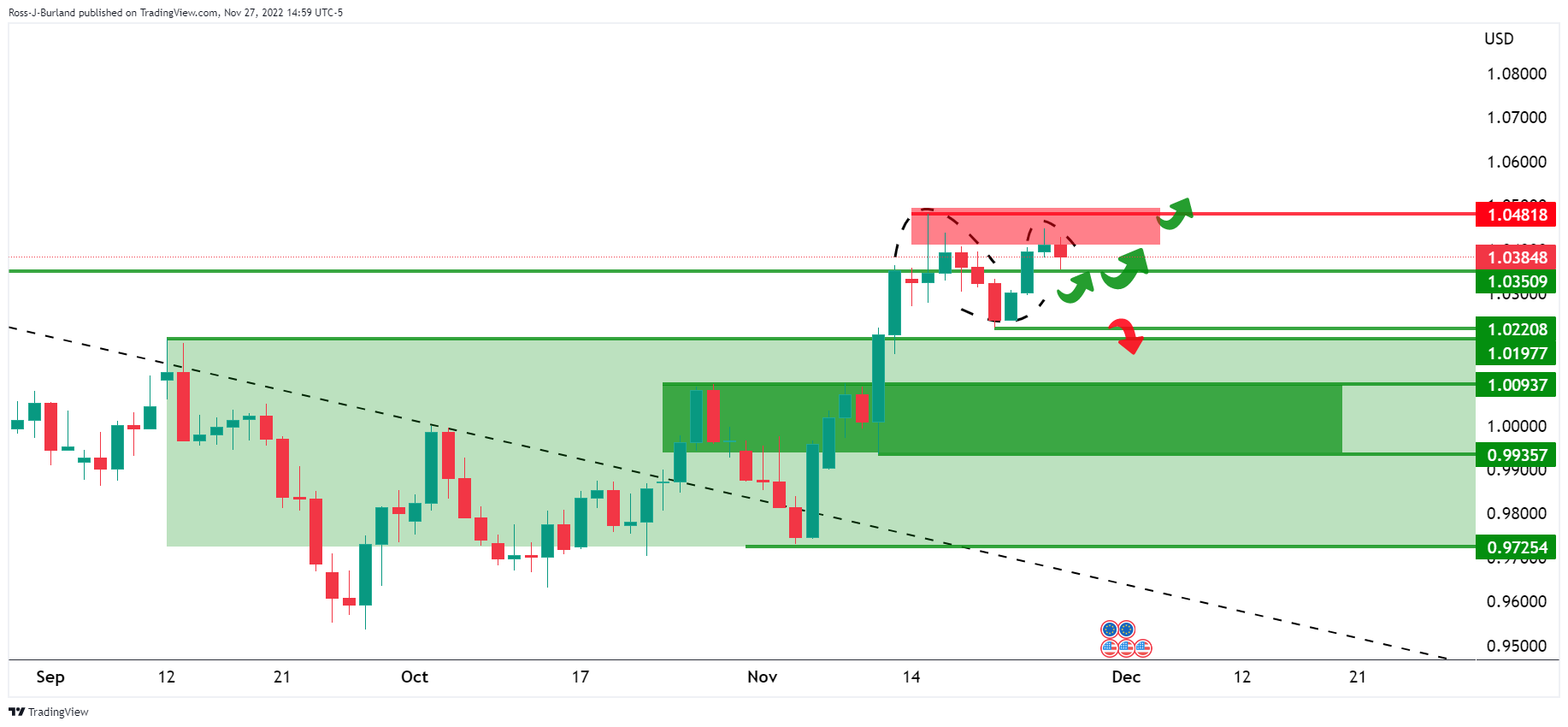
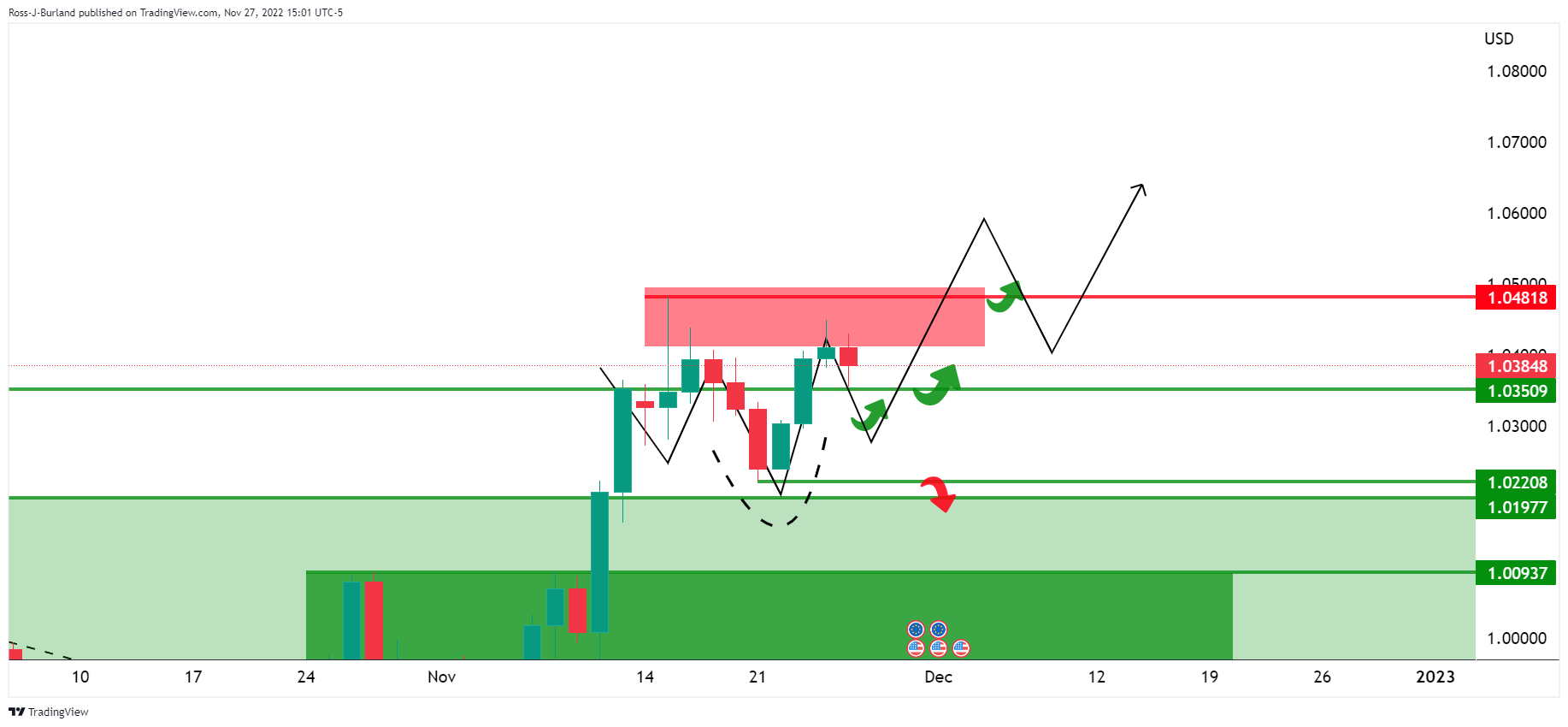
With that being said, an inverse head & shoulders could be in the making at this juncture. Bullish commitments around 1.0300/50 would be forming the right-hand shoulder of the bullish pattern. A Break of 1.0220, however, could likely leave the downside in favour.
AUD/USD H4 charts
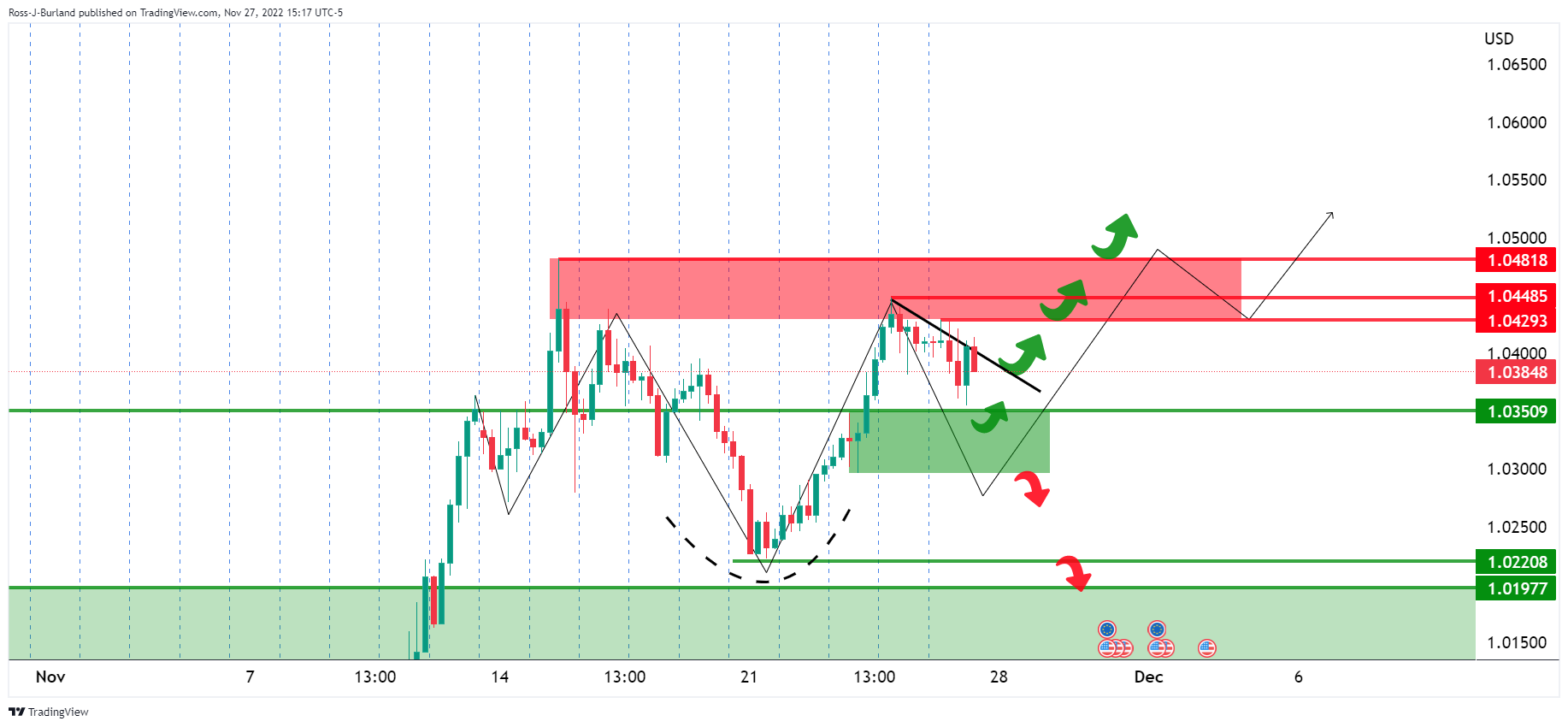
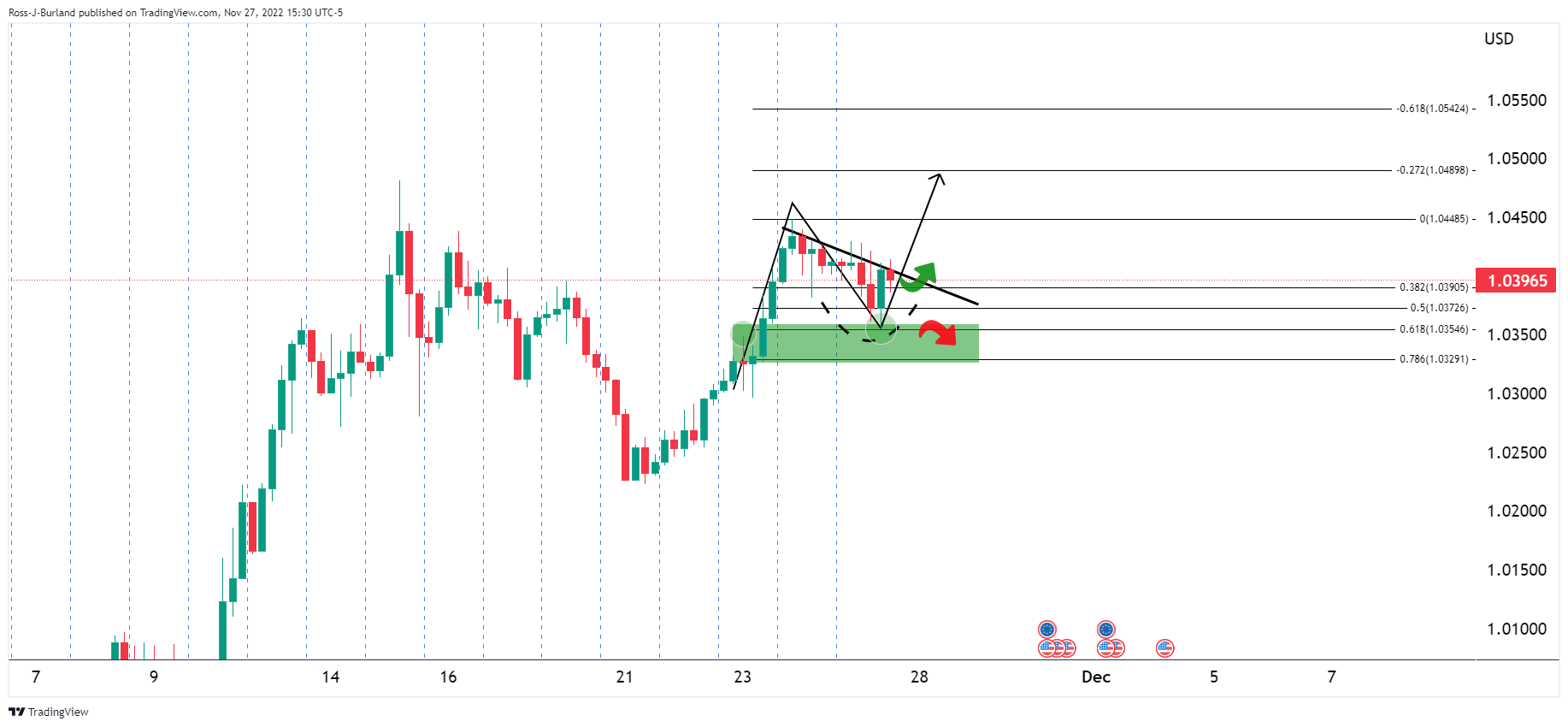
The bulls need to get on the back side of the micro bearish trendline resistance on the 4-hour and 1-hour charts:
EUR/USD H1 chart
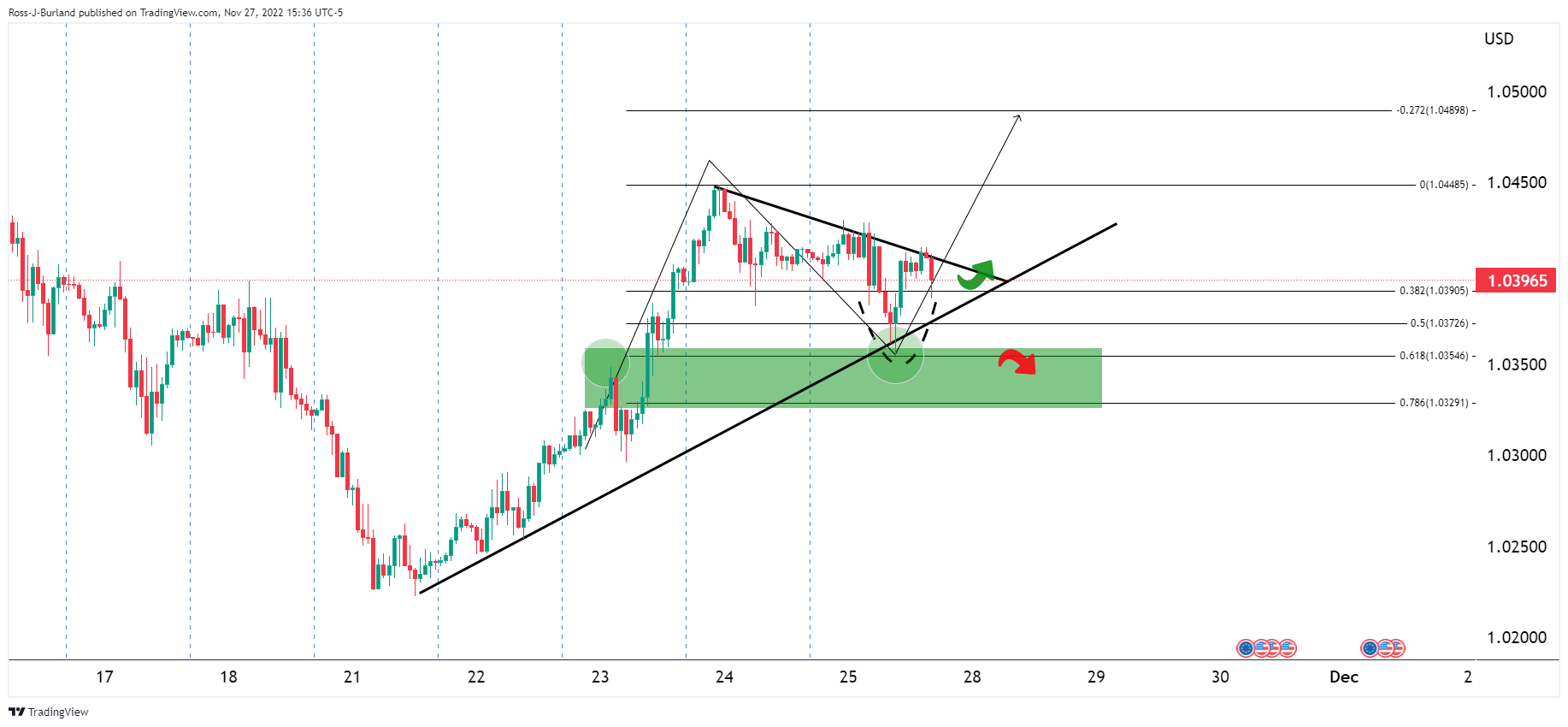
-
20:36
AUD/USD Price Analysis: Bulls could be tested at 0.6750 resistance
- AUD/USD bulls meeting M-formation neckline resistance.
- The bulls need to commit at the 0.6700 area if there is to be a retest to the downside.
As per the prior analysis, AUD/USD Price Analysis: Bulls eye 0.6900s into year-end, the bias remains to the upside for the week ahead while being on the front side of the bullish trendline. AUD/USD reached a high of 0.6778 but has so far failed to break resistance.
The following illustrates the bias for a move towards 0.6900 for an onward bullish cycle for the rest of the year.
AUD/USD prior analysis
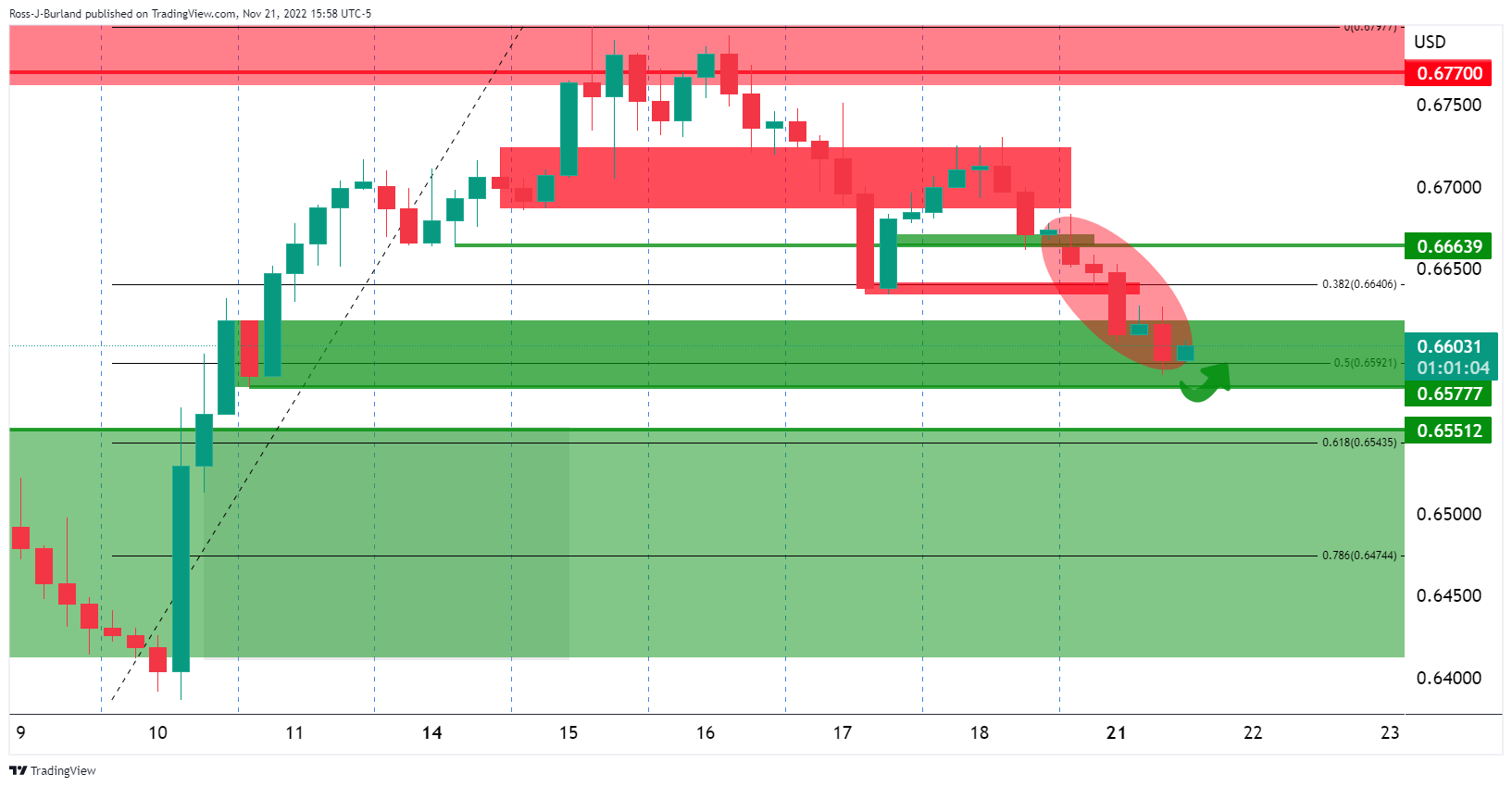
The four-hour chart showed the price meeting the 50% mean reversion of the following daily chart's prior bullish impulse:
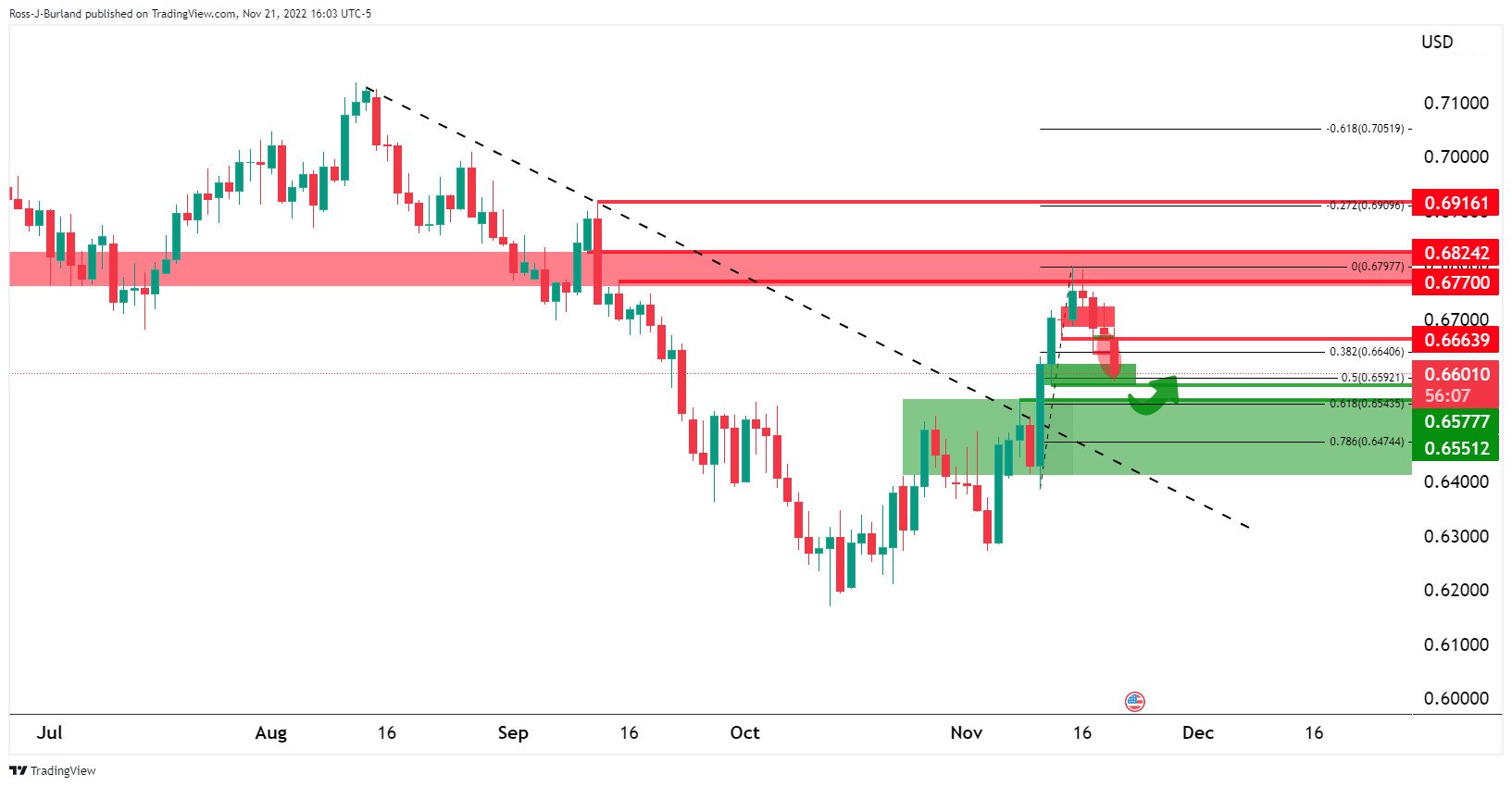
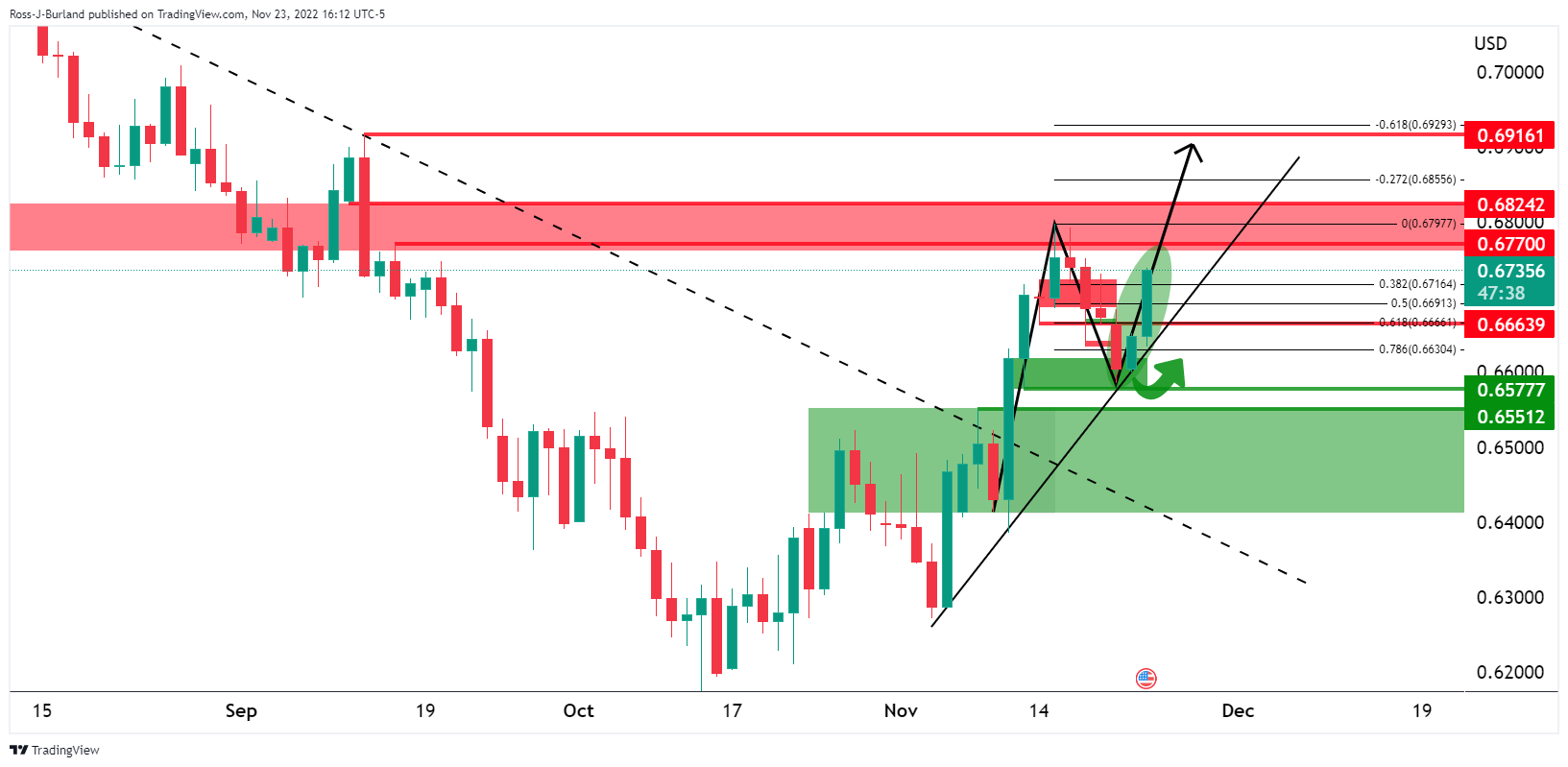
AUD/USD remains on the front side of the daily trendline with the 0.6900s eyed:
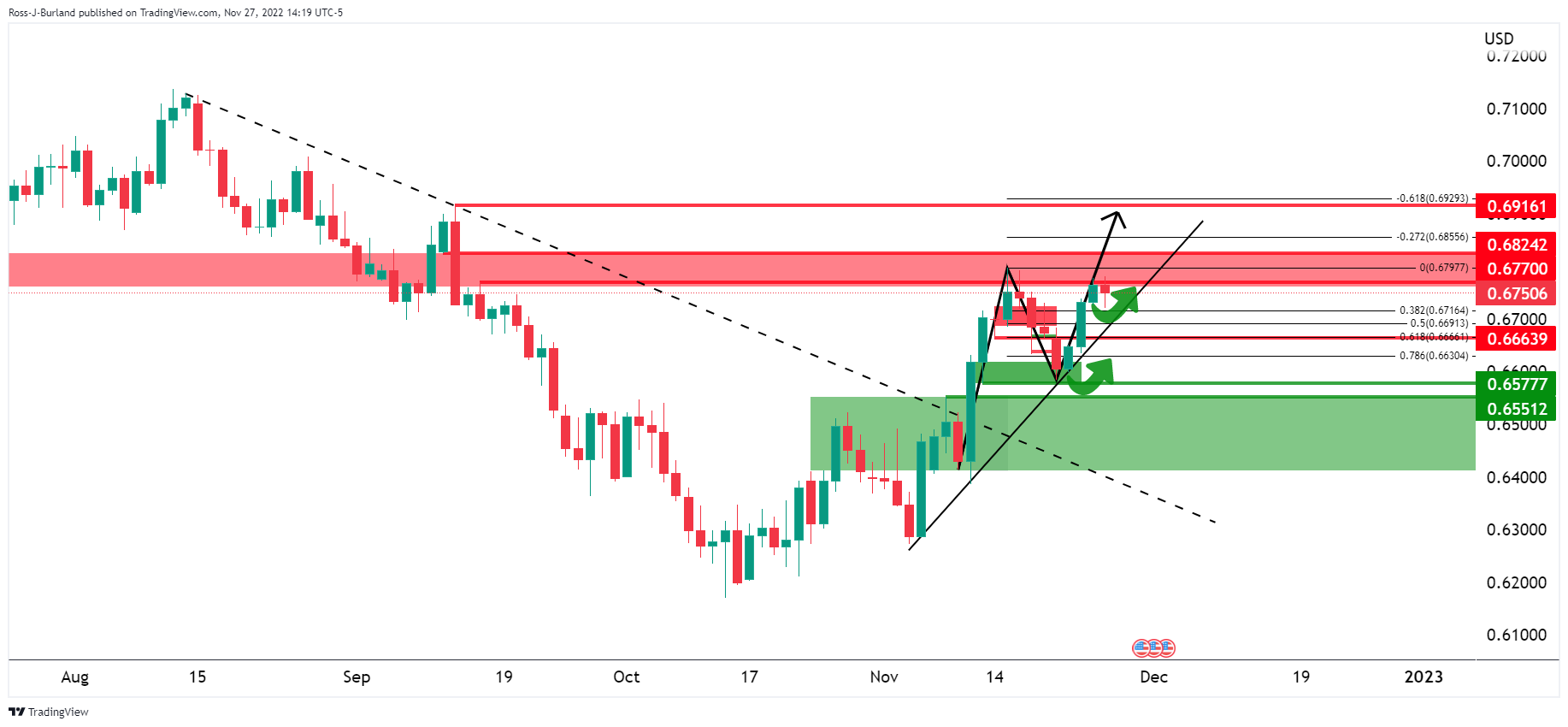
AUD/USD H4 chart
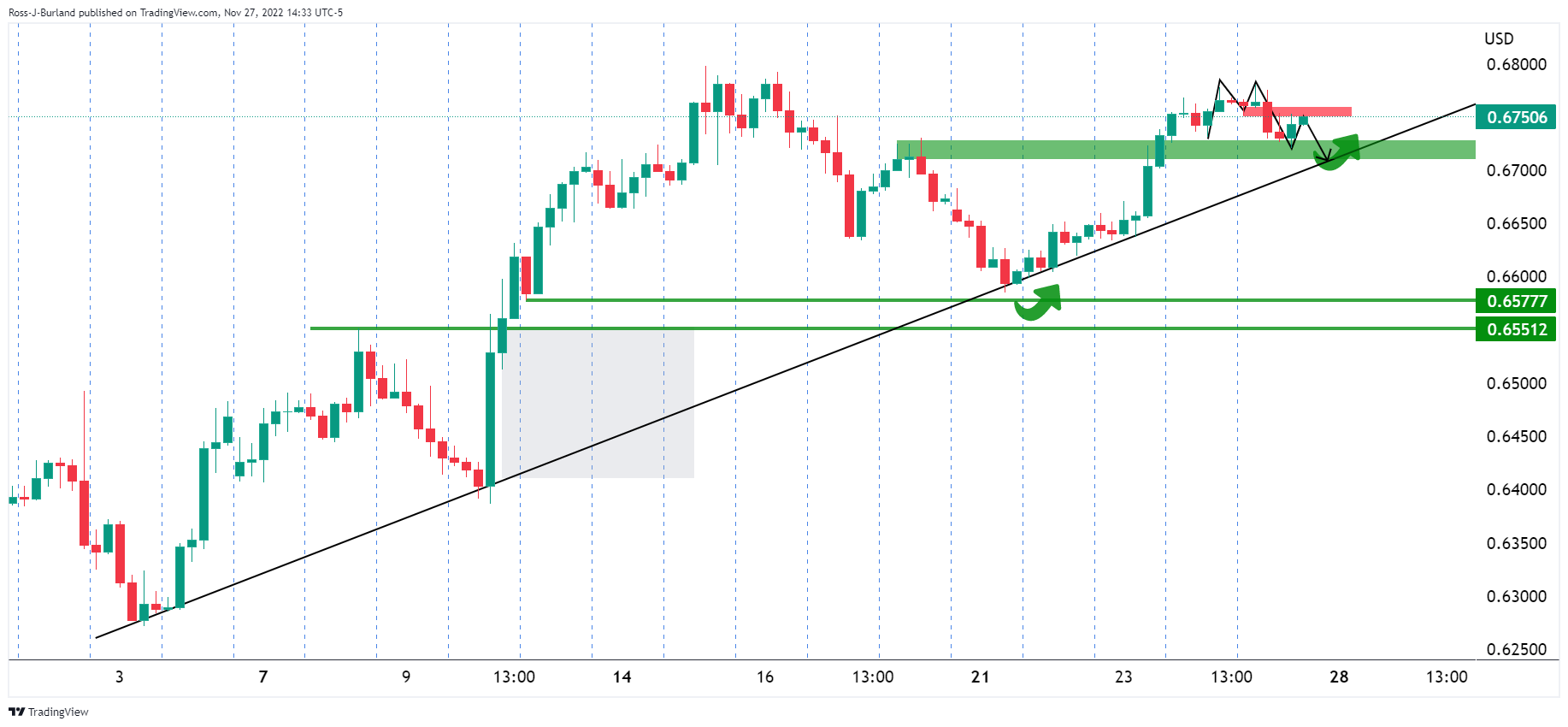
The bulls need to commit at the 0.6700 area if there is to be a retest to the downside following failures at 4-hour resistance near the neckline of the M-formation.
-
 Material posted here is solely for information purposes and reliance on this may lead to losses. Past performances are not a reliable indicator of future results. Please read our full disclaimer