- AUD/USD bears push the pair below 0.7400 and target the 50-DMA around 0.7330s
Market news
AUD/USD bears push the pair below 0.7400 and target the 50-DMA around 0.7330s
- The Australian dollar began the week on the wrong foot, down 0.64%.
- Geopolitics, a firm US dollar, and China’s mixed economic data weighed on the AUD.
- AUD/USD Price Forecast: Failure to reclaim 0.7500, to keep the pair downward pressured.
The Australian dollar extends its losses below the 0.7400 mark, battered by a dampened market mood courtesy of increased attacks of Russia on Ukraine, amid the failure of peace talks, as the Ukrainian Foreign Minister Kuleba expressed that discussions at the Ministry level had not happened in weeks. The AUD/USD is trading at 0.7346 at the time of writing.
Ukraine-Russia tussles, China’s economic data, and a firm US dollar keep the AUD pressured
Geopolitics keeps weighing on risk-sensitive currencies, like the Aussie. Also, mixed data from China, the second-largest worldwide economy and one of Australia’s biggest trading partners, reported that its economy grew for the Q1 by 4.8% y/y, higher than expected, but witnessed a contraction in consumption, as Retails Sales shrank 3.5% y/y, worse than the 1.6% decrease, a headwind for the AUD.
In the meantime, the US Dollar Index, a gauge of the greenback’s value against a basket of its rivals, is up 0.31%, sitting at 100.80, supported by expectations that the Federal Reserve would hike 50 bps at the May meeting.
In the meantime, Fed speaking propelled the prospects of the greenback. Last week, the New York Fed President John C. Williams (voter, neutral) stated that a 50 bps rate increase is a reasonable option, but the rate hikes will depend on the economy’s path. Williams added that the Fed needs to move “expeditiously” to normal policy levels and a more neutral.
- Also read: AUD/USD Weekly Forecast: Pressure mounts, but bulls are not giving up
Aside from this, the Australian economic docket would feature the release of the Reserve Bank of Australia (RBA) meeting minutes at 01:30 GMT, which would shed some light on raising interest rates. On the US front, Fed speaking led by St. Louis Fed President James Bullard will be crossing wires near the end of the New York session, and Chicago’s Fed President Charles Evans, on Tuesday.
AUD/USD Price Forecast: Technical outlook
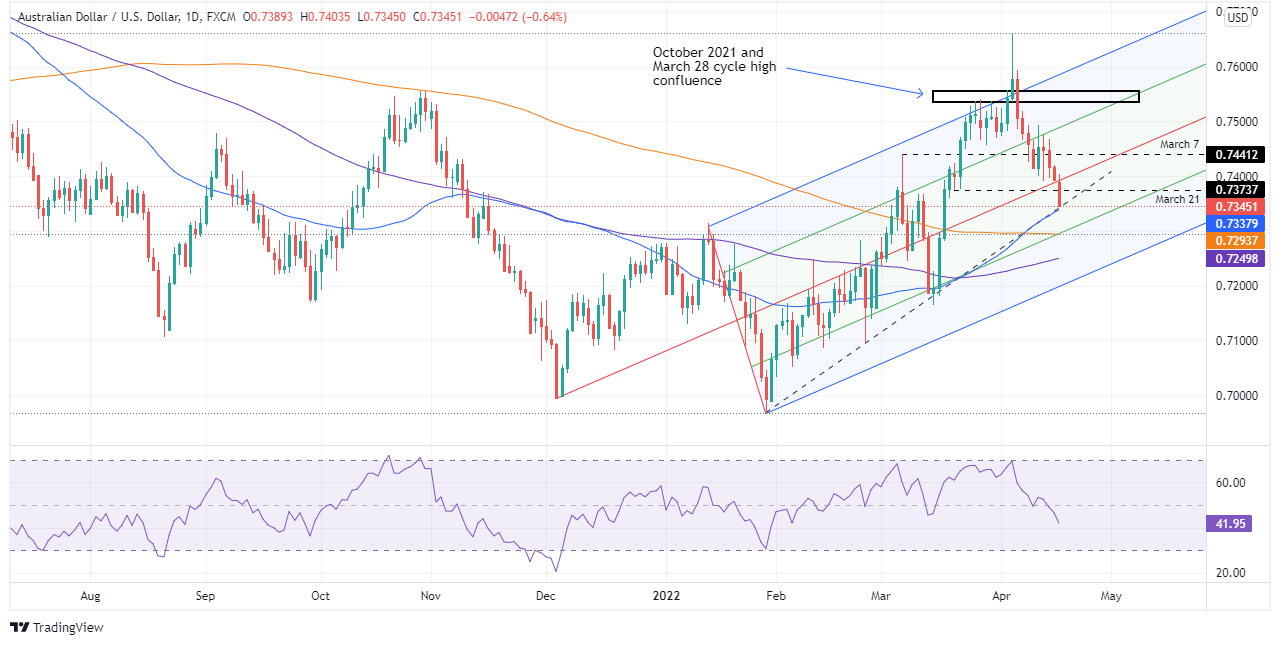
AUD/USD broke below Pitchfork’s central-parallel line around 0.7400, opening the door for further selling pressure, as the AUD/USD’s fall further extended towards the middle of the 0.73-0.74 range. At the same time, the Relative Strength Index (RSI) remains within the bearish territory at 42.54, aiming lower and with enough room before reaching oversold conditions. However, an upslope trendline that confluences with the 50-day moving average (DMA) lies around the 0.7330-40 area and would be complex support to overcome.
If that scenario plays out, the AUD/USD first support would be 0.7300. A brach of the latter would expose the 200-DMA at 0.7298 that intersects with the mid-line between the central/bottom. Pitchfork’s parallel lines, which once broken, would expose the 100-DMA at 0.7250.
 Material posted here is solely for information purposes and reliance on this may lead to losses. Past performances are not a reliable indicator of future results. Please read our full disclaimer