Noticias del mercado
-
18:20
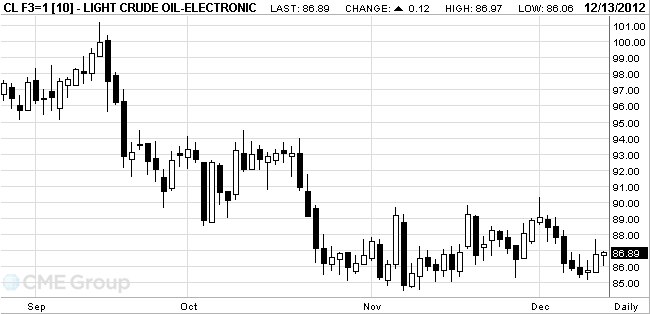
Oil fluctuated in New York
Oil fluctuated as U.S. retail sales rose less than expected in November and first-time claims for unemployment insurance declined to a nine-week low.
Prices were little changed as the Commerce Department said sales gained 0.3 percent last month. The median forecast of economists called for a 0.5 percent gain. Applications for jobless benefits fell to 343,000 in the week ended Dec. 8, the fewest since Oct. 6.
The gain in November’s retail sales followed a 0.3 percent decrease in October, Commerce Department data showed. Car sales jumped to a four-year high, in part because Americans in Hurricane Sandy’s path replaced damaged vehicles.
Last week’s jobless claims were less than the 369,000 economists had expected. The four-week moving average, a less-volatile measure of claims, decreased to 381,500 from 408,500.
Consumer confidence in the U.S. stagnated last week, showing a lack of improvement since October. The Bloomberg Consumer Comfort Index slipped to minus 34.5 in the period ended Dec. 9, the lowest level in six weeks.
The U.S., the world’s biggest oil-consuming country, used 18.8 million barrels a day in 2011, or 21 percent of the global total, according to BP Plc (BP/)’s Statistical Review of World Energy.
Investors also watched budget debates in Washington. Republicans have “some serious differences” with President Barack Obama’s budget proposals, House Speaker John Boehner said yesterday.
Crude for January delivery traded in a range of $86.06 - $86.97 a barrel on the New York Mercantile Exchange. Prices are down 12 percent this year.
Brent for January settlement on the London-based ICE Futures Europe exchange slid 57 cents, or 0.5 percent, to $108.93 a barrel.
-
17:20
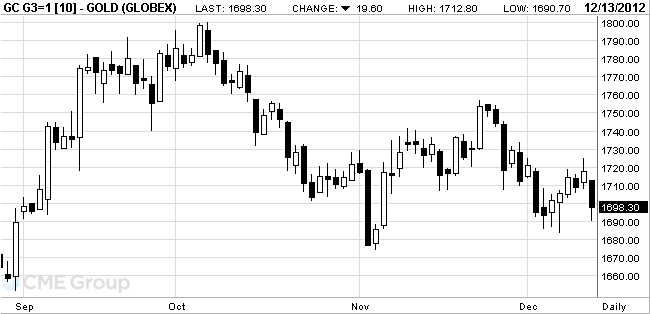
Gold fell
Gold prices on Thursday fell by more than 1% after the U.S. Federal Reserve on the eve of their policies linked to the level of unemployment. Gold futures ended the session on Wednesday, the highest level in more than a week after the Federal Reserve announced a new program of bond purchases, which, according to investors and analysts, can accelerate inflation.
Dollar rises on Thursday, as investors digested the news from the Federal Reserve and decided to take profits, eliminating the "short" dollar positions.
Virtually all indicators released today from the U.S. disappointed analysts, and only business inventories coincided with forecasts of economists, reaching 0.4%. In general, U.S. data was worse than expected: PPI (y / y) declined from 2.3% to 1.5% (forecast 1.8%), while retail sales (m / m) in November rose by 0.3% vs. 0 5%.
Investors paid attention to the eurozone leaders to take stock and analyze the achievements of the year. The ECB has recently landed the role of the supervisory authority over banks in the region, while Greece was approved the next tranche of € 34.4 billion French President Hollande praised Monti for his role in the fate of Italy and the contribution to the June summit. Merkel and Juncker also endorsed the decisions taken this week.
February futures price of gold on COMEX today fell to 1690.70 dollars per ounce.
-
07:22
Commodities. Daily history for Dec 12’2012:
Change % Change Last
Oil $86.75 -0.02 -0.02%
Gold $1,712.70 -5.20 -0.30%
-
 Material posted here is solely for information purposes and reliance on this may lead to losses. Past performances are not a reliable indicator of future results. Please read our full disclaimer