Notícias do Mercado
-
23:45
New Zealand Electronic Card Retail Sales (YoY) came in at 1.9%, below expectations (7.2%) in June
-
23:45
New Zealand Electronic Card Retail Sales (MoM) came in at 0.1% below forecasts (2.8%) in June
-
23:18
GBP/USD aims an establishment above 1.2050 as focus shifts to US inflation
- GBP/USD is expected to display more gains above 1.2050 ahead of US CPI.
- Lower Average Hourly Earnings and higher US CPI will bring a slump in the aggregate demand.
- Political turmoil in the UK economy has not strengthened the pound bears.
The GBP/USD pair is aiming northwards as the opening hour is displaying the strength of the pound bulls. The cable is expected to extend its gains after overstepping the critical hurdle of 1.2050 amid exhaustion in the US dollar index (DXY).
The DXY remained vulnerable on Friday as a failure to sustain near the 19-year high of 107.79 resulted in a steep fall. The DXY closed near the critical support of 106.84 and more downside is expected as lower Average Hourly Earnings are warranting a slump in the aggregate demand ahead.
A higher inflation rate in the US economy should be met by higher ‘paychecks’ by the households as lower earnings may force the households to cope with lower consumption and savings. This may result in lower aggregate demand by the households, which may result in lower Gross Domestic Product (GDP). The occurrence of the same will affect the US economy in a significant manner.
Going forward, investors’ focus will remain on the US Consumer Price Index (CPI), which is due on Wednesday. The US CPI is seen at 8.7%, higher than the prior print of 8.6% on an annual basis. However, the core CPI is seen lower at 5.7% vs. 6% recorded on a yearly basis.
On the pound front, the political turmoil has not strengthened the sterling bears. Former British Finance Minister Rishi Sunak, on Friday, showed his intentions of running in the contest to replace Prime Minister Boris Johnson. The news wires from the UK’s administration state that the ongoing stance of political instability won’t affect the progression of the Northern Ireland Protocol (NIP), as per Reuters.
-
22:42
AUD/USD sees upside above 0.6880 despite soaring hawkish Fed bets
- AUD/USD aims to establish above 0.6880 as the DXY may deliver a sluggish performance.
- The US NFP remained stronger however the Average Hourly Earnings have ruined the market sentiment.
- Aussie jobless rate may skid to 3.8% from the prior release of 3.9%.
The AUD/USD pair is attempting to cross the critical resistance of 0.6850 at the open as Friday’s exhaustion in the US dollar index (DXY) is expected to turn into a sluggish performance. The asset is aiming to for more gains and more upside will be warranted on overstepping the major hurdle of 0.6880.
The greenback bulls are expected to underperform despite the upbeat US Nonfarm Payrolls (NFP) data. The US economy added 372k jobs in June, significantly higher than the estimates of 268k but a little lower than the prior release of 384k. The Unemployment Rate remained in line with estimates and the prior print at 3.6%. No doubt, the outperformance of the US economy on the labor market front will empower the Federal Reserve (Fed) to announce extreme rate hikes with much less hesitation.
However, the catalyst which will hurt the US economy is the lower Average Hourly Earnings (AHE) recorded on Friday. On an annual basis, the economic data landed at 5.1%, higher than the estimates of 5% but lower than the former release of 5.3%. When the inflation rate is operating at a runaway pace, lower AHE is not lucrative for US households. Lower AHEs will hurt their paychecks vigorously in times of soaring price pressures. This may result in lower aggregate demand.
On the aussie front, investors are focusing on the employment data which will release on Thursday. The Employment Change is seen severely lower at 25k than the prior release of 60.6K. However, the Unemployment Rate will slip to 3.8% vs. 3.9% reported previously.
-
18:31
EUR/USD Price Analysis: Bulls are mounting up as US dollar runs into key monthly area
- EUR/USD bulls could be about to make their move.
- Traders are watching the US dollar for the start of the week and opening sessions.
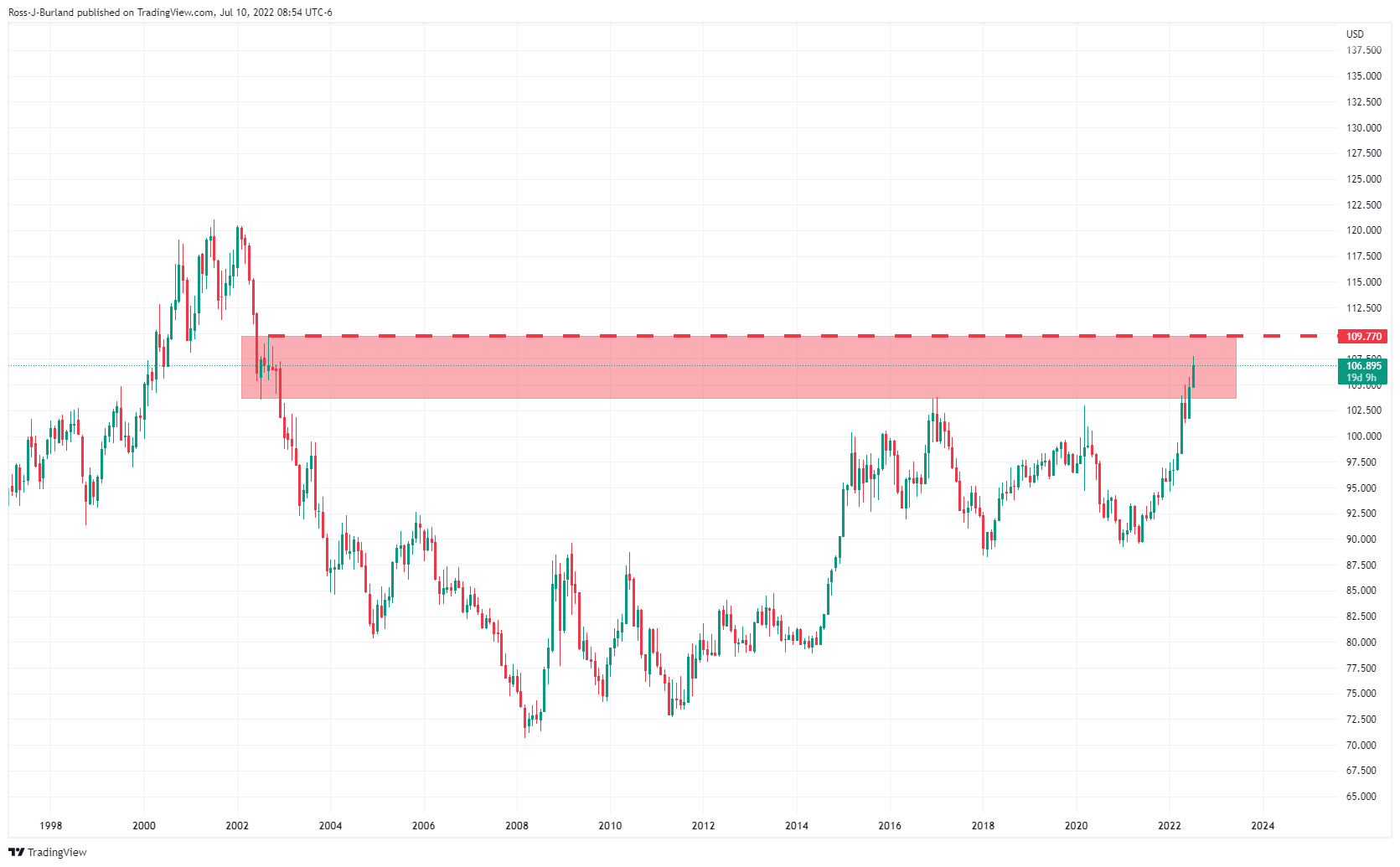
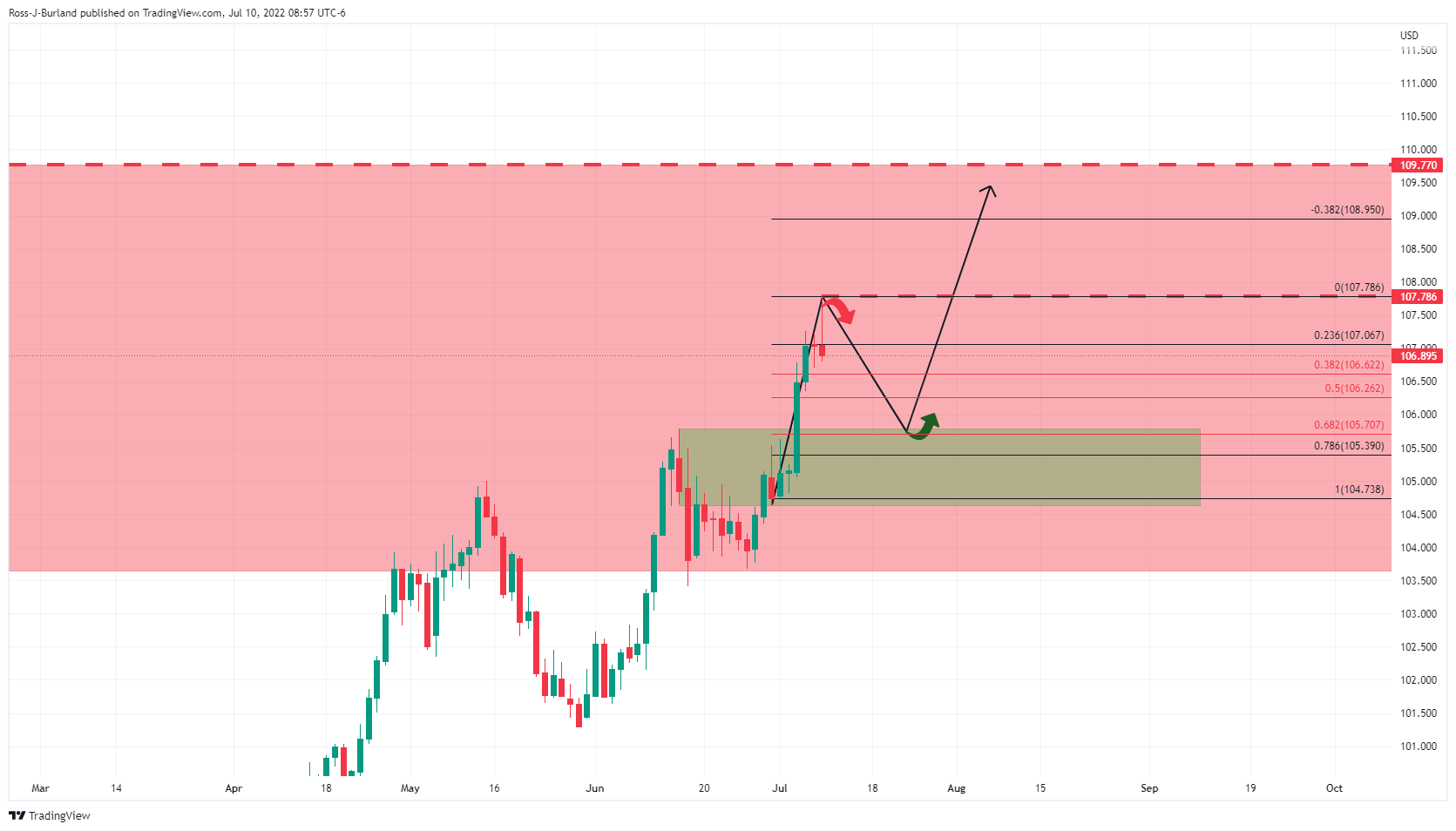
The euro could benefit at the start of the week so long as the greenback continues to correct to the downside. In the charts below, it is illustrated that the DXY is meeting a monthly supply area that could hold off the bulls for a moment giving a rise to prospects of a correction on the daily chart.
The DXY appears to top out near 107.80. A 61.8% Fibonacci retracement sits near prior swing highs near 105.70. If this were to play out, we would have had a bullish setup in the euro for the week ahead.
DXY monthly & daily chart
EUR/USD daily chart
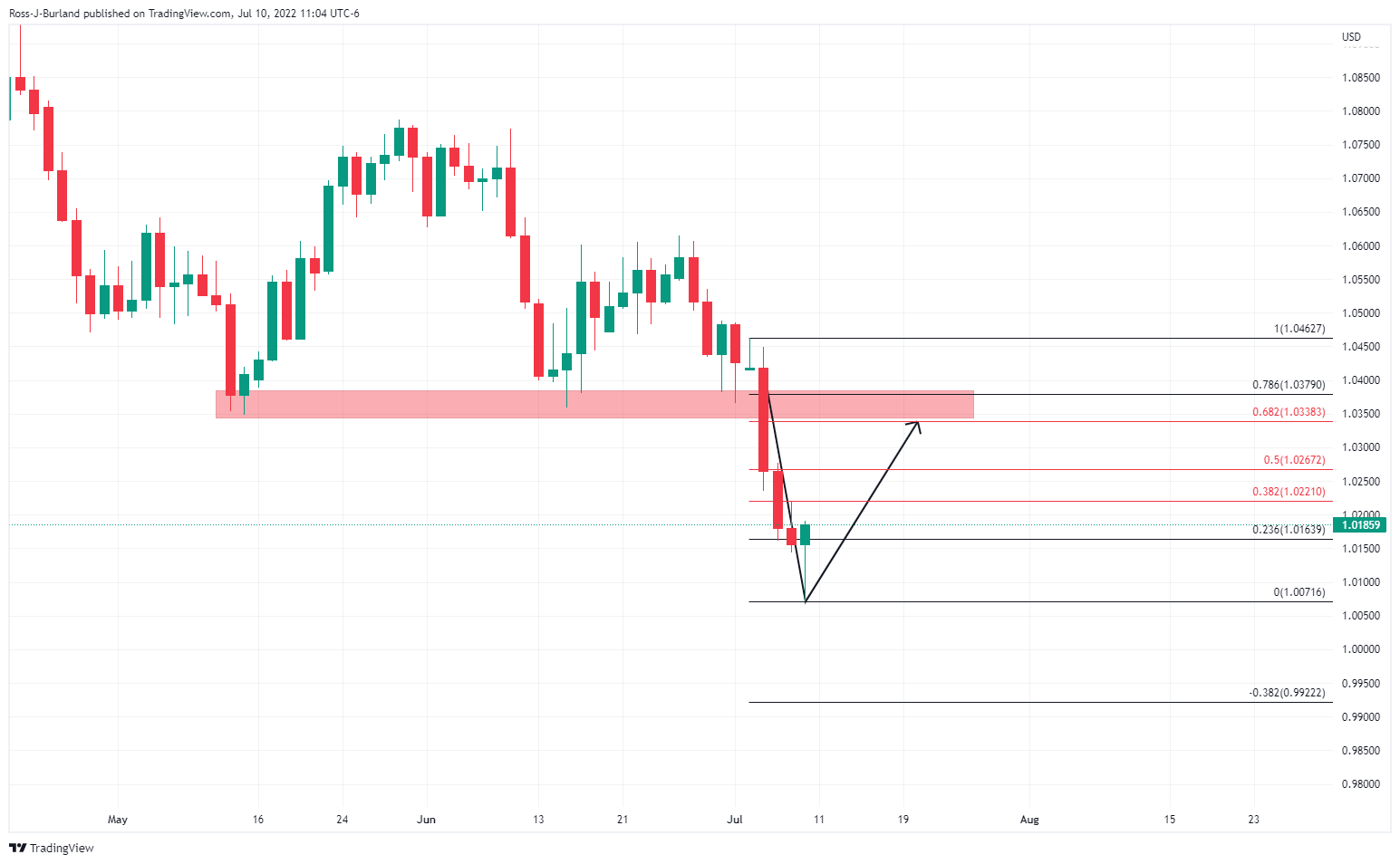
A move lower in the greenback will see the euro climb the Fibo scale, potentially all the way towards the prior lows that meets a 61.8% Fibo.
-
17:33
Japan ruling bloc wins upper house election
The Nikkei Asia has reported that Japan's ruling coalition won the majority of seats contested in Sunday's upper house election, with counting still ongoing in some districts.
''But while citizens validated Prime Minister Fumio Kishida's government, the mood among the victors was mostly joyless, as the vote came just two days after the assassination of former leader Shinzo Abe.''
''The ruling Liberal Democratic Party and its smaller partner Komeito together secured more than half the 125 available seats, according to Nikkei projections.''
In other news, the Japanese yen and the US dollar rose in Asia on Friday as investors leapt to safe assets after former Japanese prime minister Shinzo Abe was shot. Abe was shot on Friday while campaigning, a government spokesman said.
The yen fell nearly 16% on the dollar through the first half of 2022 but has lately found support on a safe haven bid and from the risk of a central bank policy shift.
-
16:51
Gold, the Chart of the Week: XAU/USD broke the mold but bulls are moving in
- Gold could be on the verge of a deeper correction to the upside.
- The US dollar is showing signs of topping out in the monthly supply area.
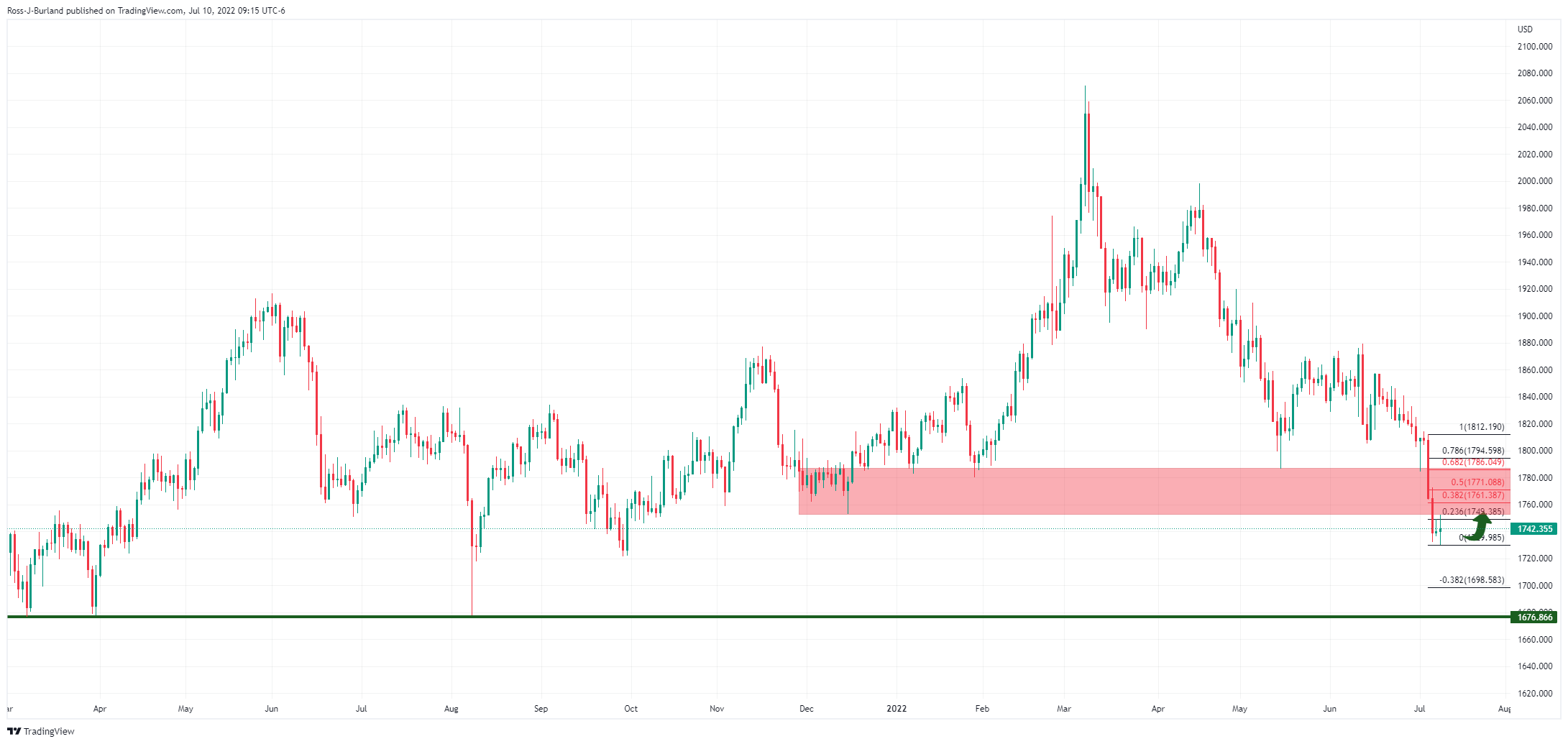
The gold price has corrected to a 23.6% Fibonacci retracement and has left two daily dojis on the charts but a stronger than expected US Services ISM and a solid US Labor report have seen the market add 14bp to end-2022 Fed Funds pricing.
This leaves the US dollar in charge and will keep pressure on gold which hovers above a fresh nine-month low as investors continue to slash their holding of the precious metal. Gold-backed ETFs have seen their holdings fall by 39t over the past week to their lowest level in almost four months.
Nevertheless, the spot market is attempting to correct both on the DXY and gold charts as follows:
DXY daily chart
The DXY is meeting a monthly supply area that could hold off the bulls for a moment giving rise to prospects of a correction on the daily chart as it appears to top out near 107.80. A 61.8% Fibonacci retracement sits near prior swing highs near 105.70. If this were to play out, we would have had a bullish setup in gold for the week ahead.
Gold daily chart
Gold, H4 chart
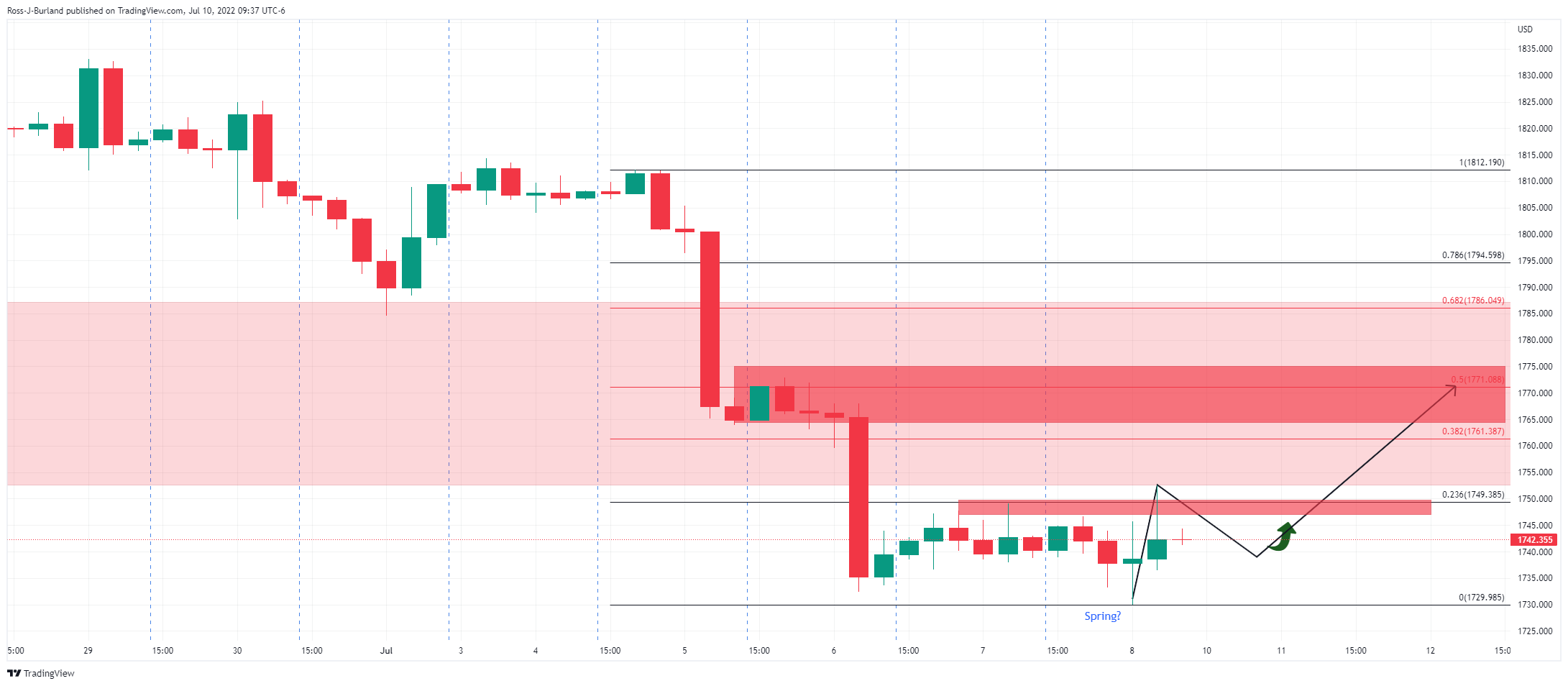
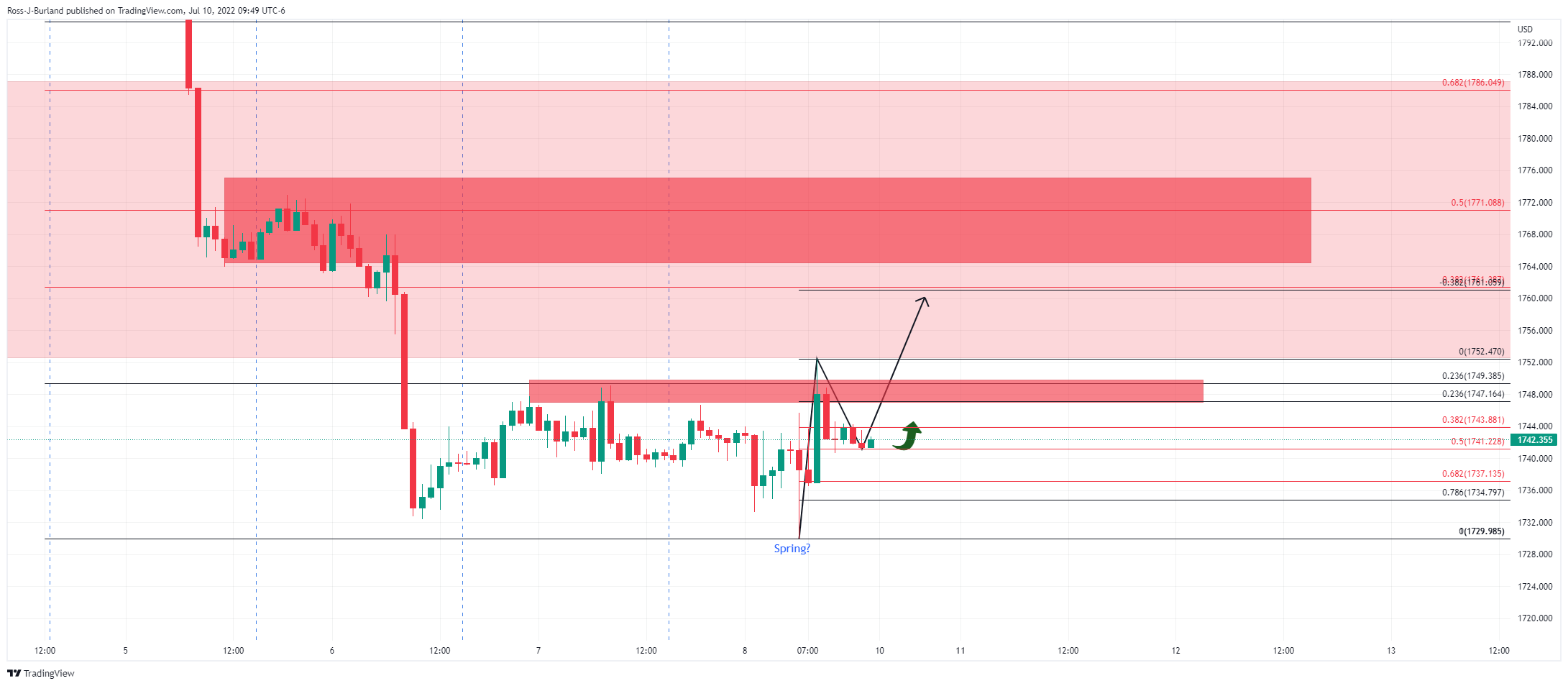
The question is whether the last low was the spring, otherwise known as the final test lower and commitments from the bulls. A break of $1,750 will be encouraging. On the hourly chart, we have seen a 50% mean reversion and retest of what could be the spring so a bullish open could set the stage for a significant bullish breakout as per the hourly chart:
-
 Material posted here is solely for information purposes and reliance on this may lead to losses. Past performances are not a reliable indicator of future results. Please read our full disclaimer