Notícias do Mercado
-
23:50
Japan: Trade Balance Total, bln, February 1109.8 (forecast 917.2)
-
22:30
Schedule for today, Wednesday, March 18, 2020
Time Country Event Period Previous value Forecast 10:00 Eurozone Trade balance unadjusted January 23.1 3.9 10:00 Eurozone Harmonized CPI ex EFAT, Y/Y February 1.1% 1.2% 10:00 Eurozone Harmonized CPI, Y/Y February 1.4% 1.2% 10:00 Eurozone Harmonized CPI February -1% 0.2% 12:30 U.S. Building Permits February 1.550 1.5 12:30 U.S. Housing Starts February 1.567 1.5 12:30 Canada Consumer Price Index m / m February 0.3% 0.4% 12:30 Canada Bank of Canada Consumer Price Index Core, y/y February 1.8% 1.7% 12:30 Canada Consumer price index, y/y February 2.4% 2.1% 14:30 U.S. Crude Oil Inventories March 7.664 2.933 18:00 U.S. FOMC Economic Projections 18:00 U.S. Fed Interest Rate Decision 0.25% 18:30 U.S. Federal Reserve Press Conference 21:45 New Zealand GDP y/y Quarter IV 2.3% 1.8% 21:45 New Zealand GDP q/q Quarter IV 0.7% 0.5% 23:30 Japan National CPI Ex-Fresh Food, y/y February 0.8% 0.6% 23:30 Japan National Consumer Price Index, y/y February 0.7% 0.8% -
21:45
New Zealand: Current Account , Quarter IV -2.657 (forecast -2.956)
-
19:50
Schedule for tomorrow, Wednesday, March 18, 2020
Time Country Event Period Previous value Forecast 10:00 Eurozone Trade balance unadjusted January 23.1 3.9 10:00 Eurozone Harmonized CPI ex EFAT, Y/Y February 1.1% 1.2% 10:00 Eurozone Harmonized CPI, Y/Y February 1.4% 1.2% 10:00 Eurozone Harmonized CPI February -1% 0.2% 12:30 U.S. Building Permits February 1.550 1.5 12:30 U.S. Housing Starts February 1.567 1.5 12:30 Canada Consumer Price Index m / m February 0.3% 0.4% 12:30 Canada Bank of Canada Consumer Price Index Core, y/y February 1.8% 1.7% 12:30 Canada Consumer price index, y/y February 2.4% 2.1% 14:30 U.S. Crude Oil Inventories March 7.664 2.933 18:00 U.S. FOMC Economic Projections 18:00 U.S. Fed Interest Rate Decision 0.25% 18:30 U.S. Federal Reserve Press Conference 21:45 New Zealand GDP y/y Quarter IV 2.3% 1.8% 21:45 New Zealand GDP q/q Quarter IV 0.7% 0.5% 23:30 Japan National CPI Ex-Fresh Food, y/y February 0.8% 0.6% 23:30 Japan National Consumer Price Index, y/y February 0.7% 0.8% -
19:02
DJIA +3.75% 20,945.70 +757.18 Nasdaq +5.02% 7,251.22 +346.63 S&P +4.77% 2,499.83 +113.70
-
17:00
European stocks closed: FTSE 100 5,283.12 +132.04 +2.56% DAX 8,939.10 +196.85 +2.25% CAC 40 3,991.78 +110.32 +2.84%
-
16:22
U.S. Treasury Secretary Mnuhcin: IRS will defer $300 billion in IRS payments
IRS will not charge interest and penalties on deferral for 90 days
We're looking at sending checks to workers immediately, within next two weeks
Corporations can defer tax payments of up to $10 million
Relief figures "may be bigger" than what's in the press ($1000)
Government wants to make sure fast-food drive-throughs stay open
Hopes stimulus legislation will help laid-off workers in hotel industry
We absolutely believe in keeping markets open
We may get to point where we shorten market trading hours
-
16:17
U.S. President Trump: Committed to getting small businesses support and flexibility
Says progress is being made on coronavirus response and testing procedures are going well
Telehealth services being expanded
Believes economy will come back very rapidly
Encouragies people to buy less; says stores will remain open
-
15:55
BoC: Governing Council stands ready to adjust policy further and to deploy other market tools, if required, to support economic growth and keep inflation on target
The Bank of Canada (BoC) issued a statement on its March 13 decision to reduce interest rates by 50 basis points.
In the statement, the Canadian central bank noted: "Although a revised staff projection was not yet available, it was evident to Governing Council that the disruptive impact of the coronavirus, along with the drop in oil prices, would in all likelihood justify some further easing of policy in the coming weeks. The economic consequences of the coronavirus itself will clearly have a major negative impact on the economy. Both the size and duration of this impact are unknown, but it was acknowledged that the effects should ultimately prove to be temporary. The impacts of the drop in oil prices are much more quantifiable and potentially more long-lasting. We recognized that maintaining the availability of credit to Canadian businesses and households is of the utmost importance in supporting the economy through a major temporary disruption of this nature. In this context, the discussion moved to the question of the appropriate timing of any further interest rate adjustments: waiting until our next fixed announcement date in mid-April, when we would also have a new staff projection; waiting for another move in global interest rates, thereby capitalizing on an international coordination effect, as we had done on March 4; or moving rates on Friday, thereby helping to create an even more powerful, domestically-coordinated policy package. After some discussion of the relative merits, Governing Council concluded that there could be considerable benefit to reducing interest rates immediately and significantly to complement the other measures supporting the functioning of credit markets."
-
15:39
Spain to allocate EUR 200 billion in virus aid - Bloomberg reports
Bloomber reports that Spain will allocate as much as 200 billion euros to offset the impact of coronavirus on the economy.
“These are exceptional circumstances that require exceptional measures,” the Spanish Prime Minister Pedro Sanchez said at a news conference Tuesday.
The government will also ensure the functioning of utilities and telecommunications services, among other policies, he added.
-
15:08
U.S. President Trump to hold press conference with COVID-19 task force today at 15:30 GMT
-
14:49
Fed to establish commercial paper lending facility to support the flow of credit to businesses
Fed announces the establishment of a Commercial Paper Funding Facility (CPFF) "to support the flow of credit to households and businesses".
- CPFF will provide liquidity backstop to U.S. issuers of commercial paper
- CPFF program is established by Fed under the authority of Section 13(3) of the Federal Reserve Act, with approval of U.S. Treasury Secretary
- U.S. Treasury will provide $10 billion of credit protection to Fed in connection with CPFF
- Pricing will be based on the then-current 3-month overnight index swap (OIS) rate plus 200 basis points
- Fed notes that commercial paper market has been under considerable strain in recent days as businesses and households face greater uncertainty in light of the coronavirus outbreak
-
14:41
U.S.: Federal regulators considering more changes to free up more bank liquidity, - CNBC reports, citing sources
The U.S. federal regulators are considering whether to relax liquidity rules on the nation's banks to help reduce pressure on them coming from the coronavirus pandemic, sources told CNBC on Tuesday.
The Office of the Comptroller of the Currency (OCC), which regulates banks and federal savings associations, is considering relaxing its 2013 rules on leveraged lending, the sources said.
-
14:37
NY Fed to conduct additional overnight repo operation for same-day settlement today
The Federal Reserve Bank of New York announced it would conduct an additional overnight repurchase agreement (repo) operation for same-day settlement today from 1:30 PM ET to 1:45 PM ET.
- This repo operation will be conducted for up to an aggregate offered amount of $500 billion with a minimum bid rate of 0.10 percent;
- All previously planned repo operations will be conducted as scheduled;
- This action is taken to ensure that the supply of reserves remains ample and to support the smooth functioning of short-term U.S. dollar funding markets
-
14:32
U.S. job openings increase in January, hires drop
The Job Openings and Labor Turnover Survey (JOLTS) published by the Labor Department on Tuesday revealed a 6.3 percent m-o-m advance in the U.S. job openings in January 2020 after a revised 3.5 percent m-o-m drop in December 2019.
According to the report, employers posted 6.963 million job openings in January, compared to the December figure of 6.552 million (revised from 6.423 million in original estimate) and economists' expectations of 6.476 million. The job openings rate was 4.4 percent in December, up from a revised 4.1 percent in the prior month. The report showed that job openings rose in finance and insurance (+65,000 jobs), federal government (+38,000), and mining and logging (+8,000). The job openings level increased for total private (+370,000) and edged up for government (+40,000).
Meanwhile, the number of hires fell by 1.7 percent m-o-m to 5.824 million in January from a revised 5.927 in December. The hiring rate edged down to 3.8 percent from 3.9 percent in December. The hires level was little changed in all industries.
The separation rate in January was 5.614 million or 3.7 percent, compared to 5.762 million or 3.8 percent in December. Within separations, the quits rate was 2.3 percent (flat m-o-m), and the layoffs rate was 1.1 percent (-0.1 pp m-o-m).
-
14:17
U.S. business inventories edge down 0.1 percent in January
The Commerce Department announced on Tuesday that business inventories edged down 0.1 percent m-o-m in January 2020, following a revised unchanged m-o-m in December 2019 (originally, a gain of 0.1 percent m-o-m).
That was in line with economists' forecast for a 0.1 percent m-o-m decrease.
According to the report, stocks at wholesalers fell 0.4 percent m-o-m in January, while those at manufacturers reduced 0.1 percent m-o-m, and retail inventories remained unchanged m-o-m.
In y-o-y terms, business inventories increased 1.1 percent in January.
-
14:07
U.S. builder confidence worsens slightly more than forecast in March
The National Association of Homebuilders (NAHB) announced on Tuesday its housing market index (HMI) fell two points to 72 in March from an unrevised February reading of 74.
Economists had forecast the HMI to drop to 73.
A reading over 50 indicates more builders view conditions as good than poor.
All three HMI components registered declines this month. The indicator gauging current sales conditions decreased two points to 79 in March, while the component measuring traffic of prospective buyers fell one point to 56 and the measure charting sales expectations dropped four points to 75.
NAHB Chairman Dean Mon noted: "Builder confidence remains solid, although sales expectations for the next six months dropped four points on economic uncertainty stemming from the coronavirus. Interest rates remain low, and a lack of inventory creates market opportunities for single-family builders."
Meanwhile, NAHB Chief Economist Robert Dietz said: "It is important to note that half of the builder responses in the March HMI were collected prior to March 4, so the recent stock market declines and the rising economic impact of the coronavirus will be reflected more in next month's report."
-
14:00
U.S.: JOLTs Job Openings, January 6.963 (forecast 6.476)
-
14:00
U.S.: Business inventories , January -0.1% (forecast -0.1%)
-
14:00
U.S.: NAHB Housing Market Index, March 72 (forecast 73)
-
13:59
China: Economic activity is expected to contract in Q1 – UOB
FXStreet reports that UOB Group’s Economist Ho Woei Chen sees the Chinese economic activity slipping back into the contraction territory in the January-March period.
“Chinese data in Jan-Feb including retail sales (-20.5% y/y vs Bloomberg est -4.0%), industrial production (-13.5% y/y vs Bloomberg est -3.0%) and fixed asset investment (-24.5% y/y vs Bloomberg est -2.0%) all recorded an unprecedented double-digit contraction. This is the first contraction for these economic data series. Meanwhile, the surveyed jobless rate jumped to 6.2% in Feb from 5.2% in Dec 2019, the highest on record.”
“Although the coronavirus (COVID-19) pandemic is expected to have a significant impact on China’s economy, the wide gap between the forecasts and actual data in the first two months of this year suggests that the GDP impact of the COVID-19 outbreak could be significantly larger than expected and a contraction in 1Q20 GDP is perhaps unavoidable. Further out, economic recovery in China may be hindered as the COVID-19 spread in Europe and the US continues unabated, dousing hopes for a sharper v-shaped rebound in growth.”
“Ahead of the 1Q20 GDP release on 17 April, we will get further data confirmation including the Purchasing Managers' Index (31 Mar), inflation (both CPI and PPI on 10 Apr) and trade (14 Apr) for March. Even with some recovery in these numbers, China’s economy is still headed for a contraction in 1Q20, the question is how deep the contraction will be. Based on Jan-Feb figures, we will further downgrade our growth forecast for China this year to 4.1% from 5.3% previously as we now expect 1Q20 GDP at -3.4% y/y, 2Q20 at 5.7% and then average 6.5% in the second half of the year. This brings 2020 to the worst year since 1990 when China registered GDP growth of just 3.9%.”
-
13:49
Fed could announce measures to support commercial paper market today - Media reports
-
13:43
U.S. industrial production increases more than anticipated in February
The Federal Reserve reported on Tuesday the U.S. industrial production rose 0.6 m-o-m in February, following a revised 0.5 percent m-o-m decline in January (originally a 0.3 percent m-o-m drop).
Economists had forecast industrial production would increase by 0.4 percent m-o-m in February.
According to the report, the February advance was due to a 7.1 percent m-o-m surge in output of utilities, which was attributable to a return of temperatures to more typical levels following an unseasonably warm January. In addition, manufacturing output edged up 0.1 percent m-o-m in February; however, excluding a large gain for motor vehicles and parts and a large drop for civilian aircraft, factory output was unchanged. The mining production fell 1.5 percent m-o-m in February.
Capacity utilization for the industrial sector increased 0.4 percentage point m-o-m in February to 77.0 percent. That was 0.1 percentage point below economists' forecast and 2.8 percentage points below its long-run (1972-2019) average.
In y-o-y terms, the industrial output was unchanged in February, following a revised 1.0 percent fall in the prior month (originally a 0.8 percent decline).
-
13:33
U.S. Stocks open: Dow +2.07%, Nasdaq +2.43%, S&P +2.40%
-
13:27
Before the bell: S&P futures +1.25%, NASDAQ futures +1.54%
U.S. stock-index futures surged on Tuesday, pointing to a bounce in the equity market following the biggest Wall Street rout in more than three decades in the previous session.
Global Stocks:
Index/commodity
Last
Today's Change, points
Today's Change, %
Nikkei
17,011.53
+9.49
+0.06%
Hang Seng
23,263.73
+200.16
+0.87%
Shanghai
2,779.64
-9.61
-0.34%
S&P/ASX
5,293.40
+291.40
+5.83%
FTSE
5,077.53
-73.55
-1.43%
CAC
3,850.90
-30.56
-0.79%
DAX
8,638.45
-103.80
-1.19%
Crude oil
$28.95
+0.87%
Gold
$1,485.90
-0.04%
-
13:15
U.S.: Industrial Production YoY , February 0%
-
13:15
U.S.: Industrial Production (MoM), February 0.6% (forecast 0.4%)
-
13:15
U.S.: Capacity Utilization, February 77% (forecast 77.1%)
-
13:08
Canada's most populous province - Ontario - closes all bars, restaurants and bans events of more than 50 people
-
13:06
Canada’s manufacturing sales fall less than forecast in January
Statistics Canada released its Monthly Survey of Manufacturing on Tuesday, which showed that the Canadian manufacturing sales fell 0.2 percent m-o-m in January 2020 to CAD56.10 billion, following an unrevised 0.7 percent m-o-m decline in December 2019.
Economists had forecast a 0.5 percent m-o-m decrease for January.
According to the survey, sales decreased in 9 of 21 industries, led by lower sales in the transportation equipment (-6.0 percent m-o-m) and petroleum and coal products (-5.2 percent m-o-m) industries. Meanwhile, sales rose in 12 industries, led by the food (+2.6 percent m-o-m), non-metallic mineral product (+15.7 percent m-o-m), machinery (+4.6 percent m-o-m) and fabricated metal product (+4.6 percent m-o-m) industries.
Overall, sales of durable goods industries declined 0.6 percent m-o-m in January, while sales of non-durable goods industries increased 0.2 percent m-o-m.
-
12:55
Wall Street. Stocks before the bell
(company / ticker / price / change ($/%) / volume)
3M Co
MMM
132.89
1.98(1.51%)
4283
ALCOA INC.
AA
7.11
0.29(4.25%)
19254
ALTRIA GROUP INC.
MO
38.55
0.33(0.86%)
23330
Amazon.com Inc., NASDAQ
AMZN
1,755.12
65.97(3.91%)
121395
American Express Co
AXP
87.18
1.31(1.53%)
16987
AMERICAN INTERNATIONAL GROUP
AIG
25.06
1.81(7.78%)
329
Apple Inc.
AAPL
247.81
5.60(2.31%)
694543
AT&T Inc
T
32.1
0.29(0.91%)
52368
Boeing Co
BA
132.99
3.38(2.61%)
202279
Caterpillar Inc
CAT
95.93
2.52(2.70%)
8523
Chevron Corp
CVX
70.5
0.80(1.15%)
24985
Cisco Systems Inc
CSCO
34.08
0.37(1.10%)
43950
Citigroup Inc., NYSE
C
42.03
0.84(2.04%)
62560
Deere & Company, NYSE
DE
122.1
2.05(1.71%)
674
E. I. du Pont de Nemours and Co
DD
34.52
0.27(0.79%)
7213
Exxon Mobil Corp
XOM
34.72
0.23(0.67%)
202905
Facebook, Inc.
FB
148.28
2.27(1.55%)
164307
FedEx Corporation, NYSE
FDX
92.8
2.31(2.55%)
7541
Ford Motor Co.
F
5.06
0.05(1.00%)
230038
Freeport-McMoRan Copper & Gold Inc., NYSE
FCX
6.35
0.11(1.76%)
57356
General Electric Co
GE
6.88
0.22(3.30%)
334870
General Motors Company, NYSE
GM
21.48
0.48(2.29%)
27690
Goldman Sachs
GS
158.01
3.35(2.17%)
10104
Google Inc.
GOOG
1,097.00
12.67(1.17%)
21520
Hewlett-Packard Co.
HPQ
14.85
0.39(2.70%)
15453
Home Depot Inc
HD
167.75
2.79(1.69%)
18872
Intel Corp
INTC
45.55
0.94(2.11%)
101567
International Business Machines Co...
IBM
101.57
2.49(2.51%)
18247
International Paper Company
IP
29.76
0.04(0.13%)
766
Johnson & Johnson
JNJ
128
0.87(0.68%)
10192
JPMorgan Chase and Co
JPM
90.24
1.88(2.13%)
84088
McDonald's Corp
MCD
149.97
0.96(0.64%)
8544
Merck & Co Inc
MRK
70.2
0.28(0.40%)
4394
Microsoft Corp
MSFT
138.12
2.70(1.99%)
504254
Nike
NKE
68.5
1.71(2.56%)
17501
Pfizer Inc
PFE
31.15
0.97(3.21%)
134914
Procter & Gamble Co
PG
111.01
2.51(2.31%)
21713
Starbucks Corporation, NASDAQ
SBUX
59.12
0.53(0.90%)
22853
Tesla Motors, Inc., NASDAQ
TSLA
440.2
-4.87(-1.09%)
374855
The Coca-Cola Co
KO
45.76
0.50(1.10%)
20994
Travelers Companies Inc
TRV
86.03
0.93(1.09%)
1602
Twitter, Inc., NYSE
TWTR
24.5
0.46(1.91%)
249228
United Technologies Corp
UTX
92.99
2.06(2.27%)
4757
UnitedHealth Group Inc
UNH
228.39
3.35(1.49%)
4668
Verizon Communications Inc
VZ
51.2
0.21(0.41%)
50980
Visa
V
156
3.99(2.62%)
33283
Wal-Mart Stores Inc
WMT
111.01
4.25(3.98%)
21454
Walt Disney Co
DIS
96.11
1.10(1.16%)
74403
Yandex N.V., NASDAQ
YNDX
30.91
0.11(0.36%)
11313
-
12:49
Upgrades before the market open
Bank of America (BAC) upgraded to Outperform from Neutral at Robert W. Baird; target $34
Walmart (WMT) upgraded to Outperform from Perform at Oppenheimer; target $125
Procter & Gamble (PG) upgraded to Buy from Hold at Deutsche Bank; target $130
-
12:49
U.S. retail sales unexpectedly decline in February
The Commerce Department announced on Tuesday the sales at U.S. retailers fell 0.5 percent m-o-m in February, following a revised 0.6 percent m-o-m advance in January (originally a 0.3 percent m-o-m gain). That was the largest decline in trade since December 2018.
Economists had expected total sales would increase 0.2 percent m-o-m in February.
Excluding auto, retail sales also dropped 0.4 percent m-o-m in February after a revised 0.6 percent m-o-m climb in the previous month (originally a 0.3 percent m-o-m advance), missing economists' forecast for a 0.2 percent m-o-m gain.
In y-o-y terms, the U.S. retail sales surged 4.3 percent in February, following a revised 5.0 jump in the previous month (originally a 4.4 percent increase).
-
12:41
European session review: EUR under pressure as coronavirus remains in spotlight
Time Country Event Period Previous value Forecast Actual 09:30 United Kingdom Average earnings ex bonuses, 3 m/y January 3.2% 3.2% 3.1% 09:30 United Kingdom Average Earnings, 3m/y January 2.9% 3% 3.1% 09:30 United Kingdom ILO Unemployment Rate January 3.8% 3.8% 3.9% 09:30 United Kingdom Claimant count February -0.2 21.4 17.3 10:00 Eurozone ZEW Economic Sentiment March 10.4 -49.5 10:00 Germany ZEW Survey - Economic Sentiment March 8.7 -26.4 -49.5 12:30 Canada Foreign Securities Purchases January -9.57 17.01 12:30 Canada Manufacturing Shipments (MoM) January -0.7% -0.5% -0.2% 12:30 U.S. Retail sales February 0.6% 0.2% -0.5% 12:30 U.S. Retail Sales YoY February 4.96% 4.35% 12:30 U.S. Retail sales excluding auto February 0.6% 0.2% -0.4% EUR fell against most major currencies in the European session on Tuesday, as investors continued to pile into safe havens as coronavirus pandemic remained in the spotlight.
Europe’s lockdown over the coronavirus continued to dominate headlines, along with government stimulus.
The French President Emmanuel Macron ordered people in France to stay at home for up to 15 days because of the coronavirus outbreak.
Meanwhile, Eurogroup's Chief, Mario Centeno, said that Eurozone finance ministers have agreed to spend 1% of GDP to battle the impact of the coronavirus. Elsewhere, the President of Germany's Public Health Agency assumed that the coronavirus pandemic will take two years to run its course.
Market participants digested the latest ZEW's survey, which revealed that Germany's economic confidence recorded its steepest drop on record in March, as global markets fear recession due to coronavirus outbreak. The ZEW Indicator of Economic Sentiment tumbled 58.2 points to -49.5 in March. That marked the biggest decline since the survey started in December 1991 and represented the lowest level since December 2011. Economists' had forecast the indicator to come in at -26.4.
A separate report from ZEW showed that economic sentiment in the broader Eurozone slumped 59.9 points from the previous month to -49.5 in March, also the lowest since December 2011.
-
12:32
Canada: Foreign Securities Purchases, January 17.01
-
12:31
U.S.: Retail Sales YoY, February 4.35%
-
12:31
Canada: Manufacturing Shipments (MoM), January -0.2% (forecast -0.5%)
-
12:30
U.S.: Retail sales excluding auto, February -0.4% (forecast 0.2%)
-
12:30
U.S.: Retail sales, February -0.5% (forecast 0.2%)
-
12:00
BoJ eased monetary conditions but kept rates on hold – UOB
FXStreet reports that senior economist at UOB Group Alvin Liew gives his views on the recent BoJ event.
“Following the footsteps of the Federal Reserve, the Bank of Japan (BOJ) brought forward its March monetary policy meeting (MPM) to Monday (16 Mar), replacing the regular review on 18/19 March. But it was of little effect as the BOJ announced that it will keep its short term and long term policy rates unchanged. It did ease a part of its monetary policy stance by doubling its purchases of exchange-traded funds (ETFs) and J-REITS to annualized paces of JPY12 trillion and JPY180 billion.”
“The BOJ’s decision to maintain its short term Policy-rate at -0.1%, keep JGB 10-year yield at 0%, the Yield Curve Control (YCC) measures and JGB purchases at annual pace of JPY80 trillion unchanged from its previous decision in January, was again not unanimous (7-2 vote).”
“As announced earlier by the Fed, the BOJ together with the central banks of Canada (BOC), UK (BOE), Eurozone (ECB), Switzerland (SNB) and the US (Fed) will provide ample US dollar funding, at a lower loan rate (by 0.25%) and offer US dollars on a weekly basis with an 84-day maturity. This is in addition to the 1-week maturity operations the BOJ currently offers.”
“Another new measure introduced by the BOJ (via a unanimous vote) was the Special Funds Supplying Operations to Facilitate Corporate Financing regarding the Novel Coronavirus (COVID-19). The BOJ will also increase the upper limit to buy commercial paper (CP) and corporate bonds by JPY2 trillion to the amounts outstanding of about JPY3.2 trillion and JPY4.2 trillion, with the additional buying continuing till End-Sep 2020.”
-
11:41
USD: Time for more cash-flow and confidence measures - ING
Chris Turner, Global Head of Markets and Regional Head of Research for UK & CEE at ING, notes that huge equity losses on Monday triggered another round of de-leveraging – this time in the commodity space (Platinum off 25%) and in popular unhedged positions in CE4 bond markets.
"The demand for dollar cash continued to see stress in the USD funding markets, where the 3m EUR cross currency basis swap briefly widened to -85bp. Today, however, there are hints of less panicked conditions starting to emerge."
"It was always going to take time for governments to organise fiscal rescue packages, not just to deal with the health emergency, but also to deal with the hole in aggregate demand. And we are now starting to see these come through."
"The major focus will be the US, where late yesterday Senate Democrat leader, Charles Schumer, said he would today be proposing a US$750 billion stimulus package – again worth around 4% of GDP."
"Markets will also be focusing on the USD funding markets again where eight of the largest US banks have said they’ll use the Fed’s discount window in order to de-stigmatise its use."
"Clearly it will take much to restore confidence – especially as Covid-19 cases rise over the next two to four weeks – but it seems as though politicians are finally stepping up to the plate."
"The dollar can hold onto its gains as markets understandably remain very fragile, but when the dust settles, we think the dollar will end up a little lower. DXY best levels may be 99-100."
-
11:31
Minneapolis Fed president Kashkari: Not much interest in rates below zero
- Airlines are easier for lawmakers to address
- Best case is people stay home for a few weeks, months
-
11:17
EUR/USD: Germany ZEW tumbles the euro – TDS
FXStreet notes that German data missed expectations and the EUR/USD is falling sharply, currently trading at 1.1050. Analysts at TD Securities detail the German ZEW survey numbers.
“The German ZEW survey came in far below expectations, with the Current Situation Index falling almost 30 points to -43.1 and the Expectations Index falling almost 60 points to -49.5.”
“Sharp declines were recorded across every sector in the survey with IT the only sector still in positive territory.”
-
11:00
India: Unclear duration of COVID-19’s impact on growth – ANZ
FXStreet reports that the nascent improvement in some demand and manufacturing indicators is increasingly being threatened by the COVID-19 outbreak. Analysts at ANZ Research details the next steps India must take. USD/INR trades at 74.218.
"With financial stress added in the mix, India faces a scenario of prolonged lower growth."
"Given the heightened risks of a sharp global slowdown, fiscal and monetary accommodation needs to be stepped up."
"We expect the Reserve Bank of India (RBI) to be at the forefront of fighting this slowdown with a 50bp reduction in the policy repo rate on or before their 3 April meeting."
"Inflation is unlikely to be a consideration in this environment."
-
10:59
US Treasury secretary Mnuchin reportedly to seek package of $850 billion or more in stimulus later today - Politico
The report says that US Treasury secretary, Steven Mnuchin, is to request a stimulus package of $850 billion or more later today, citing multiple sources involved with the matter.
-
10:39
Australia: 0.25% reduction in the cash rate expected – Westpac
FXStreet reports that the Board Minutes print to co-ordinated monetary and fiscal policy stimulus to address economic threat of COVID-19; more to come, according to analysts at Westpac Institutional Bank.
"The Minutes of the Monetary Policy Meeting of the Reserve Bank Board confirmed that the decision to lower the cash rate from 0.75% to 0.5% was driven by the Board's concern about the impact of COVID-19 on the Australian economy and the world economy."
"These Minutes provide further support to Westpac's view that a further 0.25% reduction in the cash rate can be expected. That is almost certain to be the effective lower bound for the cash rate as set out by the Governor in a speech on November 26th."
"The much awaited quantitative easing will also be announced. That policy will be targeted at the risk free yield curve effectively setting a price rather than nominating a quantity of purchases as has been used by the FOMC.
-
10:18
Economic Outlook for Germany and the Eurozone slumps in March - ZEW
According to the report from Leibniz Centre for European Economic Research (ZEW), in March, the Indicator of Economic Sentiment for Germany plunged by 58.2 points to -49.5 points, the largest drop since the survey was started in December 1991. The assessment of the economic situation in Germany has also worsened significantly compared to the previous month, with the corresponding indicator currently standing at minus 43.1 points, 27.4 points lower than in February. This combination of strongly negative values for the indicators of both the economic sentiment and the assessment of the current situation has only been witnessed once - during the financial crisis in autumn of 2008.
"The slump of the ZEW Indicator of Economic Sentiment was to be expected. The economy is on red alert. The financial market experts currently expect to see a decline in real gross domestic product in the first quarter, while also considering a further drop in the second quarter to be very likely. For the whole of 2020, the majority of experts currently expect a decline in real GDP growth of approximately one percentage point as a result of the corona pandemic," comments ZEW President Professor Achim Wambach.
With a decrease of 59.9 points, financial market experts' sentiment concerning the economic development of the eurozone worsens just as dramatically as that for Germany. The corresponding indicator currently stands at -49.5 points. The indicator for the current economic situation in the eurozone also experienced a sharp fall, dropping 38.2 points to a reading of minus 48.5 points compared to February.
-
10:02
Eurozone: ZEW Economic Sentiment, March -49.5
-
10:00
Germany: ZEW Survey - Economic Sentiment, March -49.5 (forecast -26.4)
-
09:44
The UK unemployment rate unexpectedly rose in January - ONS
According to the report from Office for National Statistics, the UK unemployment rate in the three months to January 2020 was estimated at 3.9%, largely unchanged compared with a year earlier and 0.2 percentage points higher than the previous quarter. Unemployment was expected to be 3.8%.
The UK employment rate in the three months to January 2020 was estimated at a joint record high of 76.5%, 0.4 percentage points higher than a year earlier and 0.3 percentage points up on the previous quarter.
Estimated annual growth in average weekly earnings for employees in Great Britain in the three months to January 2020 was 3.1% for both total pay (including bonuses) and regular pay (excluding bonuses).
In real terms (after adjusting for inflation), annual growth in both total pay and regular pay is estimated to be 1.5% in the three months to January 2020, down from a recent peak of 2.0% in the three months to June 2019.
In real terms (after adjusting for inflation), annual growth in total pay is estimated to be 1.4% and annual growth in regular pay is estimated to be 1.8% in the three months to January 2020.
There were an estimated 817,000 vacancies in the UK for December 2019 to February 2020; this is 19,000 more than the previous quarter but 30,000 fewer than a year earlier.
-
09:30
United Kingdom: ILO Unemployment Rate, January 3.9% (forecast 3.8%)
-
09:30
United Kingdom: Average earnings ex bonuses, 3 m/y, January 3.1% (forecast 3.2%)
-
09:30
United Kingdom: Average Earnings, 3m/y , January 3.1% (forecast 3%)
-
09:30
United Kingdom: Claimant count , February 17.3 (forecast 21.4)
-
09:18
British Chancellor Rishi Sunak is set to reveal “significant” additional economic aid for businesses hit by the prime minister’s warning to stay at home, such as pubs, clubs and theatres
-
09:17
France's Le Maire: May extend short-selling ban, possibly up to a month
-
09:15
Oil: Brent price forecast lowered – Standard Chartered
FXStreet reports that analysts at Standard Chartered Bank revise GCC macroeconomic forecasts following collapse of the OPEC+ agreement. Brent Oil is trading at $31.17/bbl.
"We recently lowered our Brent oil price forecasts for 2020 by USD 29/bbl to USD 35/bbl."
"We have significantly raised our headline GDP growth forecasts for Saudi Arabia, and to a lesser extent the UAE, as these countries scale up crude production sharply. This should support oil-sector growth, near-term."
"Sustained oil price weakness (our base case) may worsen GCC twin balances significantly, raising sovereign financing requirements."
-
09:00
EUR/CHF: Daily RSI has not confirmed the 1.0538 low – Commerzbank
FXStreet reports that EUR/CHF recently failed ahead of the 55 day ma, currently at 1.0692, and remains under pressure while capped here, in the opinion of Karen Jones from Commerzbank.
"The sell-off to the low of 1.0538 has not been confirmed by the daily RSI, which has diverged and we would allow for some near term consolidation ahead of losses to 1.0250/35, a long term Fibo and April 2015 low."
"Above the 55 day ma would allow for a test of the 1.0812 September low."
"In order to negate downside pressure longer term the cross will need to regain the 1.1058 October high on a daily chart closing basis to generate some upside interest."
-
08:40
Goldman Sachs sees China’s economy slumping 9% in first quarter
Bloomberg reports that China's economy is set to post a 9% plunge in the first quarter from a year earlier, according to the latest forecast from Goldman Sachs Group Inc.
A day after retail sales, industrial output and investment data plunged by far more than the median estimate of analysts, Goldman economists said their new forecast for 2020 real GDP growth is 3%, down from 5.5% earlier. The previous first-quarter forecast was for an expansion of 2.5%.
Annual growth of around 6% would be "well out of reach," economists Hui Shan, Andrew Tilton and Yu Song wrote in the note. "While more forceful policy support could present upside risk, the recovery could be further delayed if the pandemic is not brought under control globally over the next few months."
The weak global backdrop as the virus spreads in Europe and the U.S. will mean "the recovery in Chinese economic activity is likely to be constrained," according to the report.
-
08:19
The coronavirus outbreak is a "different kind of crisis" - Nobel laureate Joseph Stiglitz
CNBC reports that aggressive policy action by the Federal Reserve is "obviously not" enough to help the U.S. avert a downturn caused by the coronavirus outbreak, said Joseph Stiglitz, a Nobel laureate in economics.
"Given the nature of the uncertainties, given the nature of the collapsing incomes of so many people, it can help stabilize financial markets at best and it's clear that it didn't do that," Stiglitz told CNBC.
On Sunday, the Fed slashed interest rates to near-zero and announced a $750 billion asset-purchasing program to shelter the economy from the impact of the virus. Despite that, the markets crashed Monday - with the Dow suffering its worst day since the "Black Monday" market crash in 1987 and its third-worst day ever.
While the situation might have been worse without the Fed's moves, "clearly it didn't stabilize the stock markets," said Stiglitz, who is a former chief economist at the World Bank.
The problem is that "this is a different kind of crisis than normal crises. It's just not a problem of aggregate demand," he said.
"Because of the disease, people are shutting down their businesses. In the United States, restaurants in New York City have been closed," said Stiglitz. "More demand is not going to save that particular problem."
-
08:00
Central Banks: Step up support as crisis deepens – RBC Economics
FXStreet reports that as the economic and financial market toll of the coronavirus pandemic escalates, central banks have shifted focus from stimulating spending and investment to simply "bridging the gap" and getting households and businesses to the other side of this crisis, Josh Nye from Royal bank of Canada informs.
"The Fed cut its policy rate by 100 basis points and is restarting QE alongside other measures to support lending."
"The Bank of Canada cut its policy rate by 50 basis points and announced a banker's acceptance purchase facility."
"The Bank of Japan will increase its asset purchases, including doubling ETF purchases."
"The Reserve Bank of New Zealand cut its policy rate by 75 basis points and said asset purchases could be a next step."
"The Reserve Bank of Australia said it stands ready to purchase assets."
-
07:43
French finance minister Le Maire: French stock market regulator to ban short selling for 24 hours
This adds to bans from Italy and Spain as well
-
07:40
Asian session review: the US dollar rose against the yen and euro
Time Country Event Period Previous value Forecast Actual 00:30 Australia House Price Index (QoQ) Quarter IV 2.4% 3.9% 3.9% 00:30 Australia RBA Meeting's Minutes 04:30 Japan Industrial Production (MoM) January 1.2% 0.8% 1% 04:30 Japan Industrial Production (YoY) January -3.1% -2.5% -2.3% In today's Asian trading, the US dollar rose against the yen and euro. The ICE Dollar index, which shows the value of the us dollar against six major world currencies, rose 0.3% from the previous day.
The day before, the yen against the dollar jumped by more than 1.5% after the emergency decision of the Federal reserve system to reduce the base interest rate to zero. Investor demand for safe haven assets increased as the Fed's measures failed to allay concerns about the COVID-19 coronavirus outbreak.
The Fed on Monday night lowered the interest rate by a full percentage point to 0-0. 25%, announced plans for additional purchases of government bonds worth $ 500 billion and mortgage-backed securities worth $ 200 billion, as well as additional measures to provide liquidity to commercial banks. The Fed called on banks to increase lending from existing reserves. The Fed said it is ready to use "the full range of tools available to it to support the availability of credit for households and businesses."
-
07:26
The Thai Cabinet has approved the proposal to close schools to curb virus spread
-
07:26
Shanghai to apply 14-day self-quarantine for incoming travelers from some countries
Incoming travelers with recent travel history to countries like South Korea, Italy, Iran and the US will be subject to a 14-day self-quarantine.
-
07:18
Coronavirus: Hong Kong to put all visitors on 14-day quarantine to prevent further spread of the new coronavirus.
-
Malaysia's Prime Minister Muhyiddin Yassin said that the country will close its borders to travelers, shut schools and most businesses from Wednesday until March 31.
-
China's National Health Commission said as of Monday, there were 21 new confirmed cases. Of those, 20 of them were attributed to travelers from overseas.
-
The total number of cases in China stands at 80,881, of which 68,679 were cured and 3,226 people died.
-
Global cases: At least 168,019, according to the latest figures from the World Health Organization
-
Global deaths: At least 6,610, according to the latest figures from the WHO
-
-
07:03
AUD/USD risks a move to the 0.60 area – UOB
FXStreet reports that AUD/USD remains weak and it could slip back to as low as the 0.60 region in the next weeks, in opinion of FX Strategists at UOB Group.
24-hour view: "AUD dropped below the bottom of our expected 0.6100/0.6250 range (low of 0.6076) before recovering slightly. While downward pressure has eased, it is too early to expect a sustained recovery. From here, AUD could continue to edge lower towards 0.6050 (next support is at 0.6007). Only a move back above 0.6190 would indicate the current weakness has stabilized."
Next 1-3 weeks: "There is not much to add to the update from last Friday (13 Mar, spot at 0.6270). As highlighted, the lack of support levels of note could lead to further drop in AUD. AUD dropped to 0.6077 yesterday (16 Mar) and the risk is still on the downside. From here, barring a move back above 0.6400 ('strong resistance' level previously at 0.6450), AUD could continue to head south towards the GFC low of 0.6007. On a shorter-term note, 0.6330 is already a strong level."
-
07:01
French finance minister Le Maire: government are going to mobilise €45 billion in crisis measures to deal with the economic fallout from the virus outbreak.
-
Le Maire sees French economy contracting by 1% this year
-
We are not closing the stock market because "other things can be done first like banning short-selling".
-
-
06:54
Options levels on tuesday, March 17, 2020
EUR/USD
Resistance levels (open interest**, contracts)
$1.1360 (2590)
$1.1334 (3195)
$1.1314 (1056)
Price at time of writing this review: $1.1163
Support levels (open interest**, contracts):
$1.1093 (2072)
$1.1063 (1571)
$1.1030 (1733)
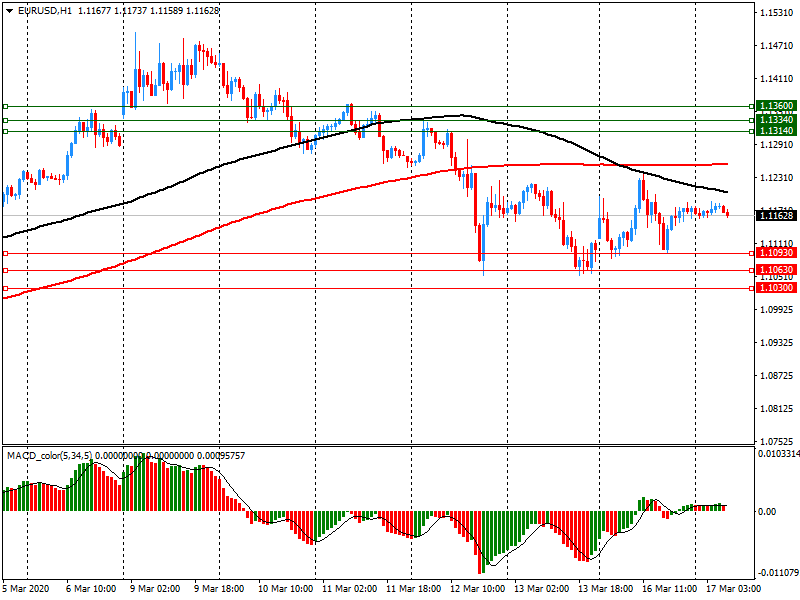
Comments:
- Overall open interest on the CALL options and PUT options with the expiration date April, 3 is 78790 contracts (according to data from March, 16) with the maximum number of contracts with strike price $1,1000 (4316);
GBP/USD
Resistance levels (open interest**, contracts)
$1.3009 (969)
$1.2914 (258)
$1.2820 (206)
Price at time of writing this review: $1.2221
Support levels (open interest**, contracts):
$1.2194 (762)
$1.2180 (140)
$1.2144 (188)
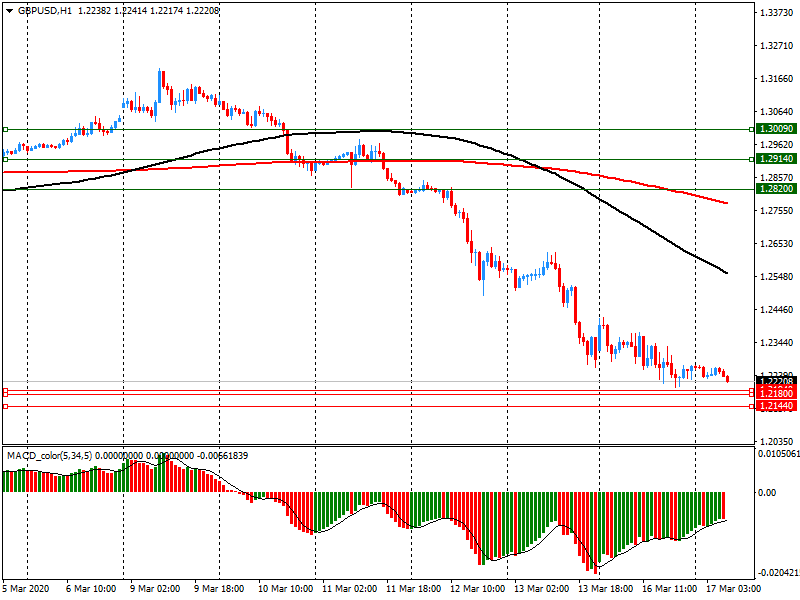
Comments:
- Overall open interest on the CALL options with the expiration date April, 3 is 17542 contracts, with the maximum number of contracts with strike price $1,3200 (2524);
- Overall open interest on the PUT options with the expiration date April, 3 is 20107 contracts, with the maximum number of contracts with strike price $1,2900 (2847);
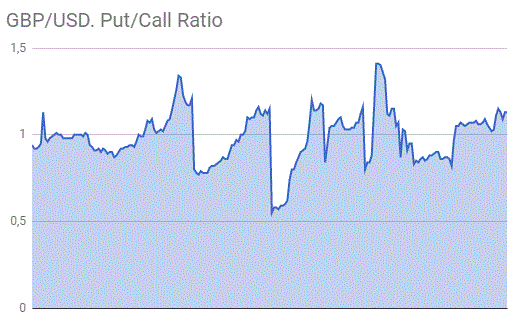
- The ratio of PUT/CALL was 1.15 versus 1.13 from the previous trading day according to data from March, 16
* - The Chicago Mercantile Exchange bulletin (CME) is used for the calculation.
** - Open interest takes into account the total number of option contracts that are open at the moment.
-
04:32
Japan: Industrial Production (YoY), January -2.3% (forecast -2.5%)
-
04:32
Japan: Industrial Production (MoM) , January 1% (forecast 0.8%)
-
02:30
Commodities. Daily history for Monday, March 16, 2020
Raw materials Closed Change, % Brent 29.27 -15.09 WTI 28.55 -13.93 Silver 12.83 -12.84 Gold 1508.786 -1.66 Palladium 1595.62 -9.73 -
00:30
Australia: House Price Index (QoQ), Quarter IV 3.9% (forecast 3.9%)
-
00:30
Stocks. Daily history for Monday, March 16, 2020
Index Change, points Closed Change, % NIKKEI 225 -429.01 17002.04 -2.46 Hang Seng -969.34 23063.57 -4.03 KOSPI -56.58 1714.86 -3.19 ASX 200 -537.3 5002 -9.7 FTSE 100 -215.03 5151.08 -4.01 DAX -489.83 8742.25 -5.31 CAC 40 -236.9 3881.46 -5.75 Dow Jones -2997.1 20188.52 -12.93 S&P 500 -324.89 2386.13 -11.98 NASDAQ Composite -970.29 6904.59 -12.32 -
00:15
Currencies. Daily history for Monday, March 16, 2020
Pare Closed Change, % AUDUSD 0.61016 -1.44 EURJPY 118.315 -1.3 EURUSD 1.11755 0.49 GBPJPY 129.866 -2.16 GBPUSD 1.22672 -0.4 NZDUSD 0.60351 -0.57 USDCAD 1.39964 1.51 USDCHF 0.94454 -0.55 USDJPY 105.859 -1.74 -
 Material posted here is solely for information purposes and reliance on this may lead to losses. Past performances are not a reliable indicator of future results. Please read our full disclaimer