Notícias do Mercado
-
19:21
American focus: the U.S. dollar exchange rate fell substantially against the euro
Euro exchange rate rose significantly against the U.S. dollar, which has been associated with the publication of the U.S. jobs report. It is learned that U.S. employers added jobs at a slower pace in July, offering a more stable, but not spectacular economic growth in the summer. Employment in the U.S. increased by 162,000 last month, the Labor Department said. The unemployment rate fell two-tenths of a percentage point to 7.4%, its lowest level since December 2008. Economists had expected an increase of 180,000, while the unemployment rate to 7.5%.
The last image in the labor market shows that slow economic growth may put pressure on the employers. Raising taxes, reducing government spending and slower growth abroad, holding back the economy for several months, although the pace of hiring to be strong this year.
The Labor Department revised down job totals for the previous two months to 26,000 in total. Over the past 12 months, the economy added an average of 189,000 jobs per month, enough to slow down the unemployment rate from 8.2% level in July 2012.
Economic growth in the last year has been anemic, prompting the Federal Reserve on Wednesday to leave the place of his $ 85 billion per month bond-buying program. The economy grew by 1.4% year on year in the first half of the year.
Note that the central bank is monitoring developments in the labor market, to take the next step to buy bonds, which are designed to keep interest rates and stimulating investment and employment. If companies continue to hire and unemployment falls, the Fed may begin to curtail the program this year.

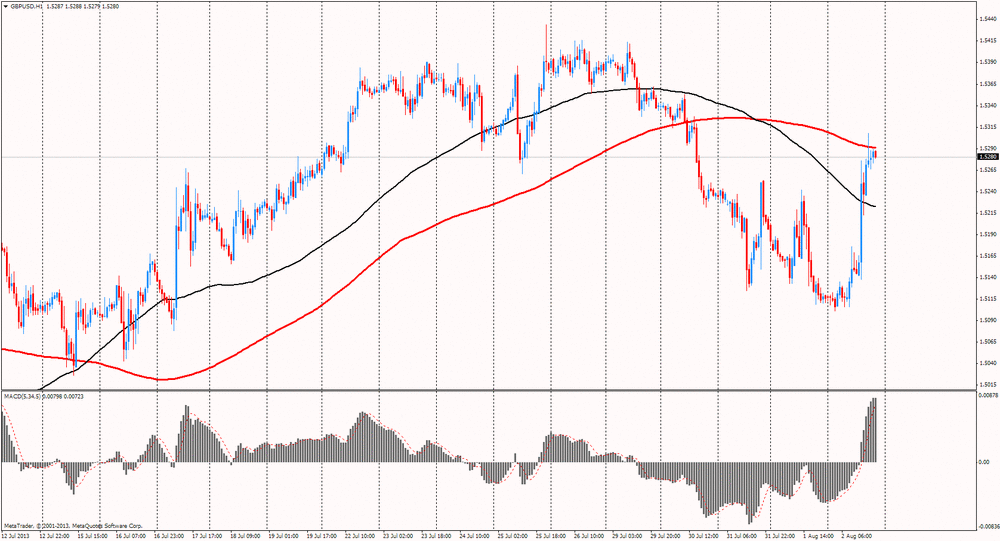
The British pound rose against the dollar after strong data on construction PMI. Activity in the construction sector in the UK in July jumped to its highest level in more than three years amid a sharp revival of activity in the housing. This was yet another confirmation that the nascent economic recovery will continue. According to Markit and the Chartered Institute of Purchasing & Supply, Purchasing Managers Index (PMI) for the construction sector in the UK in July rose to 57.0, its highest level since June 2010, against 51.0 in June. As shown by PMI for the construction sector, the volume of new orders rose at the fastest pace in more than a year, and employment growth was the strongest since December 2011.
In addition, another report showed that UK house prices in July rose to a five-year high - it was the tenth consecutive increase due to government intervention, which increased demand and fears of the emergence of another bubble in the housing market, according to Nationwide. The housing price index rose by 0.8% m / m and 3.9% y / y The last time prices rose faster in July 2010 by 6.6%. Economists had forecast a growth rate of 0.4% m / m and 3.1% y / y In June, prices rose by 0.3% m / m and 1.9% y / y This means that the average price of an apartment house in the UK was £ 170,825 in July - with up to June 2008, when it was 172,415 lbs.
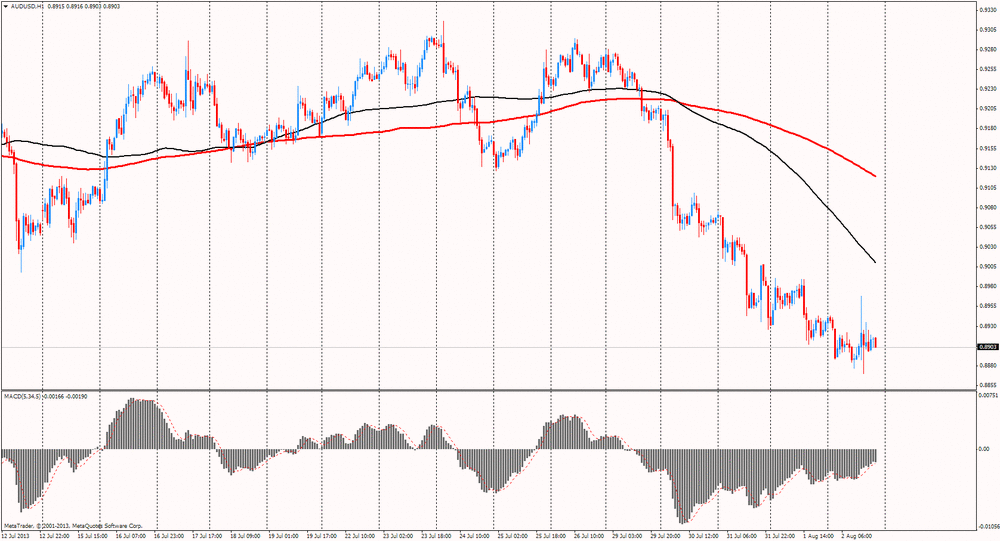
The Australian dollar fell to a three-year low on expectations that next week, with the Reserve Bank of Australia may lower the level of the discount rate. Earlier, the head of the RBA Governor Glenn Stevens found insufficient depreciation of the Australian dollar by 12% over the past three months, so it is advised of the possibility of further interest rate cuts. In this regard, investors see a 95% chance that the RBA will cut interest rates by a quarter percentage point to 2.5% at the meeting, which will take place on August 6.
-
15:29
U.S. factory orders rise less than expected in June
With a drop in orders for non-durable goods partly offsetting a jump in orders for durable goods, the Commerce Department released a report on Friday showing that new orders for manufactured goods rose by less than expected in the month of June.
The Commerce Department said factory orders increased by 1.5 percent in June following a revised 3.0 percent increase in May. Economists had been expecting orders to rise by about 2.3 percent.
The increase in factory orders in June was largely due to a 3.9 percent increase in orders for durable goods, which came on the heels of a 5.5 percent jump in the previous month.
Orders for transportation equipment drove the increase in durable goods orders, surging up by 12.0 in June after soaring by 15.1 percent in May.
Excluding the jump in orders for transportation equipment, factory orders actually fell by 0.4 percent in June compared to a 1.0 percent increase in May.
The drop in ex-transportation orders in June was partly due to a 0.6 percent drop in orders for non-durable goods, which came on the heels of a 0.8 percent increase in the previous month.
The report also showed that shipments of manufactured goods fell by 0.4 percent in June following a 1.0 percent increase in May. Shipments fell for the third time in the past four months.
Meanwhile, inventories of manufactured goods inched up by 0.1 percent in June after edging down by 0.1 percent in May. Inventories have risen in six of the last seven months.
Even with inventories rising and shipments falling, the inventories-to-shipments ratio was unchanged from the previous month at 1.30 in June.
-
15:00
U.S.: Factory Orders , June +1.5% (forecast +2.3%)
-
14:33
Swiss Manufacturing PMI jumps to 26-month high
The seasonally adjusted purchasing managers' index for the manufacturing sector climbed to
Economists were looking for a reading of 52.4 for July. The latest score was the highest since May 2011, data showed.
Driving the pick up in activity, new orders placed with Swiss manufacturers increased further in July, and at the fastest pace in around two years. In line with the upturn in new business, production growth also accelerated to levels last seen around two years ago.
At the same time, supplier delivery times increased and stocks of finished goods decreased, reflecting higher production capacity utilization. Responding to the increase in activity, Swiss goods producers halted their cutbacks in workforces, the survey showed.
-
14:15
U.S. personal spending rises more than expected in June
With personal spending in the U.S. rising at a faster rate than personal income in the month of June, the Commerce Department released a report on Friday showing a notable drop in the personal savings rate.
The report said personal spending increased by 0.5 percent in June after edging up by 0.2 percent in May. The increase in spending exceeded economist estimates for a 0.4 percent increase.
Additionally, the Commerce Department said personal income rose by 0.3 percent in June following a 0.4 percent increase in May. Economists had expected income to increase by 0.4 percent.
With spending rising at a faster rate than income, personal saving as a percentage of disposable personal income dropped to 4.4 percent in June from 4.6 percent in May. -
13:52
U.S. employment rises less than expected in July
Employment in the
The Labor Department said non-farm payroll employment increased by 162,000 jobs in July following a downwardly revised increase of 188,000 jobs in June.
Economists had expected employment to increase by about 175,000 jobs compared to the addition of 195,000 jobs originally reported for the previous month.
Despite the weaker than expected job growth, the unemployment rate dipped to 7.4 percent in July from 7.6 percent in June. The unemployment rate had been expected to edge down to 7.5 percent.
With the bigger than expected decrease, the unemployment rate fell to its lowest level since hitting 7.3 percent in December of 2008.
-
13:35
U.S.: Average workweek, July 34.4 (forecast 34.5)
-
13:33
U.S.: Personal spending , June +0.5% (forecast +0.5%)
-
13:33
U.S.: PCE price index ex food, energy, m/m, June +0.2% (forecast +0.1%)
-
13:32
U.S.: Average hourly earnings , July -0.1% (forecast +0.2%)
-
13:31
U.S.: PCE price index ex food, energy, Y/Y, June +1.2% (forecast +1.1%)
-
13:30
U.S.: Nonfarm Payrolls, July 162 (forecast 180)
-
13:30
U.S.: Personal Income, m/m, June +0.3% (forecast +0.5%)
-
13:30
U.S.: Unemployment Rate, July 7.4% (forecast 7.5%)
-
13:00
Orders
EUR/USD
Offers $1.3350/55, $1.3345/50, $1.3300/10, $1.3280, $1.3265-70, $1.3227-40
Bids $1.3180, $1.3165/50, $1.3130/20
GBP/USD
Offers $1.5255, $1.5200/10, $1.5175/85
Bids $1.5145/40, $1.5125/20, $1.5100, $1.5080, $1.5060/50
AUD/USD
Offers $0.9020/40, $0.9000/10, $0.8980, $0.8945/50, $0.8920/25
Bids $0.8870, $0.8860/55, $0.8850, $0.8800
EUR/JPY
Offers Y133.00, Y132.45/50, Y132.00
Bids Y131.25/20, Y131.00, Y130.80/70, Y130.55/50, Y130.25/20
USD/JPY
Offers Y100.35, Y100.15/20, Y100.00, Y99.80
Bids Y99.30/25, Y99.00, Y98.85/80, Y98.60/50, Y98.35/30
EUR/GBP
Offers stg0.8845/50, stg0.8830/35, stg0.8810/15, stg0.8790/00
Bids stg0.8705/00, stg0.8680/75, stg0.8645/50, stg0.8625/20, stg0.8605/00
-
11:16
British construction sector expands most in three years: Markit
Activity in the British construction sector increased at the fastest pace in more than three years in July, data from a survey by Markit Economics and the Chartered Institute of Purchasing and Supply showed Friday. The growth rate also far exceeded economists' expectations.
The seasonally adjusted purchasing managers' index for the construction sector climbed to 57 in July from 51 in June, hitting the highest level since June 2010. Economists were looking for a score of 51.5.
The index has now stayed above the neutral mark of 50, which indicates unchanged activity, for the third consecutive month. The upturn in overall activity was driven by the strength of residential construction, which increased at the fastest pace in three years.
Higher levels of business activity were recorded in all three broad areas of the construction sector, with residential building activity surging to its steepest since June 2010. Civil engineering activity returned to expansion in July, and commercial construction output rose at the most marked pace since May 2012.
New orders received by construction firms increased for the third successive month, and at the steepest rate since April 2012, helped by a marked improvement in demand within the house building sector.
In line with the pick up in activity, firms raised their employment levels further during the month. The rate of job creation was the strongest since December 2011.
-
11:00
Eurozone producer prices rise as expected in June
Eurozone producer prices rose 0.3 percent in June from a year ago, reversing May's 0.2 percent fall, Eurostat reported Friday. The rate matched economists' expectations.
The industrial producer price index remained stable on a monthly basis as expected by economists, following a 0.3 percent drop in May.
In the EU27, producer prices remained flat from a month ago, while it grew 0.6 percent on a yearly basis.
Non-durable consumer goods prices rose 2.3 percent and durable consumer goods prices gained 0.7 percent. Capital goods grew 0.6 percent, while cost of intermediate goods decreased 0.4 percent. The decline in prices in the energy sector slowed to 0.6 percent from 1.9 percent.
-
10:25
Option expiries for today's 1400GMT cut
EUR/USD $1.3100, $1.3190, $1.3200, $1.3250, $1.3260, $1.3270, $1.3300
YSD/JPY Y98.00, Y98.35, Y98.80, Y99.00, Y99.50, Y100.00, Y100.50
GBP/USD $1.5100, $1.5250
GBP/AUD A$1.6650
USD/CHF Chf0.9350, Chf0.9380
EUR/CHF Chf1.2200, Chf1.2300
AUD/UCD $0.8900, $0.9000
EUR/AUD A$1.4600
USD/CAD C$1.0320, C$1.0350, C$1.0400, C$1.0450
-
10:00
Eurozone: Producer Price Index (YoY) , June +0.3% (forecast +0.3%)
-
10:00
Eurozone: Producer Price Index, MoM , June 0.0% (forecast +0.1%)
-
09:30
United Kingdom: PMI Construction, July 57.0 (forecast 51.6)
-
08:30
Switzerland: Manufacturing PMI, July 57.4 (forecast 53.1)
-
07:22
Asian session: The dollar headed
01:30 Australia Producer price index, q / q Quarter II +0.3% +0.5% +0.1%
01:30 Australia Producer price index, y/y Quarter II +1.6% +1.6% +1.2%
The dollar headed for weekly gains against all its major peers as improvements in the U.S. economy added to the case for the Federal Reserve to slow the pace of bond purchases which tend to debase the currency.
The greenback rebounded from the lowest in six weeks versus the euro before the Labor Department releases employment data for July, following U.S. reports showing claims for jobless benefits fell to a five-year low and manufacturing expanded faster than analysts estimated. U.S. employers probably added 185,000 jobs in July, following a 195,000 gain in June, according to the median forecast of economists in a Bloomberg News poll ahead of the Labor Department’s figures today. The jobless rate probably declined to 7.5 percent from 7.6 percent.
Data yesterday showed initial claims for jobless benefits unexpectedly fell by 19,000 to 326,000 in the week ended July 27, the fewest since January 2008. The Institute for Supply Management’s U.S. factory index increased to 55.4, the strongest since June 2011 and exceeding the highest projection from economists. Readings above 50 indicate expansion.
Australia’s dollar dropped to the lowest in almost three years before a meeting next week when Reserve Bank policy maker are expected to cut interest rates to a record low. Traders agree, seeing a 95 percent chance of a reduction, according to interest-rate swaps data compiled by Bloomberg.
Demand for the shared currency was limited after European Central Bank President Mario Draghi said yesterday policy makers expect interest rates in the region to stay low for an extended period.
EUR / USD: during the Asian session the pair traded in a range of $ 1.3185-25
GBP / USD: during the Asian session the pair traded in a range of $ 1.5100-30
USD / JPY: during the Asian session the pair traded in a range of Y99.20-70
French July car registrations are expected to be released at 0700GMT, with Spain's July unemployment numbers expected at the same time. Spanish unemployment is seen down 75,000 on the month. At 0702GMT, the EMU June PPI numbers will be published, with analysts looking for an unchanged number on month and a rise of 0.3% on year. With the week's central bank meetings behind us, the focus turns to the main data release of the week - possibly the month - the US employment reports. However, ahead of the jobs numbers crossing the wires, there is some limited data in Europe. At 0600GMT, the August Nationwide House Price Index will be released and is expected to underline the continued pick up in UK house prices as the latest government schemes to underpin the housing sector continue. Economists are expecting a rise of 0.4% on month and 3.1% on year. The UK July CIPS/Markit Construction PMI data will cross the wires at 0830GMT, with expectations for a reading of 51.5 against 51.0 in June. At 1400GMT, the US June Factory Orders numbers will be released. At 1615GMT, the St Louis Federal Reserve Bank President James Bullard will give a speech on the economy, followed by a press briefing, in Boston. Across the Atlantic, there is a raft of US data expected at 1230GMT, including June Personal Income numbers, June PCE Price Index and the July Non-farm Payrolls numbers.
-
07:00
United Kingdom: Nationwide house price index , July +0.8% (forecast +0.4%)
-
07:00
United Kingdom: Nationwide house price index, y/y, July +3.9% (forecast +3.1%)
-
06:21
Currencies. Daily history for Aug 1'2013:
(pare/closed(00:00 GMT +02:00)/change, %)
EUR/USD $1,3209 -0,67%
GBP/USD $1,5116 -0,53%
USD/CHF Chf0,9364 +1,08%
USD/JPY Y99,49 +1,52%
EUR/JPY Y131,43 +1,15%
GBP/JPY Y150,40 +0,81%
AUD/USD $0,8935 -0,96%
NZD/USD $0,7897 -0,99%
USD/CAD C$1,0350 +0,69%
-
06:00
Schedule for today, Friday Aug 2’2013:
01:30 Australia Producer price index, q / q Quarter II +0.3% +0.5% +0.1%
01:30 Australia Producer price index, y/y Quarter II +1.6% +1.6% +1.2%
06:00 United Kingdom Nationwide house price index July +0.3% +0.4%
06:00 United Kingdom Nationwide house price index, y/y July +1.9% +3.1%
07:00 United Kingdom Halifax house price index July +0.6% +0.3%
07:00 United Kingdom Halifax house price index 3m Y/Y July +3.7%
07:30 Switzerland Manufacturing PMI July 51.9 53.1
08:30 United Kingdom PMI Construction July 51.0 51.6
09:00 Eurozone Producer Price Index, MoM June -0.3% +0.1%
09:00 Eurozone Producer Price Index (YoY) June -0.1% +0.3%
12:30 U.S. Average workweek July 34.5 34.5
12:30 U.S. Average hourly earnings July +0.4% +0.2%
12:30 U.S. Personal Income, m/m June +0.5% +0.5%
12:30 U.S. Personal spending June +0.3% +0.5%
12:30 U.S. PCE price index ex food, energy, m/m June +0.1% +0.1%
12:30 U.S. PCE price index ex food, energy, Y/Y June +1.1% +1.1%
12:30 U.S. Unemployment Rate July 7.6% 7.5%
12:30 U.S. Nonfarm Payrolls July 195 180
14:00 U.S. Factory Orders June +2.1% +2.3%
16:15 U.S. FOMC Member James Bullard Speaks
-
 Material posted here is solely for information purposes and reliance on this may lead to losses. Past performances are not a reliable indicator of future results. Please read our full disclaimer